


In the fast-evolving solar energy sector of 2026, PV system performance optimization hinges on one critical choice: string-level monitoring or panel-level monitoring. With global solar installations projected to exceed 500 GW annually and electricity rates climbing, asset owners, EPCs, and developers demand precise solar panel monitoring systems to maximize ROI, minimize downtime, and meet stringent performance guarantees.
String-level monitoring tracks groups of 8–20 panels via string inverters or combiner boxes. Panel-level monitoring—powered by module-level power electronics (MLPE) such as microinverters or power optimizers—delivers granular data on every individual module. Recent 2025 field data shows panel-level systems recover 5–15% more annual energy in shaded or complex rooftops, while string-level solutions keep upfront costs 10–20% lower for uniform utility-scale arrays.
This 2026 cost-benefit analysis cuts through the hype. It draws on fresh SEIA, NREL, and LBNL benchmarks plus real-world case studies to help solar companies decide which solar energy monitoring approach fits their projects—residential, commercial & industrial (C&I), or utility-scale. Sunpal, a leading provider of complete PV solutions, integrates both monitoring tiers with high-efficiency modules and energy storage for tailored, bankable performance.
Why Solar Monitoring Matters More Than Ever in 2026
Solar PV systems now face higher stakes. Module prices stabilized around $0.18–$0.25/W in early 2026, but balance-of-system (BOS) costs and O&M pressures rose due to tariffs and labor. Performance ratio (PR) targets exceed 0.80, and owners expect 25–30-year warranties with minimal degradation. Undetected issues like soiling, shading, or hotspots can slash output 10–35%.
Effective solar panel monitoring systems provide real-time alerts, predictive maintenance, and rapid fault isolation. String-level monitoring offers system-wide visibility at low cost. Panel-level monitoring (MLPE) isolates problems to the module, enabling faster fixes and higher uptime. In 2025 studies, MLPE reduced truck rolls by 40–60% in C&I installations.
Breaking Down the Technology: String-Level vs. Panel-Level Monitoring
String-Level Monitoring in Solar PV
String inverters or combiner boxes aggregate data at the string or MPPT level. Metrics include string voltage, current, power, and basic temperature correlations. Modern multi-MPPT string inverters (common in 2025–2026 utility projects) add per-string granularity without full MLPE.
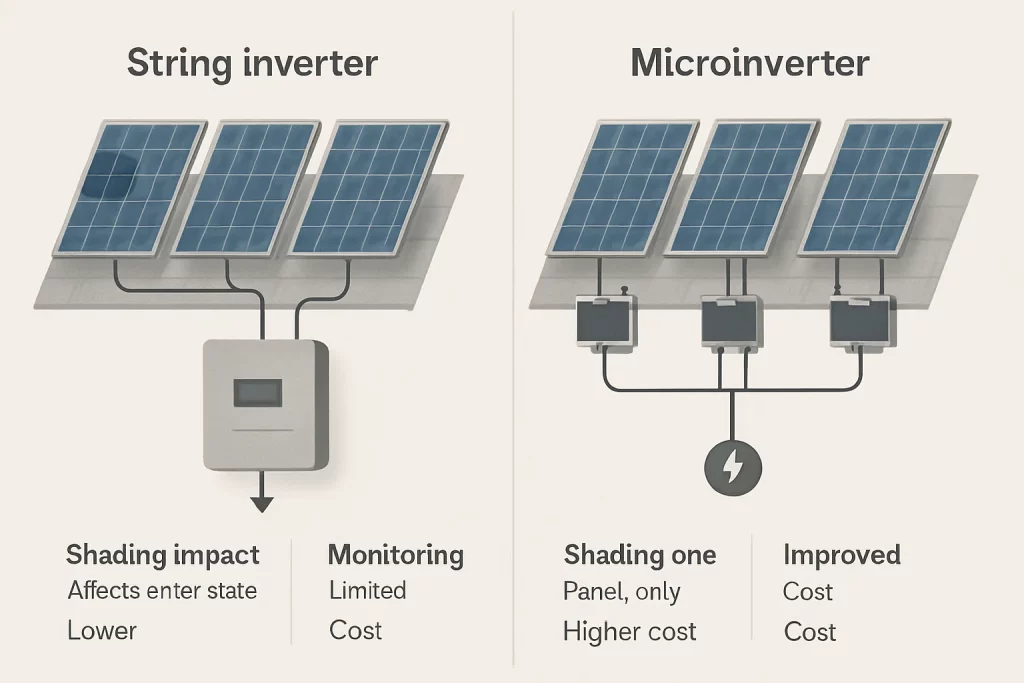
Strengths: Simple installation, lower data volume, and seamless integration with Sunpal's high-efficiency modules for large ground-mount farms. Limitations: The “Christmas light effect”—one shaded or failing panel drags the entire string. In uniform conditions, losses stay under 2–3%.
Panel-Level Monitoring with MLPE
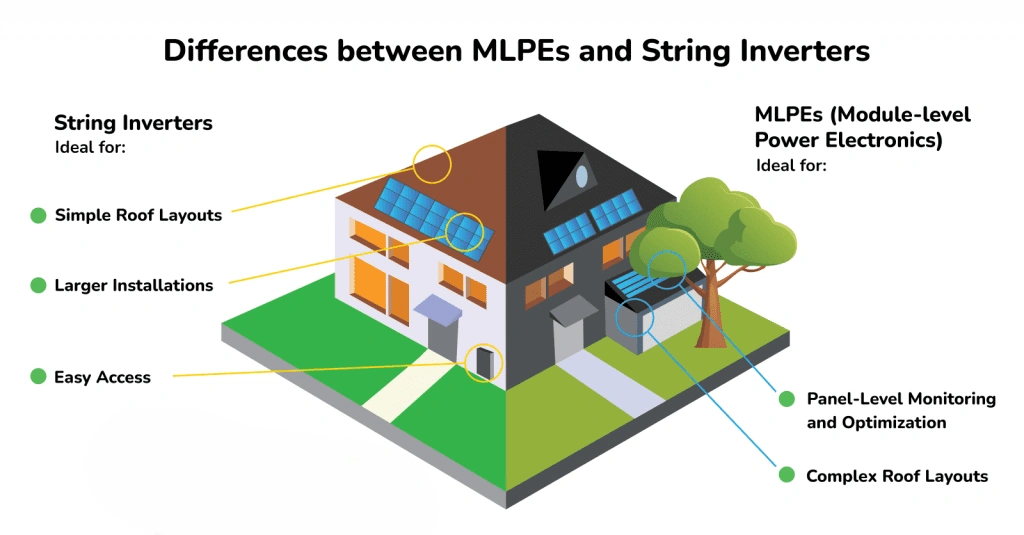
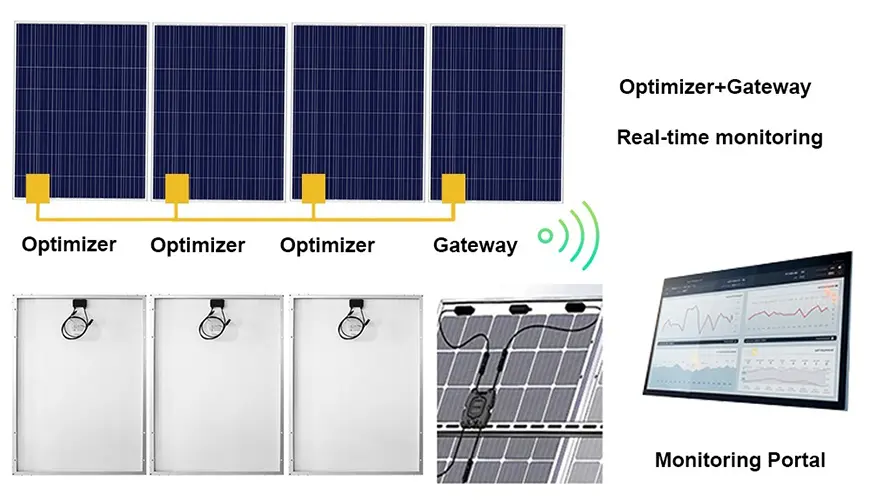
Microinverters convert DC to AC at each panel. Power optimizers (DC-DC) pair with a central inverter while providing per-module MPPT. Both deliver IV curves, individual power output, rapid shutdown compliance, and cloud-based dashboards.
Technologies like Enphase-style microinverters or SolarEdge/Tigo optimizers dominate residential/C&I. 2026 systems add AI-driven predictive analytics. Strengths: Maximum energy harvest under mismatch, shading, or mixed orientations. Limitations: Higher component count and data management needs.
| Feature | String-Level Monitoring | Panel-Level (MLPE) Monitoring |
| Granularity | String/MPPT (8–20 panels) | Individual module |
| Key Metrics | String power, voltage, current | Per-panel power, IV curve, temperature |
| Shading Recovery | Limited (string limited by weakest panel) | 15–25% higher yield in partial shade |
| Typical Use Case | Utility-scale ground mount | Residential/C&I rooftops |
| Data Volume | Low | High (cloud/AI ready) |
Upfront and Lifetime Cost Breakdown: 2026 Benchmarks
Capital Costs
String-level adds $50–$150 per string (often native to inverters). For a 1 MW system, monitoring hardware stays under $10,000. Panel-level MLPE adds $0.10–$0.40/W or $30–$80 per panel—raising total BOS by 10–15% for residential installs. A typical 8 kW residential system sees $1,500–$3,000 extra for microinverters vs. string.
SEIA Q4 2025 data pegs residential system prices at $3.35/Wdc (down 3% YoY) and utility-scale fixed-tilt at $1.16/Wdc. MLPE premiums shrink as scale grows; optimizers now cost 10–20% less than full microinverter arrays while delivering 80–90% of benefits.
Operational & Maintenance (O&M) Costs
String-level systems average $19–$22/kWdc-yr for utility-scale. Panel-level cuts labor: faster diagnostics reduce O&M by 20–40%. Over 25 years, a 1 MW C&I array saves $50,000–$100,000 in avoided downtime and repairs with MLPE.
Total Cost of Ownership (TCO)
For utility-scale with minimal shading, string-level wins on TCO. In shaded C&I rooftops, panel-level breaks even in 3–5 years via extra yield. Sunpal's integrated string + selective MLPE hybrids optimize TCO across segments.
Performance Benefits: Yield Gains and Real-World Impact
Panel-level monitoring consistently outperforms in non-ideal conditions. 2025 studies show 5–15% higher annual production for MLPE vs. string inverters; gains hit 25% on complex roofs with partial shading or multiple orientations.
In uniform utility farms, string-level PR reaches 0.81–0.85 with multi-MPPT inverters. Fault detection lags slightly but suffices for large arrays. Real 2025 rooftop case: a 140 kW industrial system with string monitoring achieved PR 0.78; adding selective optimizers lifted output 8% in shaded sections.
Panel-level excels at early hotspot/PID/soiling detection. AI dashboards flag 10–20% production drops instantly, cutting annual losses from 3–5% to under 1%. Sunpal's monitoring platforms combine string and panel data for hybrid fleets.
Safety, Compliance, Analytics, and Non-Financial Factors
Safety & Regulatory Edge
2026 NEC rapid-shutdown rules favor MLPE in most U.S. rooftops. Panel-level meets <80V requirements in 30 seconds automatically. String systems often need extra hardware.
Data Analytics & Future-Proofing
Both support cloud platforms, but panel-level feeds richer AI for predictive maintenance and virtual power plants (VPPs). Cybersecurity risk rises with more devices—Sunpal mitigates via encrypted, bankable platforms.
Warranty & Bankability
MLPE often carries 25-year warranties matching modules. String inverters typically need replacement at year 12–15, adding $0.05–$0.10/W to lifetime costs.
Real-World Case Studies: 2025–2026 Performance Data
Utility-Scale String-Level Success
A 100 MW fixed-tilt farm in Texas (2024 COD, updated 2025 data) used string inverters with combiner monitoring. LCOE hit $47/MWh post-ITC. Uniform conditions kept shading losses <2%; annual O&M stayed at $19/kWdc-yr. Monitoring dashboards flagged string anomalies within hours.
C&I Rooftop Panel-Level Win
A 2025 California warehouse retrofit (500 kW) switched to power optimizers. Partial shading from HVAC units previously cut output 12%. Panel-level monitoring recovered 9% yield (≈45,000 kWh/year extra) and slashed troubleshooting time 55%. Payback on MLPE premium: 2.8 years.
Sunpal Hybrid Deployment
A Southeast Asia C&I project paired Sunpal high-efficiency modules with selective panel-level optimizers on shaded roof sections and string monitoring elsewhere. Result: 7% overall yield gain at 40% lower MLPE cost vs. full panel-level. Remote dashboards enabled predictive cleaning, recovering 1,747 MWh in one optimized cycle.
Decision Framework: Choosing the Right Solar Monitoring System
Use this matrix for 2026 projects:
- Utility-Scale (>5 MW, uniform irradiance): String-level. Lowest TCO, proven scalability.
- C&I Rooftops (shading/mixed orientation): Panel-level or hybrid MLPE. 5–15% yield uplift justifies premium.
- Residential: Panel-level standard due to NEC and monitoring expectations.
- Budget-Constrained Expansions: Retrofit string systems with add-on panel sensors for targeted gains.
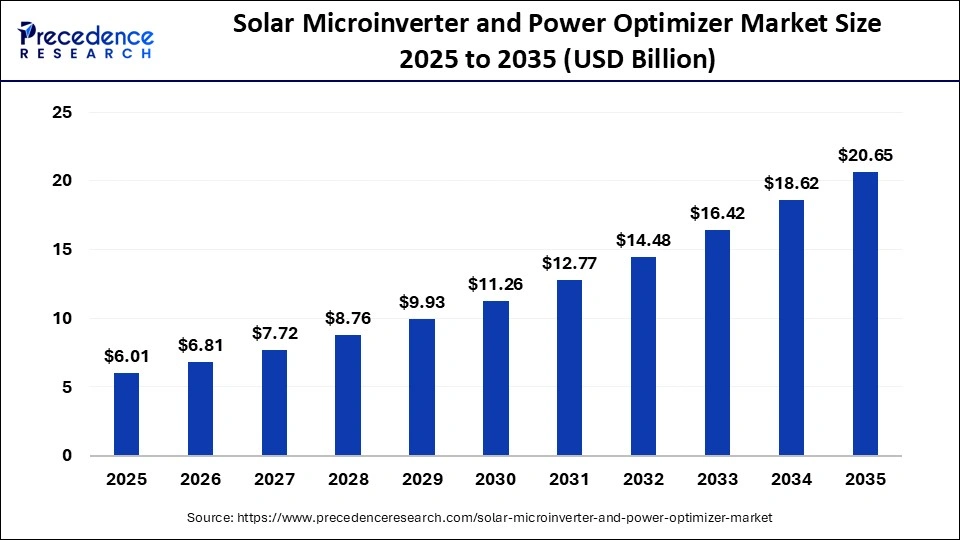
Emerging 2026 trends: AI-hybrid monitoring and cost drops in MLPE (market projected to $11.8B by 2032). Sunpal's one-stop PV solutions—modules, inverters, batteries, and monitoring—deliver plug-and-play optimization.
Conclusion: Balance Cost and Performance for Maximum Solar ROI
String-level monitoring remains the cost leader for large, uniform solar farms. Panel-level MLPE delivers superior yield, safety, and O&M savings where conditions vary. The optimal path in 2026 is often hybrid—leveraging data from both for maximum PV system performance optimization.
Solar companies and asset owners: evaluate site-specific shading, electricity rates, and ownership models. Sunpal's expert team provides customized assessments, high-efficiency modules, and integrated monitoring platforms that turn data into dollars.
Ready to optimize your next solar project? Contact Sunpal for a free performance audit and tailored string vs. panel-level monitoring recommendation. Maximize your solar energy monitoring ROI today.
Frequently Asked Questions (FAQs): String-Level vs. Panel-Level Monitoring
1. What is the main difference between string-level monitoring and panel-level monitoring in solar PV systems?
String-level monitoring collects performance data at the string or MPPT level, typically covering 8–20 panels connected in series through a string inverter or combiner box. Panel-level monitoring, enabled by module-level power electronics (MLPE) such as microinverters or power optimizers, provides detailed, individual data for every single solar panel. This allows precise fault detection, maximum power point tracking per module, and better optimization under varying conditions.
2. Is panel-level monitoring worth the extra cost?
In most residential and shaded commercial installations, yes. While panel-level (MLPE) systems increase upfront costs by 10–25%, 2025 field data shows they deliver 5–15% higher annual energy yield and up to 40–60% lower O&M costs through faster troubleshooting. For uniform utility-scale projects with minimal shading, string-level monitoring usually offers better overall value. The break-even period is typically 3–5 years for C&I and residential systems with partial shading.
3. How much more expensive is panel-level (MLPE) monitoring compared to string-level?
Panel-level MLPE typically adds $0.10–$0.40 per watt to the system cost. For an average 8 kW residential system, this translates to an extra $1,500–$3,500. In contrast, string-level monitoring adds only $50–$150 per string and is often included with the inverter. Optimizers are usually 30–50% cheaper than full microinverter systems while capturing most of the benefits. Sunpal's hybrid configurations can reduce the premium by up to 40% by applying MLPE only where needed.
4. Does panel-level monitoring really increase solar energy production or yield?
Yes. Independent 2025 studies and real-world deployments show panel-level monitoring improves annual yield by 5–15% on average, with gains reaching 20–25% on complex roofs affected by shading, soiling, snow, or different orientations. It eliminates the “Christmas light effect” where one underperforming panel drags down the entire string.
5. Which monitoring system is better for residential solar installations—string-level or panel-level?
Panel-level monitoring is the preferred choice for most residential solar installations in 2026. It satisfies strict NEC rapid-shutdown requirements, maximizes production on typical homeowner roofs with obstructions, and provides user-friendly mobile app monitoring. String-level is only suitable for very simple, unshaded residential arrays.
6. Is string-level monitoring sufficient for utility-scale or large commercial solar projects?
Yes, string-level monitoring with modern multi-MPPT string inverters is sufficient and most cost-effective for the majority of utility-scale and large ground-mount projects. These systems achieve performance ratios of 0.81–0.85 in uniform conditions while keeping capital and maintenance costs significantly lower than full MLPE deployments.
7. How do string-level and panel-level monitoring compare for maintenance, troubleshooting, and warranty?
Panel-level monitoring significantly reduces maintenance costs and time by enabling instant fault isolation and predictive analytics, cutting truck rolls by 40–60%. Most MLPE components carry 25-year warranties aligned with solar modules. String inverters typically have 10–15 year warranties and may need replacement once during the system lifetime, adding to long-term costs.
8. What happens to production if one panel is shaded or fails—string-level vs. panel-level?
In a string-level system, shading or failure of one panel can reduce the output of the entire string by 20–100% due to current mismatch. With panel-level monitoring and MLPE, only the affected panel loses production; the rest of the system continues operating at maximum efficiency. This is especially critical in areas with trees, chimneys, or seasonal shading.
9. Does panel-level monitoring improve safety, rapid shutdown compliance, and fire risk?
Yes. Panel-level systems provide automatic rapid shutdown to below 80V within 30 seconds, easily meeting 2026 NEC requirements. They also offer superior arc-fault detection and module-level isolation, which can reduce fire risks compared to traditional string systems that require additional external devices.
10. Are hybrid string + panel-level monitoring solutions available and recommended?
Absolutely. Hybrid solutions — combining string-level monitoring for most of the array with selective power optimizers on shaded or high-risk sections — have become one of the fastest-growing approaches in 2026. They deliver 70–90% of the benefits of full panel-level monitoring at 40–60% lower additional cost. Sunpal specializes in designing optimized hybrid solar monitoring systems tailored to specific site conditions.