


In the rapidly evolving solar energy landscape of 2026, project developers, EPC contractors, installers, and utility operators are under pressure to maximize every kilowatt-hour from their photovoltaic (PV) installations. Traditional solar power systems often lose 15–30% of potential output due to weather variability, soiling, equipment degradation, and inefficient energy management. Enter AI-optimized solar power systems powered by machine learning (ML): these intelligent platforms are delivering consistent gains of up to 25% in power generation through smarter forecasting, dynamic tracking, predictive maintenance, and integrated battery energy storage system (BESS) optimization.
This comprehensive guide explores how machine learning solar power generation works in practice, backed by 2025–2026 real-world data, case studies, and quantifiable results. Whether you're searching for “AI solar tracking,” “predictive maintenance solar panels,” “solar BESS AI optimization,” “AI-optimized solar systems,” or “solar energy yield increase 25%,” this article provides the actionable insights needed to stay competitive in foreign trade markets, C&I projects, utility-scale deployments, and off-grid applications.
Why Traditional Solar PV Systems Struggle in 2026
Global solar capacity continues its explosive growth. According to IRENA's Renewable Energy Statistics 2025, solar accounted for the majority of new renewable additions, with PV generation surpassing many expectations. Yet real-world performance frequently falls short of theoretical potential. Fixed-tilt arrays suffer from intermittency: clouds, dust, temperature fluctuations, and seasonal changes routinely reduce capacity factors to 18–25% in many regions. Soiling can cut output by 5–20% within weeks without intervention. Suboptimal maximum power point tracking (MPPT) under partial shading wastes an additional 10–15%. Overall, without advanced optimization, actual yields often drop 15–30% below lab or simulation predictions.
Rising electricity demand from AI data centers, electric vehicles, and industrial electrification, combined with tightening feed-in tariffs and grid stability requirements, makes these inefficiencies unsustainable. Developers need systems that deliver predictable, dispatchable power with faster ROI and lower levelized cost of energy (LCOE). AI-optimized solar power systems address these pain points by turning passive arrays into self-learning, adaptive power plants.
Core Technologies: How Machine Learning Powers Solar Optimization
Machine learning leverages vast datasets from IoT sensors, satellite imagery, weather stations, inverters, and drones to learn patterns and make real-time decisions. Key approaches include:
- Supervised learning (e.g., XGBoost, LSTM neural networks) for accurate forecasting.
- Reinforcement learning for adaptive control of trackers and inverters.
- Computer vision and unsupervised learning for anomaly detection and predictive maintenance.
- Hybrid models combining physics-based simulations with deep learning for robust performance.
Falling costs of edge computing, 5G connectivity, and sensor technology have made these solutions viable even for mid-sized commercial and industrial (C&I) projects. The result is compounded gains across the system lifecycle that routinely stack to a 25% or higher overall uplift in energy output.
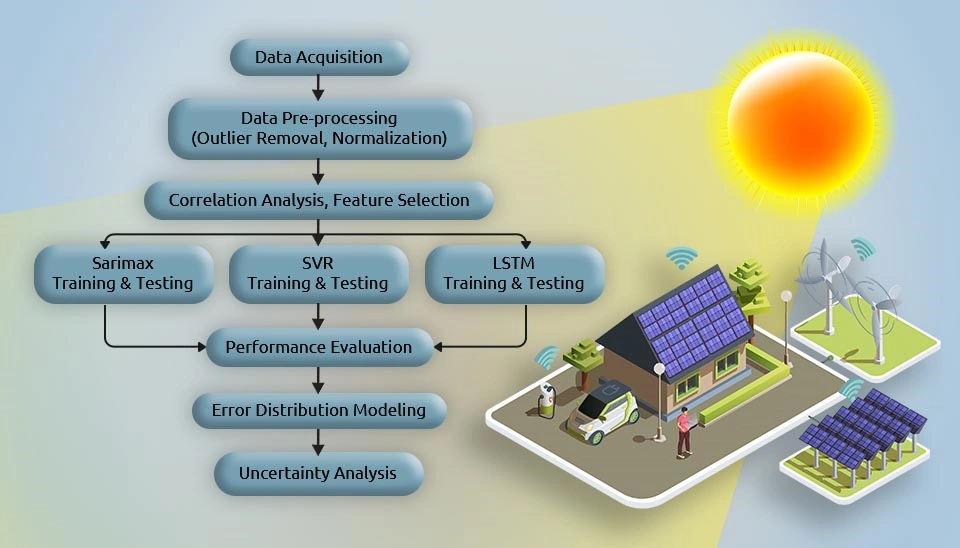
AI-driven solar forecasting and optimization pipeline using SARIMAX, SVR, and LSTM models for enhanced energy prediction and system performance.
Solar Irradiance Forecasting: Reducing Errors by 20–45%
Accurate short- and medium-term forecasting forms the bedrock of AI solar optimization. Traditional numerical weather prediction models struggle with localized cloud movements and micro-climate effects. Modern ML hybrids—such as CNN-LSTM architectures—integrate historical production data, satellite imagery, and ground sensors to slash forecast errors by 20–45% compared to conventional methods.
Better forecasts enable proactive inverter adjustments, BESS pre-charging, and curtailment avoidance. In utility-scale plants, this layer alone contributes 5–10% annual yield improvement while lowering balancing costs for grid operators. A 2026 Nature study on global solar potential forecasting using SARIMAX and Temporal Convolutional Networks (TCN) highlighted how these models project massive capacity growth while improving day-ahead accuracy for operational planning.
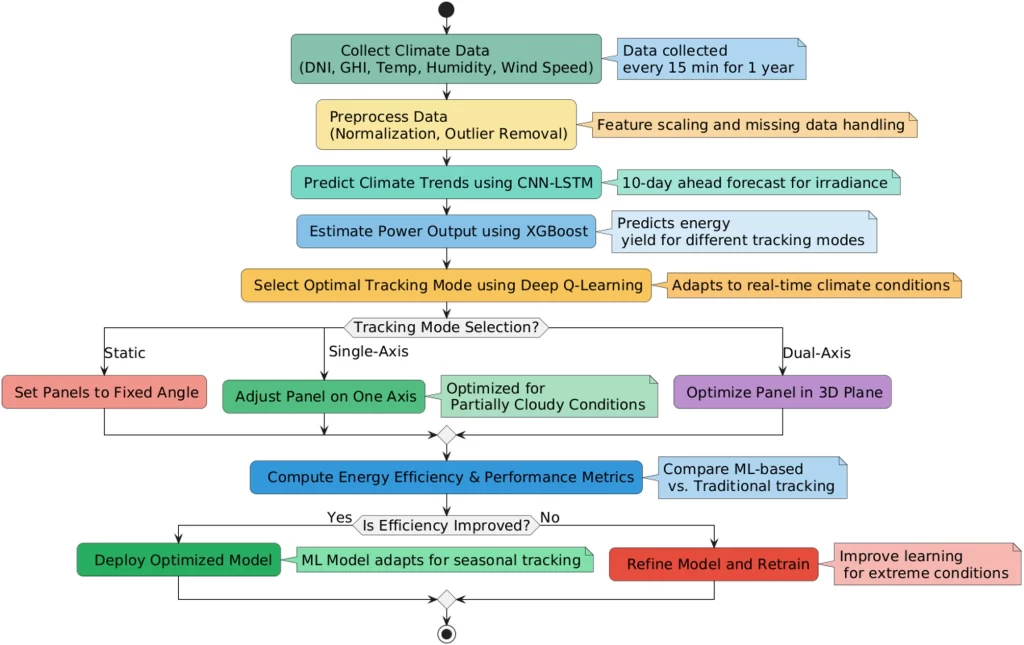
Example flowchart of a CNN-LSTM + XGBoost + Deep Q-Learning pipeline for climate-adaptive solar tracking and yield prediction (Source: Scientific Reports, 2025).
Practical Impact: Developers in variable climates (e.g., coastal Europe or monsoon-affected Asia) report significantly more reliable day-ahead scheduling, improving power purchase agreement (PPA) compliance and revenue certainty.
Video: AI Solar Forecasting and Grid Optimization in Action
Watch how AI strengthens energy systems through better forecasting and automation (Building Resilient Energy Systems with AI, 2026):
AI Solar Tracking: Dynamic Gains of 7–45% Over Fixed or Standard Trackers
Single-axis trackers typically add 15–25% yield; dual-axis systems push 30–45% in ideal conditions. Reinforcement learning elevates performance further by continuously optimizing panel angles based on real-time irradiance, wind speed, shading, and soiling data—even under partial clouds. Studies document additional gains of 7.83% on cloudy days versus rule-based commercial trackers.
These intelligent trackers learn site-specific seasonal patterns and adapt autonomously, outperforming static schedules. Integration with smart inverters and microinverters maximizes MPPT efficiency across the array.
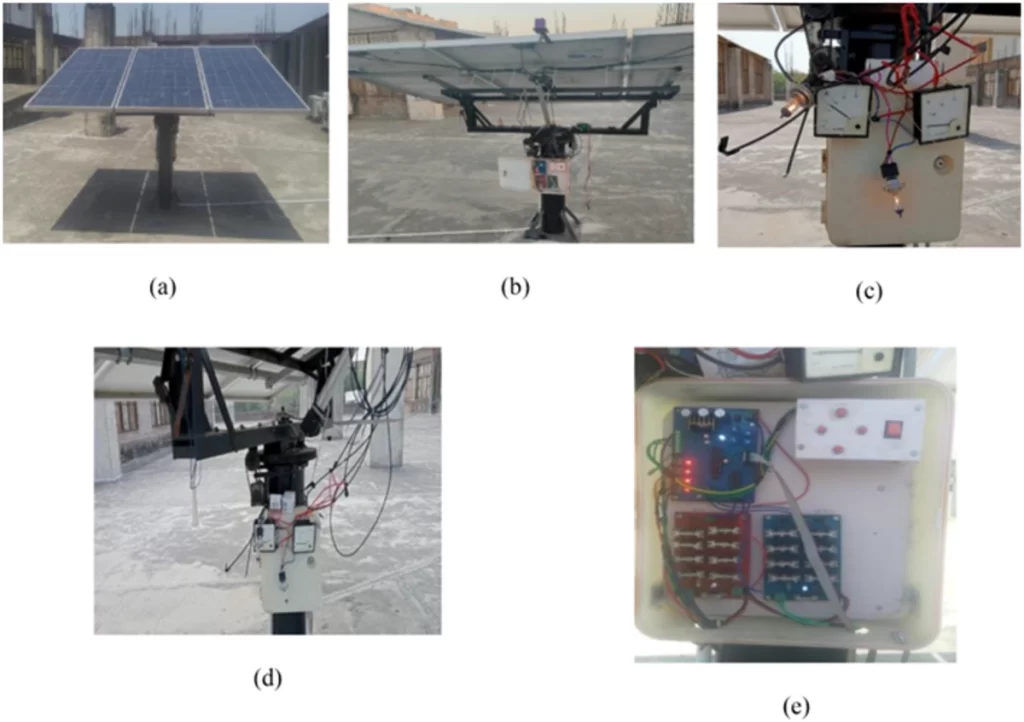
Examples of AI-enabled solar tracking hardware and control systems in field installations.
For exporters and EPCs targeting diverse climates, AI tracking reduces performance risk and enhances bankability for project financing.
Predictive Maintenance Solar Panels: Achieving 25% Productivity Gains and Drastic Downtime Reduction
One of the most impactful applications is predictive maintenance. Drone-mounted thermal cameras, combined with ML computer vision, detect hotspots, soiling, cracks, PID (potential-induced degradation), and inverter faults weeks or months in advance. Models trained on SCADA data, historical imagery, and environmental logs reach 95–98% detection accuracy.
Industry benchmarks from 2025 field deployments show:
- Up to 25% higher system availability.
- 25–40% reduction in O&M costs.
- 70% fewer unplanned breakdowns.
- Paybacks as short as 4–6 months.
A notable Arizona 75 MW solar farm using AI predictive maintenance saved approximately $425,000 annually. Broader North American deployments generated hundreds of millions in savings with ROI ranging from 400–800% for advanced platforms.
Drones equipped with AI reduce manual inspections by 80–90%, allowing teams to focus on high-value interventions. This is especially valuable for large utility-scale assets and remote off-grid installations common in emerging export markets.
Video: AI + Drone Predictive Maintenance for Solar Panels
Autonomous solar array inspection and predictive maintenance using robotics and AI:
AI-Optimized BESS Integration: Intelligent Dispatch and Extended Battery Life
Modern AI-optimized solar power systems rarely operate PV in isolation. Integrated BESS with machine learning optimizes charge/discharge cycles based on weather forecasts, electricity prices, demand signals, and grid requirements. Self-learning models can extend battery lifespan by 20–60% while minimizing degradation and maximizing arbitrage or self-consumption revenue.
Sunpal's AI-Powered BESS exemplifies this: High-efficiency lithium solutions (LFP chemistry) with embedded AI for predictive analytics, cluster-level optimization, and seamless PV integration. Deployed in over 100 countries, Sunpal's systems feature intelligent EMS (Energy Management Systems) that adapt strategies in real time, supporting utility-scale (500 kWh–10 MWh containers), C&I, and residential applications. Features include liquid cooling for uniform temperature, multi-level fire protection, and AI-driven dispatch that improves overall hybrid system ROI by 20–30%.
In one UK commercial case, AI-managed solar + storage helped a retail chain optimize on-site generation, reduce peak charges, and improve energy resilience.
Real-World Case Studies and 2025–2026 Performance Data
- Hybrid AI Stacks: Platforms combining forecasting, tracking, and maintenance report composite energy yield increases of 20–25% or higher in operational plants.
- Advanced Tracking Research: A 2025 study on reinforcement learning with perovskite-silicon tandems achieved up to 41.4% annual yield improvement versus conventional MPPT.
- Hospital Microgrid Example (Malaysia, 2025): An AI-driven smart grid with solar, wind, and BESS achieved 25% overall energy efficiency improvement, 30% less unplanned downtime, and 86% renewable coverage using LSTM forecasting and reinforcement learning dispatch.
- Grid Optimization Trends: AI platforms for renewable integration are projected to grow from ~$278 million in 2025 to $2.63 billion by 2033, delivering 15–20% efficiency gains in many deployments.
These examples span utility, C&I, and hybrid applications, proving the 25% uplift is achievable when layers work together.
Sunpal's Full-Stack Approach to AI-Optimized Solar Solutions
As a leading manufacturer with 20+ years of experience and multi-GW shipments, Sunpal delivers complete AI-ready platforms: high-efficiency TOPCon, HJT, and BC modules (up to 750W), smart inverters, mounting systems, and advanced BESS with built-in machine learning capabilities. Sunpal's AI-powered energy storage solutions use self-learning algorithms for predictive dispatch, cell health monitoring, and optimized PV-BESS interaction—helping clients achieve the full 25% performance stack with lower risk and faster deployment.
Turnkey services cover design, manufacturing, shipping, and commissioning for projects from balcony PV to 10 MW+ utility-scale. With strong presence in Europe, Africa, Asia, the Americas, and beyond, Sunpal solutions are export-optimized for compliance, rapid ROI, and long-term reliability.
Quantifiable Benefits: Economics, Environment, and Bankability
A 25% increase in output typically shortens payback periods by 1–2 years and reduces LCOE by 15–20%. O&M savings of 25–40% improve cash flow and asset longevity. Higher predictability strengthens investor confidence, lowers financing costs, and supports higher renewable penetration on grids. Environmentally, more clean MWh per MW installed accelerates decarbonization and maximizes land-use efficiency.
Challenges, Limitations, and Future Outlook (2026–2030)
Initial sensor and platform investment, data privacy concerns, model adaptation to new climates, and integration complexity remain hurdles—particularly in emerging markets. Edge AI, federated learning, and multi-agent reinforcement learning are rapidly addressing latency, security, and scalability.
Looking ahead: Tighter integration with vehicle-to-grid (V2G), smart cities, and hydrogen systems; continued efficiency gains in modules (projected 24–30%+ by 2030–2035 per ITRPV); and AI-driven circular economy approaches for recycling. The Solar AI market itself is forecast to grow at 20.8% CAGR through 2030.
Conclusion: AI as the New Standard for Competitive Solar in 2026 and Beyond
Machine learning is not a futuristic add-on—it is actively increasing solar output by up to 25% today through proven, layered optimization. AI-optimized solar power systems deliver higher yields, lower costs, greater reliability, and enhanced grid value, making them essential for developers, EPCs, investors, and policymakers navigating the energy transition.
For businesses searching for reliable “AI solar tracking,” “predictive maintenance solar panels,” or complete “solar BESS AI optimization” solutions, forward-looking manufacturers like Sunpal offer production-ready, globally deployed platforms backed by extensive project experience.
The era of passive solar is ending. Intelligent, self-optimizing PV + storage systems represent the future of high-performance renewable energy. Contact Sunpal's technical team today for tailored system designs, feasibility studies, or export-ready solutions that maximize your next project's output and returns.
Ready to boost your solar yields by up to 25%? Visit www.sunpalsolar.com or reach out for a consultation on AI-integrated PV and BESS solutions.