



A solar system can already be fully installed and operating, yet its long-term performance is effectively locked in before it generates a single kilowatt-hour.
In distributed solar projects, load estimation is often based on assumptions rather than real consumption data, making it one of the most underestimated sources of system inefficiency. While systems may appear to operate normally after installation, hidden mismatches gradually emerge over time, where energy shortfalls or oversized capacity silently erode financial returns.
Industry analyses, including observations referenced by IRENA, indicate that load misalignment remains a persistent contributor to suboptimal system performance across distributed solar markets.
Market Opportunities in Solar Load Calculation
As distributed solar deployment continues to expand, system design practices are shifting toward more data-informed and granular load assessment methods. This transition reflects a broader industry move away from generalized assumptions toward consumption-based planning frameworks.
The increasing adoption of smart meters, IoT-enabled monitoring systems, and digital simulation tools is enabling more accurate reconstruction of real load profiles. These technologies are improving early-stage design visibility and reducing uncertainty in system configuration decisions without overlapping with traditional assumption-based approaches.
At the same time, intensifying cost pressure in global solar markets is elevating the importance of design efficiency as a financial variable. Load calculation is increasingly treated as a key optimization input rather than a preliminary estimation step, influencing system configuration efficiency and capital allocation accuracy.
What Is Load in a Solar Power System?
Load refers to the total electricity demand that a system must support—measured in watt-hours (Wh) or kilowatt-hours (kWh) per day. Understanding this figure helps determine:
- How many Solar panels are needed
- The required battery storage size
- The appropriate inverter capacity
- Whether the system can go off-grid or should remain grid-tied
In practical system design, accurate load assessment ensures that the solar system matches real energy consumption needs and supports stable operation under both grid-tied and off-grid configurations.
Load Calculation Formula:
Daily Load (Wh/day) = Power Rating (W) × Hours Used × Number of Units
How to Calculate Solar Load Step by Step
Solar load calculation follows a structured process based on real consumption data rather than assumptions.
1. Inventory All Electrical Devices
Include everything: lights, appliances, machines, computers, HVAC systems.
2. Estimate Daily Usage per Device
Use real-world operation schedules, not assumptions.
3. Calculate Daily Watt-Hour Consumption
Multiply device wattage by usage hours and quantity.
4. Sum Up Your Total Daily Load
This gives your baseline system requirement in Wh or kWh.
5. Add a Safety Margin (20–30%)
To account for inefficiencies, seasonal variations, and system losses.
In this example, total consumption reaches approximately 2,400 Wh/day, which typically corresponds to a 1.8–2.2 kW solar power system with battery backup. This level of load is commonly used as a baseline reference for small residential or light commercial system design.
How to Translate Load into System Requirements
Once the total system load is determined, it must be translated into photovoltaic system components to ensure balanced energy generation, storage, and conversion performance.
- Solar Panels:
Total daily load ÷ average sunlight hours = panel capacity needed. - Battery Storage:
Cover at least 1 day of autonomy (1.5× daily load is ideal for off-grid setups). - Inverter Sizing:
Inverters should handle at least 125% of the peak demand to prevent overload.
Chart 2: Estimated Daily Output by Solar System Size
This data visualization shows how much energy different solar array sizes produce under typical sunlight conditions (4 kWh per kW of panel per day).
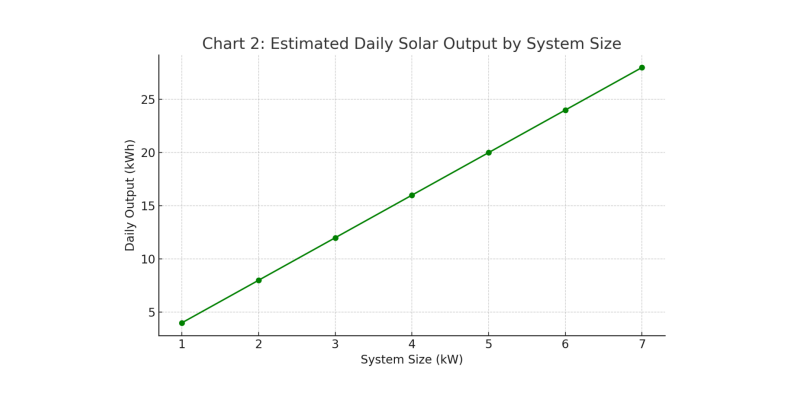
Tip: Always verify actual solar irradiance for your region to adjust these averages.
Avoid These 5 Common Mistakes in Load Estimation
In solar project development, inaccurate load estimation remains a leading cause of system underperformance, unexpected cost escalation, and long-term reliability issues. These errors often originate in early-stage design and are frequently repeated across residential, commercial, and industrial projects.
1. Excluding Startup or Surge Power
High-demand appliances such as refrigerators, pumps, and HVAC systems generate significant inrush current during startup. Failure to account for these transient peaks can result in undersized inverter selection and system instability under peak load conditions.
2. Assuming Flat Usage Profiles
Energy consumption is rarely constant. Residential and commercial load patterns fluctuate by time of day, season, and operational schedules. Simplified flat-load assumptions often lead to inaccurate system sizing and reduced operational efficiency.
3. Ignoring System Losses
Real-world energy systems experience 10–25% efficiency losses due to inverter conversion, cable resistance, battery charge/discharge cycles, and environmental factors. Neglecting these losses results in systematic underestimation of required generation capacity.
4. No Allowance for Load Growth
Future electrical demand is frequently underestimated. Additions such as EV chargers, new appliances, or facility expansion can significantly increase load requirements, making initial system designs insufficient over time.
5. Overlooking Weather and Shading Effects
Local climatic conditions, seasonal variation, and site-level shading directly impact effective solar generation hours. Ignoring these factors leads to overestimation of system output and reduced real-world performance.
Real-World Case: Hybrid System for a Family of Five
Location: Southeast Queensland, Australia
Application Type: Residential Hybrid Solar System
Daily Energy Demand: 11.2 kWh
System Design Configuration:
- Solar Array: 6.6 kW high-efficiency PV system
- Battery Storage: 10 kWh LiFePO₄ energy storage system
- Inverter: 5 kW hybrid inverter for grid-interactive operation
The system was engineered based on detailed load profiling and regional solar irradiation data to ensure balanced energy generation and storage performance.
Performance Results (Year 1 Operation):
- Grid reliance: < 6%
- Energy bill reduction: 88%
- Payback period: 6.3 years
These results demonstrate strong system stability and high self-consumption efficiency under real residential load conditions.
Engineering Insight:
This performance level was achieved through precise load calculation combined with weather-adjusted solar simulation modeling, ensuring accurate alignment between energy demand, system sizing, and local solar resource availability.
Pro Tools for Accurate Solar Load Planning
Professional system design requires more than spreadsheets. Here are the top resources used by solar engineers:
- PVWatts Calculator (NREL):
pvwatts.nrel.gov – Ideal for solar radiation and output modeling. - Sunpal System Designer (Beta):
Customized for both residential and C&I projects. - IoT Smart Plugs & Energy Monitors:
Devices like Sense or Shelly EM offer real-time usage tracking. - Sunpal Expert Support:
Engineering support for B2B partners available 24/7.
Conclusion: Right-Sizing Protects Your Investment
Accurate load-based design is the foundation of long-term solar performance. When systems are sized using real consumption data, site conditions, and proper simulation, they can operate reliably for 25+ years.
Proper sizing avoids two key issues: oversizing that increases cost, and undersizing that reduces reliability. Both affect system performance and project economics.
For end users, it means lower electricity costs, better energy independence, and more stable long-term savings. For enterprises, it improves ROI, reduces risk, and enhances system performance consistency.
Sunpal supports enterprises with integrated solar system design solutions:
- Load analysis and system sizing support
- Sunpal System Designer simulation tools
- HJT & TOPCon modules, batteries, and hybrid inverters
By turning accurate load data into optimized system design, Sunpal helps deliver efficient and reliable solar projects with stronger long-term returns.