


In the fast-evolving world of solar energy, rapid shutdown systems for PV installations stand out as critical for compliance, safety, and efficiency. As solar companies search for "best solar rapid shutdown options" and "NEC 690.12 compliance strategies," this analysis dives into cost-effective approaches that balance upfront investments with long-term gains. With global solar adoption surging—projected to hit 215-255 GW in China alone this year—businesses need smart solutions to minimize risks while maximizing ROI. Sunpal leads the charge with innovative, reliable solar PV safety systems tailored for residential and commercial setups.
Why Solar Rapid Shutdown Matters in 2026
Rapid shutdown technology, mandated by NEC 690.12 since 2014 and refined in 2023, ensures PV arrays drop to safe voltage levels (<30V or <80V) within 30 seconds during emergencies like fires. This protects firefighters, reduces liability, and can lower insurance premiums by 5-10% for compliant systems. In 2026, with tariffs on solar imports resuming and incentives like the 30% federal tax credit phasing out by 2027, efficient shutdown methods are essential for cost control. Poor choices lead to higher maintenance or retrofits, adding 12-18% to project costs. For solar businesses eyeing "solar PV hazard control systems," prioritizing shutdown enhances system longevity and meets UL 3741 standards, which allow array-level options over per-module devices.
Key benefits include enhanced first-responder safety and streamlined inspections. As solar PV installations grow at a 9.6% CAGR globally (from $289M in rapid shutdown devices in 2024 to $567M by 2032), ignoring these can stall projects. Sunpal's systems integrate seamlessly, ensuring your setups comply without excess spending.
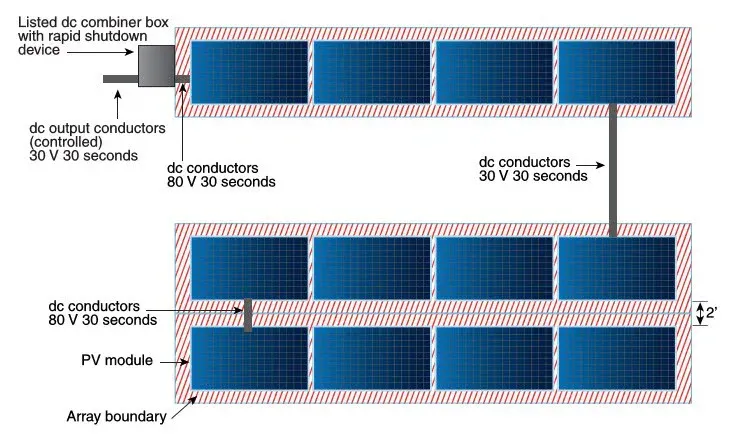
This diagram illustrates NEC 2017 rapid shutdown boundaries, highlighting voltage reduction zones for safer operations.
Exploring Top Solar Rapid Shutdown Approaches
Solar rapid shutdown options vary by scale and needs, from module-level to array-level systems. For queries like "module level rapid shutdown vs UL 3741," here's a breakdown:
- Microinversores: Convert DC to AC at each panel, inherently providing shutdown. Ideal for shaded roofs, they boost efficiency to 97%+.
- Power Optimizers + Central Inverters: Optimize per module, mitigating shading losses while enabling rapid de-energization.
- Dedicated RSD Devices: Add-on modules for shutdown, cost-effective for retrofits but exposed to heat.
- UL 3741 PV Hazard Control Systems: Array-level compliance, reducing component count and BOS costs by up to 20%.
- Junction-Box Integrated RSD: Emerging for BIPV, embedding shutdown in panels for minimal added complexity.
Use this comparison table for "solar PV rapid shutdown cost analysis":
| Approach | Shutdown Level | Added Cost ($/W) | Reliability Rating | Energy Yield Impact | Aplicações ideais | Examples |
| Microinverters | Module | 0.20-0.40 | Elevado | Minimal loss | Residential, shaded sites | Enphase, Hoymiles |
| Power Optimizers | Module | 0.10-0.30 | Medium | Positive (up to 25% gain in shade) | Commercial rooftops | SolarEdge, Tigo |
| Dedicated RSD | Module | 0.05-0.20 | Medium-High | Neutral | Budget retrofits | Various MLPE |
| UL 3741 Systems | Array | 0.05-0.15 | Elevado | Minimal | Large-scale commercial | Certified inverters |
| Integrated Junction-Box | Module | 0.10-0.25 | Emerging | Neutral | BIPV projects | 2026 innovations |
Data sourced from industry reports shows microinverters save $1,300-3,100 per system in wiring and grounding.
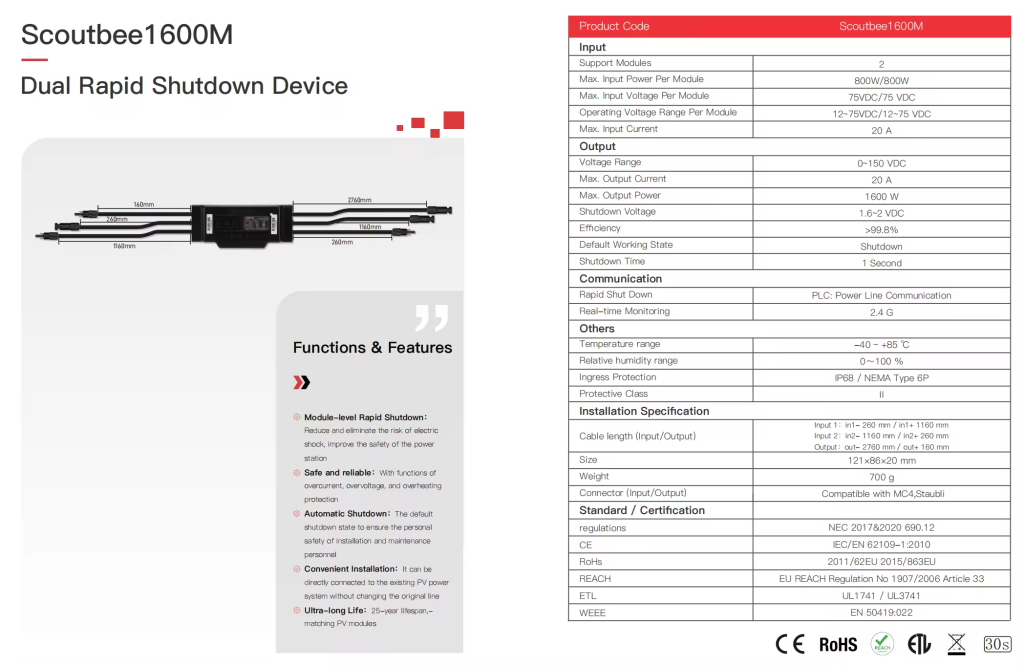
This chart details specs for a dual rapid shutdown device, emphasizing efficiency and compliance metrics.
Cost-Benefit Analysis of Solar PV Shutdown Methods
Weighing "cost-effective solar rapid shutdown solutions" requires examining upfront expenses, installation, and lifecycle value. Module-level options like optimizers add 12-18% to costs but deliver shading mitigation, potentially increasing yield by 10-25% in suboptimal conditions. UL 3741 systems shine for larger arrays, slashing BOS by eliminating per-module electronics—savings of $0.10-0.20/W.
Upfront: Dedicated RSDs are cheapest at $0.05-0.20/W, but microinverters justify higher costs with 25-year warranties. Labor: Array-level cuts rooftop time by 30%, ideal for "commercial solar PV safety systems."
Long-term: Reliability issues, like MLPE failures from heat, affect 5-10% of installs per reports. Energy ROI: Optimizers offset costs in shaded setups, with payback in 2-4 years.
Market data projects module-level RSD growth at 14.9% CAGR from 2026-2033, driven by safety regs. For businesses searching "solar PV system ROI calculator," UL 3741 offers the best balance, reducing failures while maintaining yield.
Here's a data analysis on cost savings:
- Baseline 10kW system: $25,000 without RSD.
- With MLPE: +$2,000-4,000 (8-16%), but +5% yield annually.
- With UL 3741: +$1,000-1,500 (4-6%), minimal yield impact.
- Net savings over 10 years: UL 3741 edges out by $3,000 in maintenance avoidance.
Emerging Trends in Solar Rapid Shutdown for 2026
As "UL 3741 solar adoption trends" gain traction, 2026 sees shifts toward integrated solutions. NEC 2023 refinements push module-level for residentials, but UL 3741 dominates commercial, allowing series strings without MLPEs. Global trends: China's PV installs may dip to 215-255 GW due to pricing reforms, yet rapid shutdown markets expand 9.6% CAGR.
Innovations include smart-grid compatible devices and junction-box embeds, reducing complexity. Environmental drivers boost demand, with rising awareness cutting emissions via efficient solar.
Projection graph from ITRPV: PERC tech fades by 2029, TOPCon peaks at 69% market share, efficiencies hitting 25-30% by 2035.
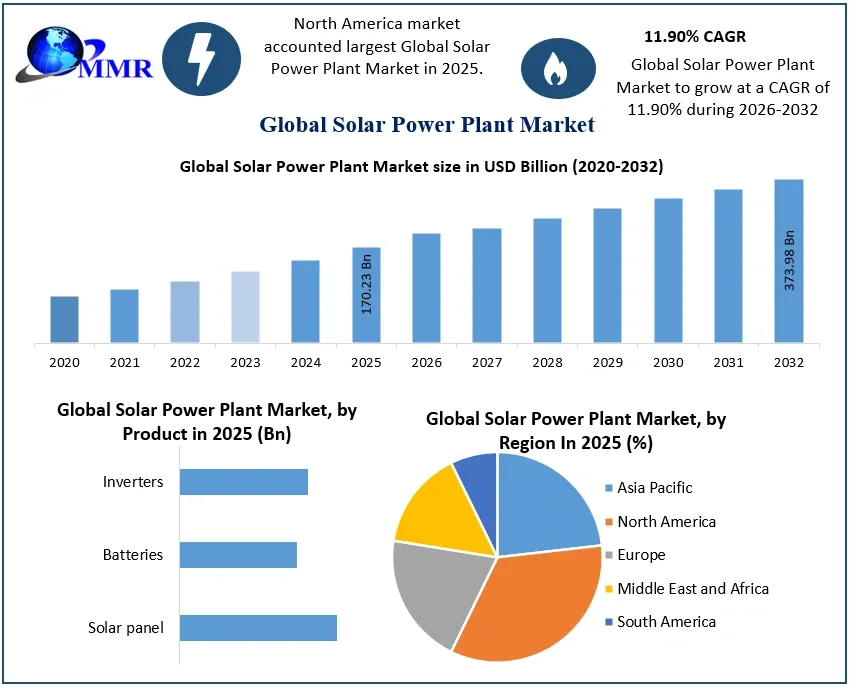
This graph forecasts global solar power plant market growth at 11.9% CAGR through 2032, segmented by region and product.
Key Considerations for Solar Installers and Owners
For "solar rapid shutdown compliance guide," factor local codes—NEC 2023 adoption varies by state. Project scale matters: Residentials favor microinverters for ease; commercials lean UL 3741 for scale. Fire departments prefer <30V inside arrays.
Budget for incentives: Secure 30% tax credits by starting construction before July 2026. Scale and site: Shaded? Optimizers. Cost-sensitive? Dedicated RSD.
Sunpal advises holistic designs, blending safety with performance.
How Sunpal Delivers Superior Solar PV Safety Solutions
At Sunpal, we specialize in "reliable solar rapid shutdown systems," offering flexible integrations with microinverters, optimizers, and UL 3741 paths. Our products cut costs by 15-20% through optimized designs, backed by robust warranties. Whether residential or commercial, Sunpal ensures NEC compliance without compromising yield.
Contact us for customized "solar PV system designs 2026" that prioritize safety and savings.
Wrapping Up: Future-Proof Your Solar Investments
In summary, selecting the right rapid shutdown—be it module or array-level—hinges on balancing safety, costs, and efficiency. With markets evolving and incentives waning, advances like UL 3741 make compliance more accessible. Sunpal empowers businesses with cutting-edge solutions for sustainable solar success.
Ready to optimize? Explore Sunpal products, get a free consultation, or download our compliance guide.