


Aqui está algo que a maioria das pessoas desconhece: enquanto lia essa última frase, a indústria solar dos EUA instalou capacidade suficiente para abastecer cerca de 50 casas. Isso acontece a cada minuto de todos os dias agora. Alcançámos 11,7 gigawatts apenas no 3º trimestre de 2025 - um número que teria parecido impossível há apenas uma década.
Mas eis a questão que me tira o sono (e não estou sozinho - fale com qualquer investigador de energia solar e verá a mesma energia inquieta): estamos a construir esta infraestrutura solar maciça a uma velocidade vertiginosa, e só agora começamos a fazer algumas perguntas muito importantes. O que acontecerá a todos estes painéis em 30 anos? Podemos torná-los melhores, mais leves, mais eficientes? E, honestamente, podemos fazer isto sem transformar cada parque solar numa zona morta ecológica?
As respostas que saem dos laboratórios neste momento? São genuinamente entusiasmantes.
O Problema da Perovskita Que Acabou de Ser Resolvido (Talvez)
Permita-me levá-lo de volta a cerca de cinco anos atrás. Eu estava numa conferência sobre energia solar e um investigador estava a apresentar as células solares de perovskita. A sala estava lotada – sem lugar para sentar – porque todos sabiam que as perovskitas eram a "pedra filosofal" da área. São baratas de fabricar, são flexíveis e, em laboratório, estavam a atingir números de eficiência que faziam o silício parecer lento.
Depois vieram as perguntas. "Mas e a estabilidade?", perguntou alguém. A sala ficou em silêncio. Porque esse era o problema. Estes materiais milagrosos degradar-se-iam mais rapidamente do que leite deixado ao sol. Calor? Desintegrar-se-iam. Humidade? Nem pensar. Até a luz – aquilo que deveriam converter – iria desfazê-los lentamente.
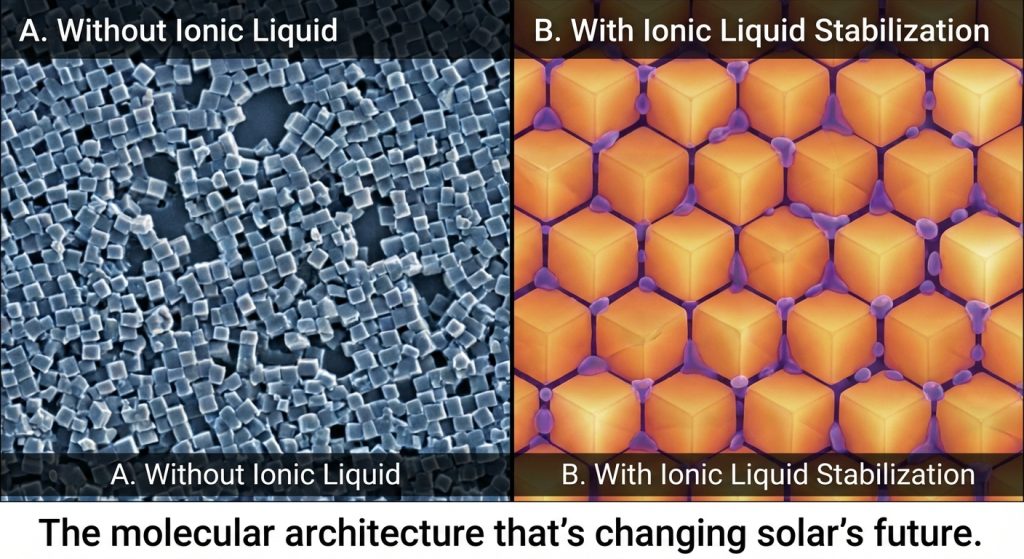
Avançando para 2025, acabou de acontecer algo notável. Os investigadores descobriram como utilizar líquidos iônicos — essencialmente sais que permanecem líquidos à temperatura ambiente — para estabilizar estes materiais delicados. Os resultados publicados na revista Nature mostraram que as células atingiram uma eficiência de 25,91% e mantiveram 90,1% do seu desempenho após condições de teste rigorosas. Não se trata apenas de uma melhoria incremental. É a diferença entre uma curiosidade de laboratório e algo em torno do qual se pode realmente construir um negócio.
Pense no que isto significa para produtos como os painéis solares TOPCon de 700W e a próxima geração para além deles. Estamos a falar de painéis que poderão ser potencialmente mais leves, mais eficientes e adaptáveis a superfícies onde os painéis tradicionais de silício simplesmente não conseguem chegar. Telhados curvos? Integração em veículos? Fachadas de edifícios? O mundo rígido da energia solar está prestes a tornar-se flexível.
📌 Realidade de Aprovisionamento Comercial de 2026: Enquanto as perovskitas flexíveis avançam através da estabilização em laboratório, os módulos TOPCon do tipo N como os Série Sunpal BiMAX 6N (com uma potência de 700 W ou mais e uma eficiência do módulo de até 23,51 TP3T) continuam a ser, atualmente, o padrão do setor, passível de financiamento, para implementações em redes de distribuição e no setor comercial e industrial.
Comparação de Arquitetura Solar Fotovoltaica de 2026: Investigação vs. Realidade de Campo
| Tecnologia | Eficiência do Módulo Comercial | Coef. de Temp. | Bifacialidade | Bancabilidade de 25 anos | Impacto nos Custos BOS |
|---|---|---|---|---|---|
| Mono-PERC do Tipo P | 21.0% - 21.8% | -0,351 TP3T/°C | 65% - 70% | Em declínio | Linha de base |
| N-Type TOPCon (Sunpal BiMAX) | 22.8% - 23.5%+ | -0,301 TP3T/°C | 80% - 85% | Verificado de Nível 1 | Poupança de -4% a -6% |
| Heterojunção (HJT) | 23.0% - 24.0% | -0,261 TP3T/°C | 85% - 90% | Moderado (CapEx superior) | Neutro |
| Tandem de Perovskite-Si | 25,5% - 27,5% (Piloto) | -0,251 TP3T/°C | 70% - 75% | Apenas Fase Piloto | Escala não comprovada |
O Desafio de Escalabilidade de Que Ninguém Fala nas Festas de Cocktail
Sabes o que é engraçado? Tornámo-nos tão bons a instalar painéis solares que isso criou um conjunto de problemas totalmente novo. De acordo com o Relatório Solar Market Insight, estamos a assistir a um crescimento de 20% em relação ao ano anterior. Isso é enorme. É tão enorme que nos obriga a "repensar tudo completamente".
Estava a conversar com uma amiga engenheira no mês passado que trabalha em instalações de grande escala. Ela disse-me algo que me ficou na memória: "Basicamente, estamos a construir o equivalente a uma nova central elétrica a cada poucas semanas, mas estamos a fazê-lo com tecnologia que ainda estamos a descobrir como eliminar corretamente."
Ela tem razão. E é aí que a investigação se torna realmente interessante — e, francamente, realmente necessária.
Quando a Sua Central Solar Precisa de Conviver com a Natureza
Mas aqui fica uma questão: o que acontece quando se cobrem milhares de hectares com painéis solares? Parece simples – gera-se energia limpa. Mas também se alteram habitats, se interrompem corredores de vida selvagem e se modifica fundamentalmente a forma como a terra interage com o seu ecossistema.
O Renewable Energy Wildlife Institute tem vindo a desenvolver um trabalho fascinante aqui. Não se limitam a estudar problemas; estão a engenheirar soluções. Centrais solares amigas dos polinizadores que criam habitat enquanto geram eletricidade. Sistemas de sensores que podem detetar e afastar aves de áreas potencialmente perigosas sem lhes causar dano. É o tipo de pensamento sistémico que reconhece que a energia solar não se trata apenas dos painéis — trata-se de toda a pegada.
E a eficiência no uso do solo continua a melhorar. O trabalho da Universidade de Oxford sobre perovskitas de película fina sugere que, eventualmente, poderão ser necessários muito menos espaço físico para gerar a mesma quantidade de energia. Imagine instalações solares que ocupam metade da área, mas geram a mesma energia. Isso já não é ficção científica, é investigação revista por pares.
O Segredo Sujo Sobre a Energia "Limpa" (e Como a Ciência a Está a Resolver)
Sejamos francos sobre algo desconfortável. Os painéis solares não duram para sempre. Eventualmente, todos os painéis instalados hoje precisarão de ser desativados. Estamos a falar de milhões — eventualmente milhares de milhões — de painéis. E, neste momento, não somos bons a reciclá-los.
A EPA sabe isto. É por isso que está a financiar investigação em locais como a Universidade de Binghamton para compreender a viabilidade a longo prazo e o impacto ambiental dos painéis solares. O que acontece quando um painel se degrada? Os materiais podem infiltrar-se no solo? Como é que projetamos para a desmontagem?
Destaques Principais de Dados
Composição do Material & Recuperação
| Material | % do painel | Taxa de Recuperação | Valor de 2050 |
| Vidro | 75% | 95% | $2.7B |
| Alumínio | 10% | 100% | $3.1B |
| Silício | 3-4% | 85% | $4.2B |
| Cobre | 1% | 95% | $2.8B |
| Prata | 0.05% | 94% | $2.2B |
Análise de Lacunas de Reciclagem
| Métrica | 2024 | Objetivo 2030 | Alvo de 2050 |
| Taxa Global | ~10% | 40% | 90-95% |
| Classificação da UE | 85% (mandato) | 90% | 95% |
| Resíduos Anuais | 500 mil toneladas | 4 milhões de toneladas | 10 milhões de toneladas |
| Acumulado | 2 milhões de toneladas | 8 milhões de toneladas | 78 milhões de toneladas |
Esta não é uma investigação que vá trazer boas notícias. É o tipo de trabalho crítico e pouco glamoroso que determina se a energia solar é genuinamente sustentável ou apenas adiar os problemas ambientais. Os primeiros resultados são encorajadores — conseguimos recuperar a maioria dos materiais valiosos dos painéis, incluindo silício, prata e vidro. Mas os processos precisam de ser economicamente viáveis, não apenas tecnicamente possíveis.
A New York State Energy Research and Development Authority (NYSERDA) tem sido particularmente ativa no financiamento desta investigação. Compreendem que, para que a energia solar mantenha a sua licença social – para que as comunidades continuem a dizer sim às instalações – todo o ciclo de vida precisa de ser responsável.
Painéis Inteligentes em Sistemas Mais Inteligentes
É aqui que as coisas ficam técnicas, mas acompanhe-me porque é realmente muito interessante. Costumávamos pensar nas centrais solares como algo, na verdade, passivo – ficam ali, geram eletricidade quando o sol brilha, e é só. Mas isso está a mudar rapidamente.
O CAL-NEXT Center for Solar Energy Research – uma colaboração entre a UC Berkeley e a Nextracker – está a trabalhar no que chamam de design de centrais de próxima geração. Essencialmente, estão a tornar as centrais solares inteligentes. Estamos a falar de manutenção preditiva impulsionada por IA que pode detetar um painel defeituoso antes que este falhe. Algoritmos de rastreio avançados que não se limitam a seguir o sol, mas que otimizam para a procura da rede, padrões climáticos e até preços da eletricidade.
Resumo das Especificações Principais
Matriz de Comparação de Desempenho
| Parâmetro | Instalação Estática | Instalação Inteligente | Vantagem |
| Otimização do Rendimento Energético | Referência (0%) | +15% a +35% | Inteligente: até 351 TP3T de energia a mais |
| Eficiência MPPT | 95-97% | 99.5-99.9% | Inteligente: eficiência de +3-51 TP3T |
| Rácio de Desempenho | 75-82% | 85-92% | Smart: +10% PR |
| Disponibilidade do Sistema | 95-97% | 99-99.5% | Inteligente: +2-41 TP3T de tempo de atividade |
Capacidade de Serviços de Rede
| Serviço | Estático | Inteligente | Potencial de Receita |
| Regulação da Frequência | ❌ | ✅ Total | $5-30/kW-ano |
| Suporte de Tensão | Limitado | ✅ Dinâmico | $2-8/kW-ano |
| Resposta à Procura | ❌ | ✅ Automatizado | $10-50/kW-ano |
| Central Virtual de Energia | ❌ | ✅ Total | Variável |
Economia da Manutenção
| Métrica | Estático | Inteligente | Redução |
| Custo Anual de O&M | $15-25/kW | $8-15/kW | -40% |
| Deteção de Falhas | Dias-Semanas | 1 segundo | 99.9% |
| Tempo Médio de Reparação | 24-72 horas | 2-8 horas | -90% |
| Camiões/Ano/MW | 12-20 | 4-8 | -60% |
Tempo de Resposta
| Parâmetro | Estático | Inteligente | Melhoria |
| Resposta do Sinal da Rede | Minutos-Horas | 20-200 ms | 1000× mais rápido |
| Resposta em frequência | N/A | <100 ms | Somente inteligente |
| Latência de Comunicação | 1 segundo | <10 ms | 100× mais rápido |
| Atualizações de Setpoint | Minutos | 10-100 ms | 1000× mais rápido |
Para projetos de grande escala que consideram tecnologias como painéis solares TOPCon de 700W, esta perspetiva a nível de sistema altera toda a proposta de valor. Já não se trata apenas da classificação de eficiência estampada no painel. Trata-se de como esse painel se integra num ecossistema de energia inteligente que pode fornecer estabilidade à rede, suporte de tensão e regulação de frequência — serviços cada vez mais valiosos à medida que a penetração de energias renováveis aumenta.
Pense desta forma: estamos a passar de centrais solares como fábricas de eletricidade para centrais solares como ativos responsivos na rede. Os painéis são os mesmos (bem, melhores), mas o sistema à volta deles é fundamentalmente diferente.
Para Além da Geração: Integração de Painéis de 700W+ com Armazenamento Refrigerado a Líquido (BESS)
A otimização de centrais solares modernas vai além do seguimento dinâmico, estendendo-se ao armazenamento ativo de energia. Em 2026, emparelhar a produção de alta potência com Sistemas de Armazenamento de Energia em Baterias (BESS) de refrigeração líquida em ciclo fechado aborda a redução de produção pelas operadoras e os sobrecustos de pico de procura:
- Controlo Térmico de Precisão: O arrefecimento líquido mantém a variação da temperatura das células dentro de <2 °C em todo o conjunto (em comparação com 5 °C–8 °C nos invólucros antigos arrefecidos a ar), prolongando a vida útil da bateria LiFePO₄ em até 20%.
- Sistema de Gestão de Energia Interativo com a RedeOs Sistemas de Gestão de Energia nativos da cloud permitem que as instalações comerciais executam o corte automático de picos (peak shaving), a arbitragem TOU (Time-of-Use) e a resposta de frequência de Centrais Elétricas Virtuais (VPP).
A Lacuna Entre a Magia do Laboratório e a Realidade do Mundo Real
Já vi demasiadas manchetes eufóricas sobre avanços "revolucionários" na energia solar que nunca se materializam no mundo real. Existe um motivo para essa lacuna, e não é porque os investigadores estejam a mentir ou a exagerar o seu trabalho. É porque a distância entre uma célula de laboratório com desempenho recorde e um produto financeiramente viável, na ordem dos gigawatts, é enorme.
É aqui que as organizações focadas em ligar a investigação a aplicações do mundo real ganham o seu sustento. A transição do laboratório para o mercado exige a resolução de desafios de fabrico que nem sequer são visíveis na fase de investigação. Como revestir uniformemente milhões de metros quadrados de material? Como manter o controlo de qualidade em velocidade? Como construir uma cadeia de abastecimento para materiais que mal existiam há dois anos?
E depois há a estrutura de financiamento. Os investidores precisam de garantias de desempenho de 25 anos. Precisam de bancabilidade. Precisam que as companhias de seguros concordem que sim, esta nova tecnologia é suficientemente fiável para apostar centenas de milhões de dólares nela. Isto requer dados, testes, validação - todas atividades de investigação que acontecem longe do laboratório do cientista de bancada, mas que são igualmente críticas para a implementação.
Para compradores B2B e decisores de projetos que avaliam tecnologias como os painéis solares TOPCon de 700W, a compreensão desta ponte de comercialização é crucial. A melhor eficiência laboratorial não significa nada se os painéis não puderem ser fabricados em larga escala, financiados ou integrados na infraestrutura de rede existente.
A Corrida pela Eficiência que Nunca Acaba
Os painéis solares de silício estão a aproximar-se dos seus limites teóricos de eficiência — o limite de Shockley-Queisser, para ser mais preciso. Estamos a falar de cerca de 29,1 % para as células de junção única. Os painéis comerciais atuais já atingem valores entre os 20 % e os 25 %. É impressionante, mas significa que os frutos mais fáceis de colher já foram colhidos.
Aqui vem uma visualização interativa abrangente que mostra a evolução histórica das eficiências das células solares de 1954 até ao presente, com projeções e limites teóricos.
É por isso que o avanço das perovskitas com líquidos iónicos é tão importante. Não se trata apenas de superar a eficiência do silício — embora isso seja possível com células duplas de perovskita-silício. Trata-se de abrir novos espaços de aplicação. Trata-se de reduzir o uso de materiais. Trata-se de processos de fabrico que podem ser mais baratos e menos intensivos em energia do que os processos de alta temperatura necessários para o silício.
Mas sejamos francos por um momento. A indústria solar é conservadora, e por boas razões. Quando se pede a alguém para investir milhões num ativo de 25 anos, "tecnologia nova e entusiasmante" não é suficiente. É preciso um desempenho comprovado, cadeias de abastecimento estabelecidas e garantias sólidas como rocha. É por isso que, mesmo com estes avanços, a transição não será instantânea.
O que isto significa para as pessoas que escrevem cheques
Se for um diretor financeiro, oficial de compras ou decisor de projetos, provavelmente está a perguntar-se: o que significa toda esta investigação para a minha próxima aquisição de energia solar?
Aqui está a minha opinião honesta. A curto prazo – os próximos 2-3 anos – ainda terá tecnologias de silício avançadas. Produtos como os painéis solares TOPCon de 700W representam o ponto ideal atual: tecnologia comprovada, fabrico estabelecido, desempenho fiável, mas com melhorias significativas em relação às gerações anteriores de painéis. Os ganhos de eficiência são reais, as melhorias no custo por watt são reais e, o mais importante, os mercados de financiamento e seguros compreendem-nos e aceitam-nos.
Médio prazo—3-7 anos—observe atentamente o espaço das perovskitas. Se as melhorias de estabilidade se mantiverem em condições reais (e isso ainda é um "se"), poderá ver produtos híbridos ou arquiteturas de painéis totalmente novas a entrar no mercado comercial. Os primeiros a adotar poderão obter vantagens, mas haverá prémios de risco.
A longo prazo? As inovações a nível de sistemas poderão ser mais importantes do que as melhorias na eficiência das células. O design inteligente das centrais, as capacidades avançadas de integração na rede e as soluções comprovadas de economia circular poderão diferenciar os projetos mais do que um ponto percentual adicional de eficiência.
A Investigação que Acontece em Folhas de Cálculo e Salas de Reunião
Aqui está algo que não dá manchetes sensuais: alguma da investigação solar mais importante não está a acontecer em laboratórios com microscópios. Está a acontecer em análise tecno-económica. Está a acontecer em estudos de otimização da cadeia de suprimentos. Está a acontecer em investigação de políticas que descobre como criar estruturas de mercado que valorizem os serviços de rede de instalações solares.
Um painel com eficiência 30% não serve de nada se custar dez vezes mais do que um painel com eficiência 22%. Um novo material revolucionário não serve de nada se não houver uma cadeia de abastecimento escalável. Um parque solar inteligente não serve de nada se o operador da rede não tiver um mecanismo para pagar pelos seus serviços de flexibilidade.
Esta investigação existe na intersecção pouco glamorosa da engenharia, economia e políticas. Mas é absolutamente crucial para traduzir descobertas científicas em transição energética real.
Onde Vamos a Partir Daqui
O panorama atual da investigação em energia solar faz-me lembrar os primórdios da computação. Sabemos que a tecnologia funciona. Sabemos que está a melhorar. Mas ainda estamos a decifrar as implicações, ainda a resolver problemas que nem sequer sabíamos que existiam há poucos anos.
As perovskites estabilizadas são entusiasmantes – genuinamente entusiasmantes. As inovações a nível de sistemas em design inteligente de instalações e integração com a rede são necessárias. A investigação sobre o ciclo de vida em termos de durabilidade, reciclagem e coexistência ambiental é crítica para manter o apoio social e político.
Mas o que me causa mais impacto é o quão interligadas estas frentes de investigação se tornaram. Já não se pode simplesmente melhorar a eficiência da célula e dar por terminado o assunto. É preciso pensar na escalabilidade da produção, na resiliência da cadeia de abastecimento, na integração na rede elétrica, no impacto ambiental, na gestão do fim de vida útil e nas estruturas de financiamento, tudo ao mesmo tempo.
Isso é, na verdade, encorajador. Significa que ultrapassámos a fase de "prova de conceito" e entrámos na fase de "descobrir como fazer isto à escala planetária". As perguntas são mais difíceis, mas são as perguntas certas.
Para aqueles de nós que observam atentamente — quer como investigadores, profissionais da indústria, investidores ou simplesmente cidadãos preocupados — os próximos anos serão fascinantes. Estamos a construir a infraestrutura energética que irá alimentar a civilização durante o próximo século, e estamos a fazê-lo enquanto inventamos simultaneamente muitas das tecnologias que a irão compor.
Os painéis a serem instalados hoje, incluindo opções avançadas como Painéis solares TOPCon 700W, representam o estado da arte atual. Mas a investigação que está a acontecer neste momento em laboratórios de materiais, institutos de vida selvagem, instalações de reciclagem e centros de integração de redes? É isso que determina como será a energia solar em 2040, 2050 e para lá destes anos.
E, honestamente? Com base no que estou a ver na linha de investigação, estou prudentemente otimista. Estamos a fazer as perguntas certas, a encontrar respostas promissoras e a fazê-lo rápido o suficiente para talvez — apenas talvez — corresponder ao momento que as alterações climáticas e a segurança energética exigem.
O Sol está lá há 4,6 mil milhões de anos. Só agora estamos a tornar-nos realmente bons a capturar o que ele tem vindo a dar gratuitamente durante todo este tempo.
Perguntas Frequentes (FAQ) – Realidades da Tecnologia Solar de 2026
Q1: Qual é a maior eficiência para os painéis solares comerciais em 2026?
Os painéis TOPCon de tipo N convencionais apresentam uma eficiência de módulo entre 22,81 TP3T e 23,51 TP3T+ na produção em massa comercial, com módulos de referência como o BiMAX 6N da Sunpal a ultrapassarem os 700 W.
Q2: Estão os painéis solares em tandem de perovskita-silício prontos para aquisição a nível de utilidade pública?
Ainda não está pronto para a implementação em grande escala por parte das empresas de serviços públicos. Embora as células em laboratório ultrapassem os 30%, as linhas-piloto continuam a resolver questões relacionadas com a consistência do rendimento em wafers de grandes dimensões e a estabelecer dados de viabilidade financeira a longo prazo.
Q3: De que forma os módulos TOPCon de 700W+ reduzem os custos do Balanço do Sistema (BOS)?
Uma potência mais elevada por módulo reduz o número total de painéis necessários por megawatt. Isto diminui as despesas com estruturas de montagem, cablagem de corrente contínua, caixas combinadoras e horas de instalação mecânica no local em 4% a 6%.
Q4: Porque é que o arrefecimento líquido se está a tornar o padrão para os sistemas de armazenamento de energia solar?
O arrefecimento líquido limita as diferenças de temperatura entre células a menos de 2 °C, prevenindo pontos quentes, diminuindo a energia parasita de arrefecimento e melhorando a vida útil em ciclos, em comparação com os tradicionais armários HVAC arrefecidos a ar.
Q5: Que materiais podem ser recuperados de painéis solares desativados?
Os circuitos de reciclagem convencionais recuperam aproximadamente 95% de vidro, 100% de caixilhos de alumínio e 85% de silício e cobre, em peso, contribuindo para os objetivos a longo prazo da economia circular.