


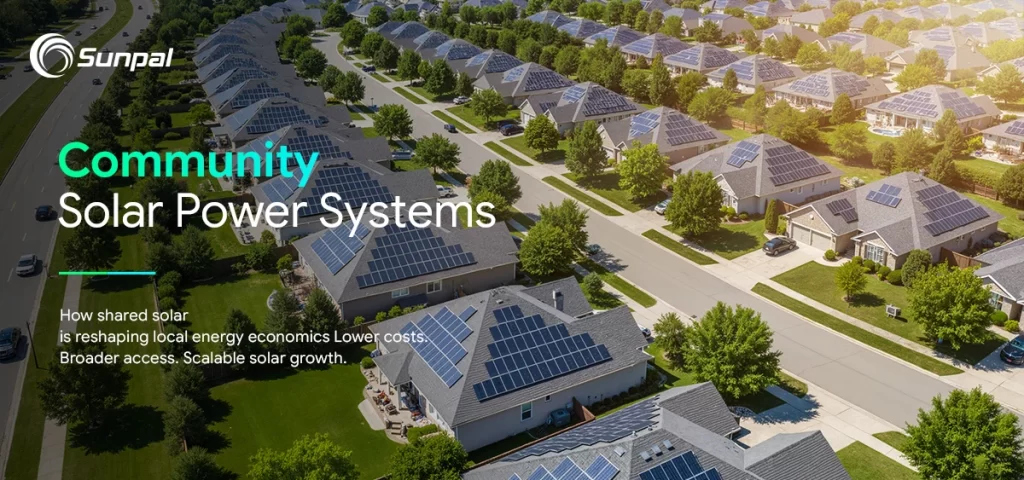
Can shared solar projects deliver lower energy costs, faster deployment, and broader access to clean power at the same time? Community solar power systems are emerging as one of the fastest-growing segments in the global solar market. As energy prices fluctuate and grid infrastructure faces mounting pressure, shared solar generation offers a scalable solution that redefines how neighborhoods, businesses, and utilities access renewable energy. Unlike rooftop solar, community solar removes ownership and space barriers, reshaping local energy economics through collective participation and optimized system design.
Why Community Solar Is Reshaping the Solar Energy Market
The solar industry is moving beyond individual rooftops toward distributed energy models that prioritize flexibility and cost efficiency. Community solar has gained traction because it directly addresses three persistent challenges in solar adoption: limited installation space, high upfront investment, and unequal access to clean energy.
For residential and commercial users unable to install rooftop photovoltaic systems, community solar provides subscription-based access to solar power without property modification. For utilities and developers, it enables faster project scaling, improved grid management, and predictable revenue streams.
This shift positions community solar as a critical component of modern distributed solar power systems and a practical bridge between utility-scale solar farms and decentralized energy networks.
What Is a Community Solar Power System?
A community solar power system is a grid-connected photovoltaic installation that supplies electricity to multiple subscribers from a single solar array. Participants receive energy credits or bill reductions proportional to their subscribed share of the system’s output.
Core Characteristics:
- Centralized solar PV installation
- Multiple residential, commercial, or municipal subscribers
- Virtual net metering or equivalent billing mechanisms
- Long-term subscription or power purchase agreements (PPAs)
Common Ownership Models:
- Utility-owned community solar projects
- Developer-owned subscription solar farms
- Municipal or cooperative solar programs
This model allows solar energy companies to deploy medium-scale systems—typically ranging from 500 kW to 5 MW—with optimized land use, standardized equipment, and streamlined operations.
How the Neighborhood Model Transforms Energy Economics
Community solar fundamentally changes cost structures across the energy value chain. By aggregating demand and centralizing generation, projects achieve economies of scale that are difficult to replicate with individual rooftop systems.
Key Economic Advantages:
- Lower installation cost per watt
- Reduced balance-of-system expenses
- Centralized maintenance and monitoring
- Stable long-term energy pricing for subscribers
Chart 1: Levelized Cost of Energy (LCOE) Comparison
| Solar System Type | Average LCOE (USD/kWh) |
| Residential Rooftop Solar | 0.12 – 0.18 |
| Community Solar Systems | 0.06 – 0.10 |
| Utility-Scale Solar Farms | 0.04 – 0.07 |
Data reflects typical global project averages.
Community solar consistently delivers lower energy costs than rooftop installations while maintaining stronger local economic engagement than utility-scale solar plants.
Stakeholders and Value Distribution in Community Solar Projects
Community solar creates a multi-stakeholder value ecosystem, balancing financial returns, energy access, and grid stability.
Chart 2: Stakeholder Value Matrix
| Stakeholder | Primary Benefits |
| Residential Subscribers | Lower electricity bills, no installation |
| Commercial Users | Predictable energy costs, ESG compliance |
| Utilities | Grid load balancing, peak shaving |
| Developers & EPCs | Scalable project pipelines |
| Local Governments | Energy equity, emission reduction |
This shared-value structure explains why community solar is increasingly supported by public policy and utility procurement programs worldwide.
Technology Architecture Behind Community Solar Power Systems
From a technical perspective, community solar projects rely on commercial-grade photovoltaic modules combined with intelligent grid integration.
Typical System Configuration:
- High-efficiency solar modules
- String or central inverters
- Grid-tied electrical architecture
- Smart metering and energy monitoring platforms
Energy storage systems are now being integrated into many projects to enhance grid flexibility, reduce curtailment, and enable peak-load management.
For solar manufacturers and EPC providers, this trend increases demand for modular PV systems, reliable inverters, and scalable battery energy storage solutions.
Policy and Regulatory Drivers Accelerating Adoption
Government policies play a decisive role in the growth of community solar. Virtual net metering, renewable energy credits, and clean energy mandates have created favorable conditions in many markets.
Chart 3: Community Solar Market Growth by Region
| Region | Annual Growth Rate |
| North America | 18–22% |
| L'Europe | 15–18% |
| Asia-Pacific | 20–25% |
| Emerging Markets | 25%+ |
Supportive regulatory frameworks reduce investment risk and encourage long-term participation from utilities and private developers.
Challenges Limiting Community Solar Expansion
Despite its advantages, community solar faces operational and regulatory constraints that influence project viability.
Key Challenges:
- Complex interconnection procedures
- Regulatory fragmentation across regions
- Subscriber management and churn
- Land acquisition near load centers
Addressing these barriers requires standardized system design, digital management tools, and close coordination between developers, utilities, and policymakers.
The Role of Community Solar in Future Energy Systems
Community solar is increasingly viewed as a building block for smart grids, distributed energy resources (DERs), and low-carbon cities. When combined with energy storage and advanced grid controls, shared solar systems can support:
- Peak demand reduction
- Grid resilience during outages
- Integration of electric vehicle charging
- Local energy independence
For commercial and industrial users, community solar also provides a scalable pathway to meet renewable energy targets without on-site infrastructure constraints.
Industry Perspective: How Sunpal Supports Community Solar Development
As a global photovoltaic system manufacturer, Sunpal provides end-to-end solutions for community-scale solar projects. Its portfolio covers high-efficiency solar modules, inverters, and containerized energy storage systems designed for medium-scale, grid-connected applications.
Sunpal’s one-stop system integration approach supports developers and EPCs seeking reliable equipment, flexible configurations, and fast delivery timelines—key factors in successful community solar deployment.
Conclusion: A Scalable Model Redefining Local Energy Economics
Community solar power systems represent a practical evolution of the solar industry—one that balances affordability, accessibility, and scalability. By lowering costs, expanding participation, and supporting grid stability, the neighborhood solar model is reshaping how clean energy is generated and consumed.As global demand for distributed solar solutions accelerates, community solar is positioned to become a cornerstone of the next-generation energy economy.