


Wir helfen gewerblichen Solaranlagenbetreibern, angesichts steigender Strompreise energieunabhängig zu werden – entdecken Sie kostengünstige Solaranlagen, die eine jährliche Rendite von 10–15 % bieten und sich bereits nach 4 Jahren amortisieren.
Einführung
Im Jahr 2026 sehen sich kleine Unternehmen mit steigenden Energiekosten konfrontiert, die ihre Gewinne gefährden. Nach Angaben der Internationalen Energieagentur (IEA) werden die Strompreise für gewerbliche Kunden voraussichtlich jährlich um 41 % steigen, was zu unvorhersehbaren Betriebskosten führt. Für Kleinunternehmer ist es zu einer entscheidenden Herausforderung geworden, diese Kosten zu bewältigen und gleichzeitig wettbewerbsfähig zu bleiben. Solarenergie bietet eine überzeugende Lösung: Sie senkt die Stromkosten um bis zu 75 %, sorgt für vorhersehbare monatliche Ausgaben und liefert langfristige finanzielle Erträge.
Bundesförderung Programme wie das „Rural Energy for America Program“ (REAP), das bis zu 50 % der Installationskosten übernimmt, machen Solarenergie in Kombination mit staatlichen Rabatten und den verbleibenden Steuergutschriften des Bundes zugänglicher denn je. Über die Förderungen hinaus legen die Trends für 2026 den Schwerpunkt auf hybride Solaranlagen mit integriertem Speicher. Diese Systeme schützen nicht nur vor Stromausfällen, sondern optimieren auch den Energieverbrauch, um von Spitzenpreisen zu profitieren, und erzielen eine Kapitalrendite von 10–15 %, womit sie viele traditionelle Anlageformen übertreffen. Die hocheffizienten TOPCon und HJT-Module sind für eine nahtlose Integration konzipiert und bieten kleinen Unternehmen sowohl Leistung als auch Zuverlässigkeit.
Warum Solar 2026 für Kleinunternehmen sinnvoll ist
Kleine Unternehmen, die im Jahr 2026 Solar- und Speichersysteme einführen, profitieren von zahlreichen Vorteilen. Der Strombedarf steigt jährlich um 3,71 % an, und Schwankungen bei den Strompreisen können die Rentabilität erheblich beeinträchtigen. Der Einsatz von Solaranlagen mindert diese Risiken, senkt die Energiekosten um 50–75 % und verbessert das Markenimage bei umweltbewussten Kunden.
Moderne bifaziale Module verbessern die Kapitalrendite zusätzlich, indem sie Licht von beiden Seiten des Moduls einfangen und so 10–20 % mehr Energie erzeugen als herkömmliche Module. Dadurch eignen sie sich ideal für verschiedene Dachtypen, darunter Flachdächer, Schrägdächer und sogar reflektierende Oberflächen. Die Fördermöglichkeiten bleiben attraktiv: Selbst nach dem teilweisen Auslaufen der ITC im Jahr 2025 können Unternehmen weiterhin REAP-Zuschüsse und staatliche Vergünstigungen wie Rabatte von $300/kW in ausgewählten Regionen in Anspruch nehmen.
Markttrends deuten darauf hin, dass die Investitionen in Solaranlagen zwar Anfang 2025 um 181 % zurückgingen, die Nachfrage sich jedoch 2026 wieder erholte, angetrieben durch hybride Solar-Speicher-Systeme und die Einführung durch Hyperscaler. Kleine Unternehmen haben jetzt Zugang zu in den USA hergestellten Systemen, die für Bonusanreize qualifiziert sind und die Amortisationszeiten beschleunigen.
Wachstum der Solarkapazität in den USA
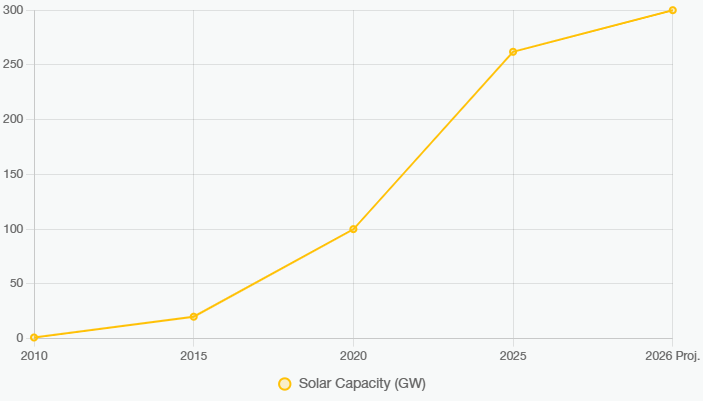
Bis Ende 2026 wird in den USA voraussichtlich eine Solarkapazität von 300 GW erreicht sein, die über 50 Millionen Haushalte und Unternehmen versorgen wird.
Schlüsselkonfigurationen für Solaranlagen für maximalen ROI
Kleine Unternehmen sollten Systemkonfigurationen in Betracht ziehen, die Effizienz, Anreize und Energieunabhängigkeit maximieren. Hier ist ein detaillierter Blick auf die wichtigsten Optionen:
- On-Grid-Systeme: An das Stromnetz angeschlossen, verkaufen diese Systeme überschüssige Energie über Net-Metering. Ideal für Bürogebäude, Einzelhandelsgeschäfte und energieintensive Betriebe während des Tages. Die Amortisation liegt mit bifazialen Modulen zwischen 4 und 7 Jahren, und die Anfangskosten sind moderat.
Vorteile: Reduziert Energiekosten am Tag erheblich.
Nachteile: Vollständig vom Netz abhängig. - Hybride Systeme mit SpeicherNetzanschluss mit Batteriespeicher kombinieren. Perfekt für Unternehmen, die anfällig für Stromausfälle sind, wie z. B. Restaurants oder Gesundheitskliniken. Die Amortisationszeit beträgt 6-9 Jahre, unterstützt durch Peak Shaving und Energiearbitrage.
Vorteile: Bietet Energieunabhängigkeit und Ausfallsicherheit.
Nachteile: Höhere Anfangsinvestition. - Autarke SystemeVollständig batteriebetrieben, für abgelegene Standorte ohne Netzanbindung konzipiert. Die Amortisation liegt zwischen 8 und 12 Jahren, bietet aber vollständige Autonomie.
Vorteile: Eliminiert die Abhängigkeit von Versorgungsunternehmen vollständig.
Nachteile: Erfordert sorgfältige Systemdimensionierung und höhere Anfangskosten. - PPA / Leasing-ModelleAnsatz ohne Investitionsausgaben, bei dem Unternehmen nur für die erzeugte Energie bezahlen, typischerweise zu Sätzen unter denen des lokalen Energieversorgers. Sofortige Einsparungen sind ohne Vorabinvestitionen möglich.
Vorteile: Minimales finanzielles Risiko, sofortige Senkung der Energiekosten.
Nachteile: Begrenzte Kontrolle über Systembesitz und Anreize.
Sunpals hocheffiziente HJT-Module die Energieerzeugung um 15–20 % steigern und die Amortisationszeiten bei allen Konfigurationen verkürzen.
Vergleichstabelle:
| Einrichtungsart | Kostenstufe | Amortisationszeitraum | Am besten für | Kernvorteil |
| Netzgekoppelt | Mittel | 4-7 Jahre | Büros/Einzelhandel | Rechnungs Gutschriften |
| Hybrid | Hoch | 6-9 Jahre | Gesundheitswesen/Lebensmittel | Ausfallschutz |
| Off-Grid | Höchste | 8–12 Jahre | Fernbetrieb | Volle Autonomie |
| PPA/Leasing | Niedrig/Keine | Instant | Klamme Unternehmen | Keine Vorabinvestition |
Berechnung der Solarrendite
Das Verständnis des Paybacks ist entscheidend für fundierte Solarentscheidungen. Berücksichtigen Sie diese Faktoren:
- EnergieauditAktuellen Stromverbrauch analysieren.
- Systemauslegung & KostenschätzungBundes-/Länderanreize berücksichtigen.
- Prognostizierte Einsparungen: Leistung × lokale Stromtarife.
- AmortisationszeitKosten / Einsparungen.
- ROI-Berechnung(Lebenslange Gewinne – Kosten) / Kosten.
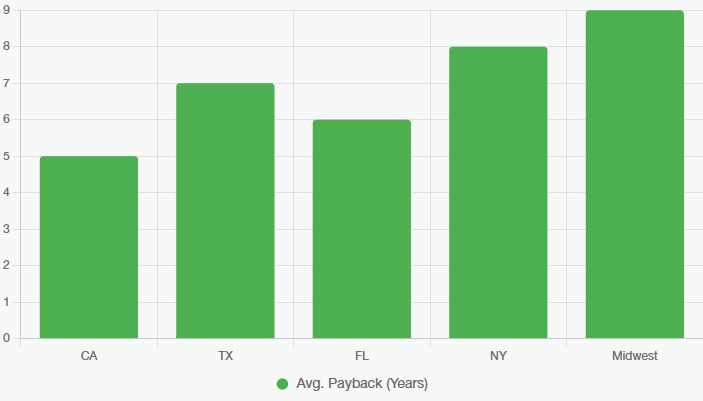
Zu den Einflussfaktoren zählen die lokale Sonneneinstrahlung, jährliche Strompreiserhöhungen (~41–30 %), der Wirkungsgrad der Module sowie noch laufende Förderprogramme. In sonnenreichen Bundesstaaten wie Texas können sich Hybridsysteme bereits nach 5 bis 7 Jahren amortisieren, während sich die Amortisationszeit in bewölkteren Regionen auf bis zu 9 Jahre verlängern kann. Bei richtiger Integration von Speichersystemen liegt die Kapitalrendite nach der Amortisationsphase oft bei 10–20 % und übertrifft damit viele herkömmliche Investitionen.
Amortisationsvergleich nach Bundesland (Schätzungen 2026)
Reale Geschäftserfolge
- Texas Einzelhandelsgeschäft (20 kW Hybrid): Die monatlichen Kosten sanken von 1.426.000 auf 1.500.000. Durch die Optimierung der Speicherkapazität wurde die Amortisationszeit auf 7 Jahre verkürzt.
- Florida Food Service (PPA)Sofortige finanzielle Vorteile mit einer Amortisationszeit von 3-5 Jahren.
- Midwest Boutique-Einsätze: Die bifazialen Anlagen von Sunpal erzielten dank der beidseitigen Energiegewinnung eine Gesamtkapitalrendite von 1401 % über die gesamte Lebensdauer.
Trendanalyse-Diagramm zum Sparkassenwachstum:
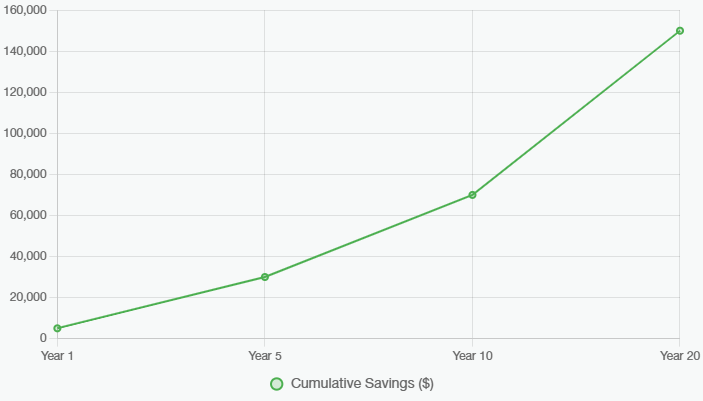
Jährliche Einsparungen basierend auf einer Anlage mit einer Leistung von 1 kW und 50.000 Litern, bei einer Senkung der Stromrechnung um 751 kW.
Diese Beispiele verdeutlichen, dass Solarenergie nicht mehr nur ein Werkzeug für Nachhaltigkeit ist – sie ist ein greifbarer Profitbringer für kleine Unternehmen.
Ihre Solarreise starten
Schritte zur Umsetzung eines erfolgreichen Solarprojekts:
- Führen Sie eine Energieberatung durch und beurteilen Sie die Standorttauglichkeit.
- Mehrere Angebote und Finanzierungsmöglichkeiten einholen (Fokus auf REAP).
- Wählen Sie die richtige Systemkonfiguration basierend auf Amortisation und Risikotoleranz.
- Planung für zukünftige Trends, einschließlich der Integration von Elektrofahrzeugladestationen.
- Arbeiten Sie mit erfahrenen Anbietern wie Sunpal für individuelle Beratungen und nahtlose Installationen zusammen.
Sorgfältige Planung und professionelle Beratung sorgen für maximale Rentabilität und langfristige betriebliche Vorteile.
Schlussfolgerung
Das Jahr 2026 ist ein entscheidendes Jahr für die Einführung von Solaranlagen in kleinen Unternehmen. ROI-optimierte Anlagen, insbesondere Hybridanlagen aus Solarmodulen und Speichern, bieten vorhersehbare Kosteneinsparungen, Energieunabhängigkeit und jährliche Renditen von 10–15 % (TP3T). Dank staatlicher Förderungen auf Bundes- und Landesebene, hocheffizienter Module und intelligenter Systemkonzepte wird Solarenergie zu einer strategischen Investition und nicht mehr nur zu einem Betriebsaufwand. Kleine Unternehmen können sich so finanzielle Widerstandsfähigkeit und Nachhaltigkeit sichern und gleichzeitig ihren Markenwert steigern. Kontaktieren Sie Sunpal noch heute ihr Sonnenpotenzial zu erschließen.