


A solar module may meet every specification on paper, but can its quality remain consistent across thousands of units in a bulk order? For distributors, this question is central to choosing a reliable manufacturing partner. Beyond comparing product specifications and supplier credentials, buyers need to understand how manufacturers control quality throughout production. Our solar manufacturer, supplier, and wholesale guide covers the broader supplier evaluation and procurement process, while this article focuses on the factory-level controls behind consistent module quality.
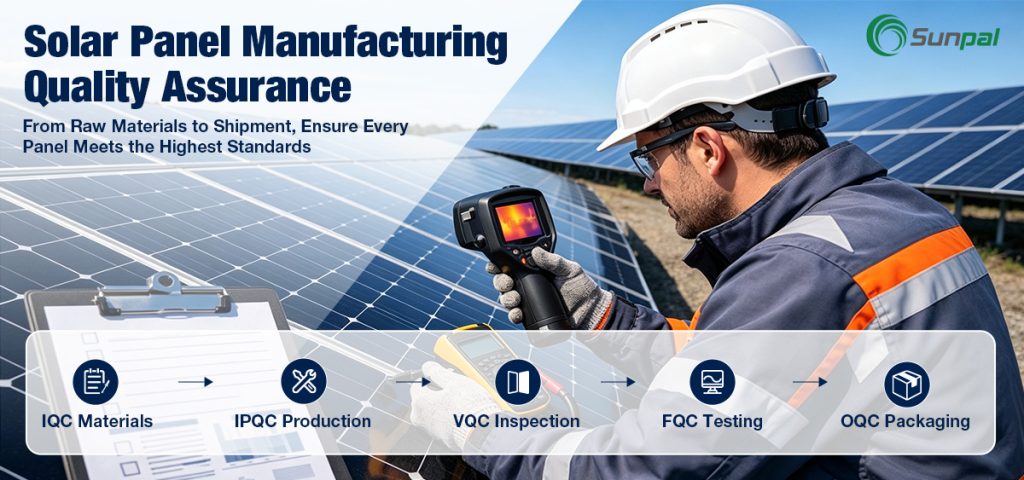
From incoming materials to finished-product dispatch, each production stage plays a role in preventing defects and maintaining product reliability. This guide examines five key inspection stages—Incoming Quality Control (IQC), In-Process Quality Control (IPQC), Visual Quality Control (VQC), Final Quality Control (FQC), and Outgoing Quality Control (OQC)—alongside the management practices and audit considerations that help buyers evaluate factory quality control.
Why Factory Quality Control Matters
Solar module defects do not always originate from faulty materials. They can also develop through inconsistent cell handling, poor soldering, uneven lamination, or improper assembly. If these issues go unnoticed, they may affect electrical output, insulation performance, mechanical strength, and long-term reliability.
The challenge is that some defects can become difficult to detect or correct once a module moves further along the production line. Effective factory quality control helps identify problems early, reduce the risk of defects carrying over into subsequent processes, and maintain consistency across production batches.
Product certification confirms that a module design has been evaluated against applicable standards, while factory quality control focuses on whether actual production continues to meet the approved requirements. Both are important when assessing a manufacturer's ability to deliver consistent products.
Five Stages of Solar Module Factory Quality Control
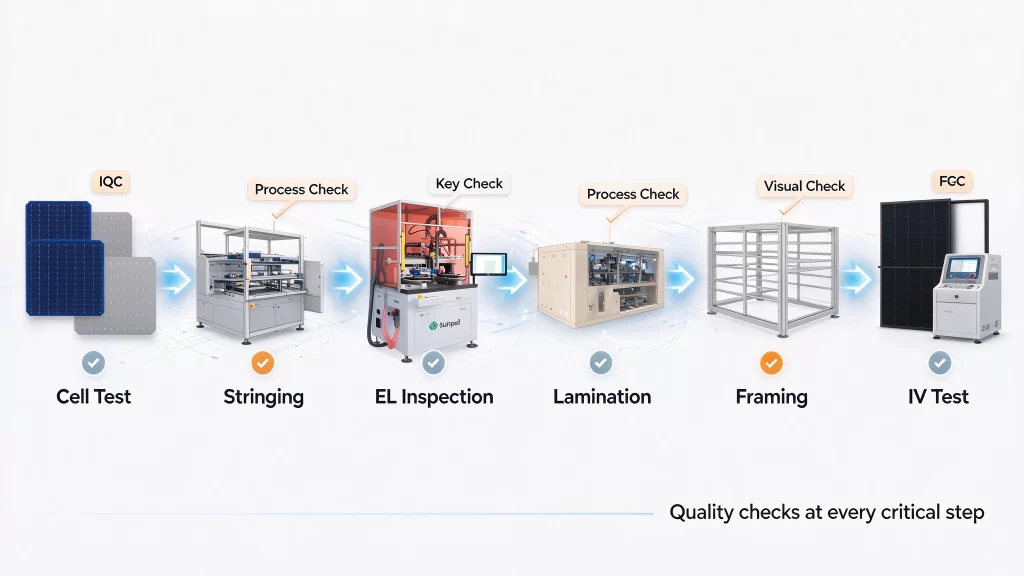
A practical factory inspection process covers five stages, from incoming materials to finished-product dispatch. Each stage addresses a different source of quality risk, helping prevent defects from progressing through production and reaching the customer.
1. Incoming Quality Control (IQC): Raw Material Inspection
IQC prevents unsuitable or nonconforming materials from entering the manufacturing process. It verifies that incoming components match approved specifications and are suitable for the intended module design.
Puntos clave de inspección:
- Solar cells: Check dimensions, appearance, color consistency, efficiency grade, and supplier batch information.
- Encapsulant materials: Verify the EVA or POE type, thickness, batch number, shelf life, and storage conditions.
- Front and rear glass: Inspect dimensions, thickness, surface condition, and edge quality. For bifacial double-glass modules, ensure both glass layers match the approved bill of materials (BOM).
- Backsheet: Check material type, thickness, appearance, and batch information for backsheet module designs.
- Aluminum frames: Confirm dimensions, alloy and coating specifications, corner connections, and surface condition.
- Junction boxes, cables, and connectors: Verify model numbers, electrical ratings, bypass diode specifications, connector compatibility, and sealing requirements.
Material storage is equally important. Temperature, humidity, handling, and shelf-life conditions should follow supplier specifications. Rejected, expired, or unapproved components must be identified and isolated to prevent accidental use.
2. In-Process Quality Control (IPQC): Manufacturing Process Monitoring
IPQC focuses on process-related defects that may develop during module assembly. Its main objective is to keep critical manufacturing parameters within defined limits and prevent process deviations from affecting subsequent production stages.
Puntos clave de inspección:
- Cell stringing and soldering: Monitor ribbon alignment, soldering conditions, cell spacing, and interconnection quality. Poor soldering can create unreliable electrical connections.
- Layup and alignment: Check the positioning of cells, ribbons, encapsulant, and glass or backsheet. Foreign particles and alignment deviations can affect the finished laminate.
- Pre-lamination inspection: Use visual checks and, where required, EL images to identify cell cracks or interconnection issues before lamination.
- Lamination: Monitor temperature, vacuum pressure, curing time, and other specified parameters. Incorrect settings may contribute to bubbles, poor adhesion, or delamination.
- Framing and sealing: Focus on frame dimensions, corner connections, sealant application, and curing conditions.
- Junction box installation: Check bonding, cable connections, potting, and sealing against the approved manufacturing process.
Consistent process control depends on maintaining specified operating parameters throughout production. Deviations can affect subsequent assembly steps and may lead to defects that are difficult to identify through final visual inspection alone.
3. Visual Quality Control (VQC): Appearance and Workmanship
VQC focuses on visible defects and assembly workmanship. Unlike IPQC, which monitors manufacturing operations, this stage evaluates the physical condition of assembled modules and identifies issues that may affect appearance, installation, or structural integrity.
Puntos clave de inspección:
- Glass surface: Scratches, chips, cracks, stains, and other visible damage.
- Cell appearance: Discoloration, visible cracks, irregular spacing, and alignment problems.
- Laminate condition: Bubbles, foreign particles, delamination, and uneven encapsulant edges.
- Frame and corners: Dents, scratches, sharp edges, loose connections, and dimensional deviations.
- Cables and connectors: Cable length, connector condition, polarity identification, and consistency with approved specifications.
- Labels and markings: Legibility and accuracy of model numbers, serial numbers, electrical ratings, and required certification markings.
Documented defect classifications help distinguish acceptable cosmetic variations from issues requiring rework or rejection. This is particularly important for private-label products, where distributors may have specific appearance and workmanship requirements.
4. Final Quality Control (FQC): Electrical and Performance Testing
FQC verifies whether completed modules meet their rated electrical specifications and applicable safety requirements. Unlike visual inspection, it relies on measurable test results to identify performance and electrical defects.
Puntos clave de inspección:
- Solar flash testing: Measure maximum power (Pmax), open-circuit voltage (Voc), short-circuit current (Isc), voltage at maximum power (Vmpp), and current at maximum power (Impp) under Standard Test Conditions (STC). Results are compared with the agreed power class and nameplate tolerance.
- Electroluminescence (EL) inspection: Identify cell cracks, inactive areas, broken fingers, and other internal anomalies. Where required, images are retained against individual module serial numbers.
- Insulation resistance and dielectric withstand testing: Evaluate electrical insulation and safety against applicable test procedures and product requirements.
- Ground continuity: For module designs with applicable grounding provisions, verify relevant bonding and continuity requirements.
- Additional reliability verification: Depending on the module design, certification scope, project requirements, and buyer agreement, tests may include mechanical load, thermal cycling, damp heat, humidity-freeze, or other environmental stress tests.
Routine production tests should be distinguished from design qualification and periodic reliability tests. Flash testing and other routine checks may be performed during finished-module production, while mechanical load and environmental stress tests generally follow applicable qualification or verification programs rather than being conducted on every module.
For an overview of common inspection methods, see this solar panel quality inspection overview.
5. Outgoing Quality Control (OQC): Packaging and Shipment Preparation
OQC focuses on delivery-related risks after modules have passed the required production inspections. Its purpose is to prevent incorrect quantities, inadequate packaging, product mix-ups, and shipping preparation errors from affecting the order.
Puntos clave de inspección:
- Product quantity: Match finished-module quantities against the production order, packing list, and shipment requirements.
- Pallet and carton condition: Assess pallet strength, carton integrity, protective materials, and stacking arrangements.
- Module protection: Verify corner guards, separators, cushioning, and moisture protection where required by the packaging design.
- Loading arrangements: Follow approved packaging and handling instructions, including the specified orientation and stacking method.
- Shipment identification: Match pallet labels, carton markings, and product identification with the order details.
- Shipping documentation: Ensure packing lists, serial-number records, product specifications, and other agreed documents are complete and consistent.
For international wholesale orders, packaging and handling should account for the full transportation route, from container loading and port handling to inland transport and final delivery.
The following table summarizes the main inspection focus and typical records generated at each quality-control stage.
| QC Stage | Main Inspection Focus | Typical QC Records |
|---|---|---|
| IQC | Incoming material quality | Material specifications, incoming inspection records |
| IPQC | Manufacturing processes and critical parameters | Process parameter logs, in-process inspection records |
| VQC | Module appearance and workmanship | Visual inspection standards, inspection and defect records |
| FQC | Electrical performance and safety | Electrical test reports, flash test results, EL images |
| OQC | Packaging and shipment preparation | Final inspection reports, packing lists, loading records |
Key Management Systems for Solar Module Quality Control
The five inspection stages define where product checks take place during manufacturing. However, consistent quality also depends on the management systems supporting those inspections. Quality documentation, equipment management, material traceability, change control, and corrective action procedures help maintain production consistency and address problems that may extend beyond an individual inspection stage.
Quality Management System and Equipment Control
A quality management system (QMS) establishes how quality responsibilities, operating procedures, documentation, and internal reviews are managed across the factory. It provides a consistent framework for implementing inspection requirements and maintaining production standards.
Equipment management supports the reliability of this framework. Calibration ensures that measuring and testing equipment provides results within its required accuracy, while preventive maintenance helps keep production and inspection equipment in suitable operating condition. Equipment status is particularly important when production decisions depend on measurements or test results.
Material Traceability and Manufacturing Change Control
Material traceability connects incoming component batches with production records and finished-module identification. This relationship helps manufacturers investigate quality issues, identify potentially affected products, and establish the origin of materials used in a particular production batch.
Manufacturing change control governs how changes to materials, suppliers, components, or production processes are evaluated and approved before implementation. The approved BOM and its revision history provide a reference for maintaining the agreed product configuration.
For repeat wholesale orders, traceability and change control are especially important. They help maintain consistency between batches and provide a basis for assessing whether a product change could affect its specifications or existing certification coverage.
Nonconformity and Corrective Action Management
A structured nonconformity management process defines how quality problems are identified, documented, investigated, and resolved. It also establishes how affected materials or products are controlled to prevent unintended use or shipment.
Corrective action management goes beyond addressing an individual defect. Root-cause analysis helps identify the underlying reason for a problem, while corrective actions aim to prevent recurrence. Follow-up verification determines whether the actions have addressed the cause effectively.
Together, these procedures help a manufacturer move from detecting defects to improving the processes that may have caused them.
Sampling Plans and Inspection Agreements
Sampling plans define how products are selected for inspection, how frequently checks are performed, and what acceptance criteria apply. They provide a consistent basis for sample-based quality assessments and help clarify how failed results should be handled.
A quality agreement should distinguish between tests performed on every module, sample-based production inspections, and periodic reliability verification. These activities serve different purposes and should be defined according to the test method, product specifications, certification scope, and order requirements.
For large wholesale orders, independent pre-shipment inspections may provide an additional verification step. Their scope, sampling method, acceptance criteria, and procedures for resolving disputed results should be established before the inspection takes place.
Factory Audit Checklist for Solar Distributors and Wholesale Buyers
The management measures described above establish how a factory maintains quality beyond individual product inspections. A factory audit should determine whether these systems are documented, consistently implemented, and supported by reliable records. The following checklist focuses on verifying those management practices rather than repeating the five stages of product inspection.
Quality Management System and Responsibilities
- Review the current quality manual and relevant management procedures.
- Verify the scope and validity of ISO 9001 certification, where applicable.
- Check whether quality responsibilities are clearly assigned across relevant departments.
- Review internal audit records and documented follow-up on identified issues.
- Confirm that employees receive training relevant to their quality-related responsibilities.
Equipment Calibration and Maintenance
- Request calibration schedules and records for critical measuring and testing equipment.
- Check whether calibration records identify the equipment, calibration date, and next due date.
- Review preventive maintenance schedules and equipment maintenance records.
- Ask how equipment found outside calibration limits or with overdue maintenance is handled.
- Verify whether potentially affected inspection results or products are evaluated and documented.
Material Traceability and Change Control
- Select a finished-module batch and trace it back to the relevant production and incoming material records.
- Check whether material batches can be linked to production dates and finished-module serial numbers.
- Review the approved BOM and its revision history.
- Examine documented approvals for changes to materials, suppliers, components, or manufacturing processes.
- Confirm how relevant changes are communicated and how their potential effect on product specifications or certification is assessed.
Nonconformity and Corrective Action Management
- Request anonymized examples of nonconformity reports and corrective action records.
- Check whether each record identifies the issue, affected products or materials, and containment measures.
- Review the documented root-cause analysis and corrective actions.
- Verify whether corrective action effectiveness is assessed and recorded.
- Check how recurring issues are tracked and whether unresolved problems receive further action.
Sampling Plans and Inspection Agreements
- Review the sampling plan and quality agreement applicable to the order.
- Confirm that sample selection, inspection frequency, and acceptance criteria are clearly defined.
- Check whether the agreement distinguishes between routine per-module tests, sample-based inspections, and periodic reliability verification.
- For third-party inspections, verify that the scope, sampling method, and procedures for handling failed or disputed results are documented.
A completed audit checklist should be supported by objective evidence rather than verbal assurances alone. Missing records, inconsistent documentation, or unresolved corrective actions may indicate gaps in the factory's quality management practices and should be clarified before a large order is approved.
Solar Module Standards and Quality Systems
Product standards and factory quality systems address different aspects of manufacturing quality. Product standards define requirements for module performance, safety, and qualification, while quality management standards establish frameworks for controlling manufacturing processes and maintaining consistent operations. Understanding this distinction helps buyers evaluate supplier documentation without treating different certifications as interchangeable.
| Estándar | Main Scope | What It Covers |
|---|---|---|
| IEC 61215 | PV module design qualification and type approval | Evaluates module design performance under specified environmental and operating conditions |
| IEC 61730 | PV module safety qualification | Addresses construction and safety requirements for PV modules |
| IEC 62941 | Quality system for PV module manufacturing | Provides quality management requirements specific to the manufacturing of terrestrial PV modules |
| ISO 9001 | General quality management system requirements | Establishes a framework for managing quality processes across an organization |
IEC 61215 and IEC 61730 focus on product qualification, covering module performance and safety respectively. IEC 62941 addresses quality management practices specific to PV module manufacturing, whereas ISO 9001 provides a broader framework applicable across different industries.
These standards serve complementary rather than interchangeable purposes. Product qualification does not guarantee that every production batch is defect-free, while a quality management system certification does not replace module-specific performance and safety testing. Both product qualification and effective factory quality management contribute to a more complete assessment of manufacturing quality.
The relevance of these standards depends on the supplied module model and manufacturing configuration. Certificates and test reports should cover the products being purchased, while changes to key materials, components, or design elements may require an assessment of whether existing test reports or certification coverage remain applicable.
Practical Project Example: Applying QC to a 1 MWp Module Order
Consider a distributor preparing to purchase approximately 1 MWp of 585W N-type TOPCon bifacial double-glass modules for a commercial solar project. At 585W per module, the order would require approximately 1,710 modules, subject to the final system capacity and module selection.
Instead of relying only on the quoted price and product datasheet, the buyer can establish quality requirements at three procurement milestones.
Before production: The distributor approves the module datasheet, BOM, cell and glass specifications, junction box model, connector requirements, and applicable certification documents. The buyer and manufacturer also agree on inspection scope, sampling methods, acceptance criteria, and the records to be supplied with the order.
During production: The factory records incoming material inspections and monitors key assembly processes, including stringing, layup, lamination, framing, and junction box installation. The buyer requests relevant inspection records and confirms how nonconforming materials or modules are isolated and handled.
Before shipment: The buyer reviews final flash-test data, the agreed EL inspection records, visual inspection results, and packaging condition. Available serial-number records are matched against the packing list and test data. If required by the purchase agreement, a third-party inspector verifies the agreed sample scope and acceptance criteria before shipment.
This example shows how factory QC requirements can be connected to a real procurement process. The inspection frequency, sampling plan, testing scope, and acceptance limits should be agreed upon before production. They should not be treated as universal requirements for every module order.
Conclusion: The Future of Quality Control in Solar Module Manufacturing
As solar module technologies continue to evolve, factory quality control will become increasingly important in maintaining product reliability and manufacturing consistency. Higher power outputs, new cell architectures, advanced encapsulation materials, and more demanding application requirements are placing greater emphasis on precise process control and continuous quality improvement.
At the same time, digital production monitoring, automated inspection, and more comprehensive traceability systems are creating opportunities for manufacturers to identify process deviations earlier and maintain better visibility across production batches. For distributors and wholesale buyers, these developments make manufacturing transparency and consistent quality management increasingly important factors in building reliable supply relationships.
Successful solar module procurement will depend not only on product specifications and pricing, but also on manufacturers' ability to adapt to technological changes while maintaining stable production standards. SUNPAL works with distributors and project partners on solar module specifications, product customization, and wholesale supply requirements. Contact SUNPAL to discuss your sourcing plans and explore long-term cooperation opportunities.