


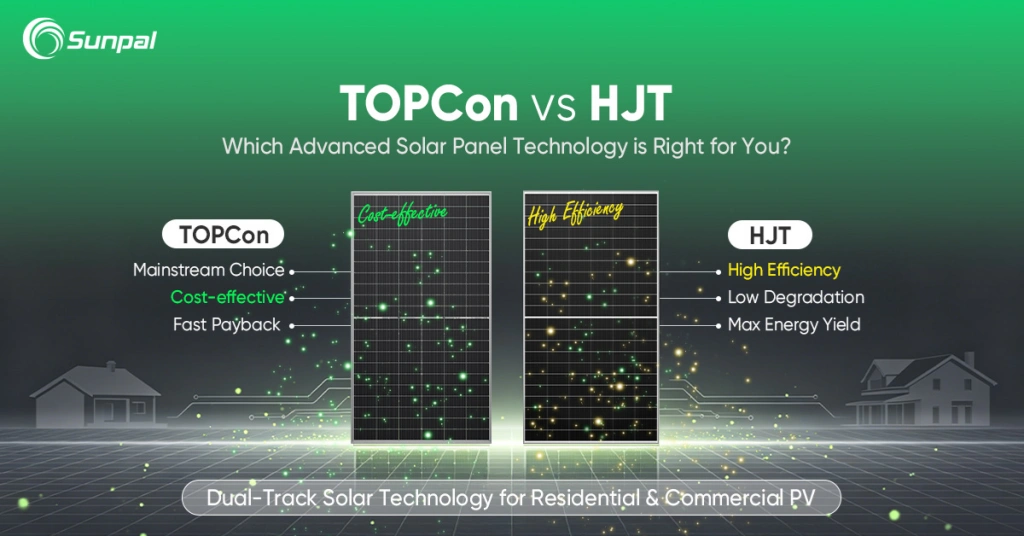
The global photovoltaic industry is undergoing a rapid structural transition toward high efficiency solar panels, with N-type solar technologies increasingly replacing traditional P-type PERC across residential, commercial, and utility-scale applications.
HJT (Heterojunction) and TOPCon (Tunnel Oxide Passivated Contact) have emerged as the two dominant technology pathways driving new global module capacity additions.
According to the International Technology Roadmap for Photovoltaics (ITRPV), N-type technologies are expected to account for the majority of crystalline silicon production expansion through the remainder of the decade, supported by efficiency improvements and lower long-term degradation rates.
Fraunhofer ISE further confirms that N-type architectures deliver significantly reduced power degradation compared to PERC, particularly in humid and low-irradiance environments commonly observed in European rooftop markets.
HJT: High-Efficiency Premium Solar Architecture
HJT solar panels (Heterojunction Technology) are built on a hybrid n-type silicon structure combining crystalline silicon wafers with ultra-thin amorphous silicon passivation layers, enabling superior surface recombination control.
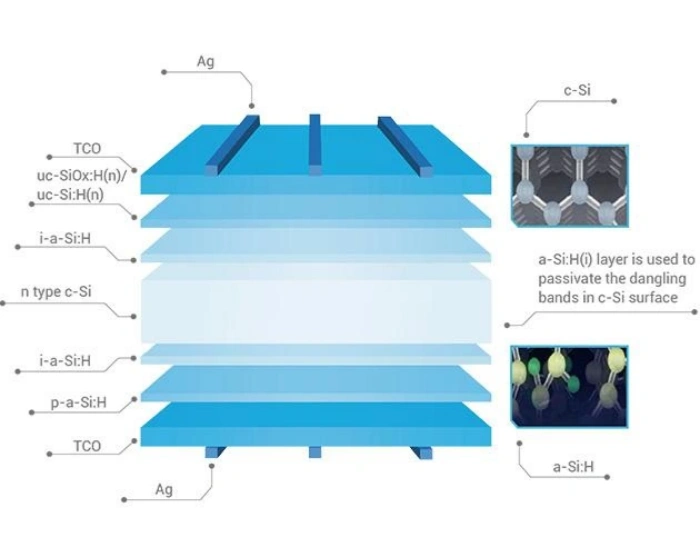
In real-world conditions, HJT modules demonstrate strong low-light response and excellent thermal stability. Fraunhofer ISE testing indicates that HJT maintains more consistent performance under variable irradiance conditions, particularly in cloudy and humid climates.
The technology also benefits from very low degradation rates over long-term operation, contributing to higher lifetime energy yield.
However, the complexity of the HJT solar cell manufacturing process results in higher production costs, positioning HJT firmly within the premium efficiency segment of the market.
TOPCon: The Mainstream N-Type Standard
TOPCon solar panels have rapidly become the dominant N-type technology globally due to their compatibility with upgraded PERC production infrastructure and their strong balance between efficiency and cost performance.
By introducing a tunnel oxide layer and doped polysilicon rear contact, the TOPCon solar cell enhances carrier selectivity while maintaining scalable industrial manufacturing capability.
According to ITRPV forecasts, TOPCon is expected to remain the leading N-type technology in global production capacity through at least 2030, making it the mainstream choice for residential and commercial PV deployment.
Fraunhofer ISE reliability assessments confirm stable long-term field performance, with degradation rates aligned with standard 25–30 year warranty expectations.
HJT vs TOPCon: Core Technology Differentiation
In any advanced solar panel comparison, HJT and TOPCon stand out as the two most important N-type technologies shaping the future of the photovoltaic industry. While both technologies deliver higher efficiency and lower degradation than conventional PERC products, their differentiation lies primarily in device architecture and carrier transport mechanisms.
HJT employs a heterojunction structure combining crystalline silicon with amorphous silicon passivation layers, significantly reducing surface recombination losses and improving temperature performance.
TOPCon, by contrast, utilizes a tunnel oxide and doped polysilicon contact layer to improve electron selectivity and carrier collection efficiency while maintaining compatibility with mass production lines.
From a technical standpoint, HJT typically delivers stronger low-light response and superior thermal stability, whereas TOPCon offers a more balanced performance profile optimized for scalable deployment and industrial cost efficiency.
Cost Structure: Scale and Manufacturing Advantage
The divergence between HJT and TOPCon becomes most visible at the manufacturing level.
VI. Cost Structure
HJT requires advanced deposition processes and tighter production control, resulting in higher CAPEX and limited cost reduction potential at scale.
TOPCon benefits from compatibility with existing PERC production upgrades, enabling rapid capacity expansion and significantly lower cost per watt.
Industry projections from ITRPV consistently indicate that TOPCon' s structural cost advantage will remain a key driver of its dominance through the late 2020s.
Yield and Return Analysis: Lifecycle Performance and Financial Impact
Beyond module efficiency, long-term system economics play a decisive role in technology selection.
HJT systems typically deliver slightly higher cumulative energy output over a 25–30 year lifecycle, driven by improved low-light response and lower temperature coefficients. These advantages are particularly relevant in high-humidity and low-irradiance regions where environmental variability is significant.
TOPCon systems, however, tend to outperform in financial return metrics under standard residential and commercial conditions. Lower upfront investment combined with competitive efficiency levels results in faster payback periods and improved short-term cash flow performance.
Lifecycle Yield & ROI Comparison
📈 Key Performance Indicators
🕒 25-Year Lifecycle Timeline
Total Output: 31 MWh
Total Output: 28 MWh
📊 Core Data Comparison
📍 Best Fit Applications
🏭 HJT Recommended Scenarios
🏠 TOPCon Recommended Scenarios
☆ Advantages Summary
⚡ Why HJT
💲 Why TOPCon
💡 Industry Key Takeaway
HJT maximizes long-term energy yield, while TOPCon delivers faster capital return. Final selection depends on local climate, investment timeline and project financial goals.
📄 Authoritative Data Sources
- Fraunhofer Institute for Solar Energy Systems ISE – Annual PV Technology Benchmark Report 2025
- International Renewable Energy Agency (IRENA) – PV System LCOE & Lifecycle Financial Model Database
- Sunpal N-Type Module 25-Year Outdoor Degradation Lab Accelerated Test Data
- PV Magazine Global N-Type Cell Performance & Cost Tracking Research
- US Department of Energy Solar Energy Technologies Office – Bifacial PV Gain Simulation Whitepaper
- Global solar manufacturer mass production CAPEX & supply chain cost survey 2025
From a project finance perspective, the distinction between the two technologies is increasingly defined by capital efficiency, investment timing, and lifecycle return structure rather than absolute energy yield.
Clear Market Segmentation
Field deployment patterns show a clear segmentation between HJT and TOPCon across global PV markets.
In Northern Europe, TOPCon dominates residential rooftop installations due to its cost-effectiveness and strong performance under diffuse and cloudy conditions, thereby supporting stable self-consumption-oriented system designs.
HJT is more frequently deployed in premium or space-constrained applications, where maximizing energy density per square meter is critical. In regions such as Southern Germany, HJT systems demonstrate measurable advantages in constrained rooftop environments.
Across the industry, manufacturers such as Sunpal reflect this dual-technology strategy, with TOPCon targeting mainstream residential and commercial markets, while HJT is positioned for high-efficiency, space-optimized applications.
Selecting the Optimal Technology
The selection between HJT and TOPCon is increasingly driven by project-specific constraints rather than pure technological preference.
7-Dimension Tech Selection Radar
Selection factors: installation area, investment budget & power generation targets.
Roof Space
Investment Cost
Weak Light
Temp Coefficient
Attenuation
Bifacial Gain
Maturity
HJT is typically recommended where rooftop space is limited and maximizing energy density is a priority, particularly in regions with variable irradiance conditions.
TOPCon remains the preferred solution for standard residential and commercial systems where cost efficiency, predictable payback periods, and scalable system design are primary considerations.
In practical engineering terms, decisions are generally based on three core factors: available installation area, investment structure, and long-term energy consumption goals.
Market Outlook: Dual-Track Technology Structure
According to long-term industry projections, TOPCon is expected to maintain dominance in global N-type production capacity through at least 2030, supported by strong manufacturing scalability and cost competitiveness.
Meanwhile, HJT is expected to expand steadily within premium market segments, particularly in regions with high electricity prices and constrained rooftop space, where incremental efficiency gains have greater economic value.
Beyond 2030, emerging technologies such as back-contact and tandem perovskite architectures may begin reshaping the competitive landscape, although N-type silicon technologies are expected to remain the backbone of global PV deployment in the medium term.
Conclusion
HJT and TOPCon are two differentiated N-type technology routes rather than direct competitors.
HJT focuses on high energy yield for space-constrained applications, while TOPCon serves as the cost-efficient mainstream standard for large-scale deployment.
The choice for EPCs, system designers, and homeowners should be based on site conditions, investment structure, and long-term energy performance objectives.
For full product coverage and system solutions, visit Sunpal.
At Sunpal, we translate advanced PV technologies into reliable, performance-driven solar systems—supporting projects that prioritize both stable returns and long-term energy value across residential and commercial applications.