


Dans la course actuelle aux pratiques commerciales durables, les petites entreprises — des fermes isolées aux éco-lodges, en passant par les ateliers mobiles et les bureaux de terrain — se tournent vers des systèmes d'énergie renouvelable efficaces pour réduire les coûts et renforcer leur indépendance. Oubliez les grands panneaux ; les systèmes solaires compacts d'environ 500 watts prouvent que des installations optimisées peuvent fournir une alimentation fiable pour les opérations essentielles sans se ruiner. Ces kits solaires de faible puissance permettent aux entreprises d'alimenter des appareils critiques tels que les outils de communication, l'éclairage et les appareils électroménagers de base dans des endroits hors réseau, favorisant ainsi des opérations respectueuses de l'environnement malgré la hausse des frais d'électricité.
Les applications concrètes démontrent que Les solutions solaires hors réseau de 500 watts génèrent 2-3 kWh par jour en cas d'ensoleillement modéré, suffisant pour les besoins minimalistes. Chez Sunpal, nous avons équipé de nombreux clients avec ces installations efficaces pour les vans, les cabanes et les sites isolés, en mettant l'accent sur une gestion intelligente de l'énergie plutôt que sur une capacité excessive. Ce guide explore les configurations viables de 500 watts, les composants essentiels et les stratégies d'optimisation adaptées à la résilience des entreprises en 2026.
Vérification de faisabilité : 500 watts peuvent-ils soutenir les besoins d'une entreprise hors réseau ?
Évaluer la praticité des systèmes d'énergie solaire compacts commence par comprendre les rendements énergétiques. Une installation de 500 watts produit généralement 1,5 à 2,5 kWh par jour, en fonction de l'emplacement et des conditions. Dans les régions ensoleillées comme l'Arizona ou la Californie, attendez-vous à environ 2 à 2,5 kWh par jour, tandis que les régions du nord pourraient en produire 1 à 1,5 kWh..Ce résultat prend en charge les besoins essentiels de l'entreprise : éclairage de travail à LED (50-100 Wh/jour), stations de recharge d'appareils (100-300 Wh/jour), réfrigération compacte pour les fournitures (500-1 000 Wh/jour) et systèmes de ventilation (200-400 Wh/jour).
Les informations de la communauté révèlent des succès, comme de petites fermes utilisant des panneaux de 500 watts pour re.
Pour visualiser les variations régionales, considérez cette analyse de données sur les heures d'ensoleillement maximal :
| Région | Heures d'ensoleillement maximal moyen par jour | Production journalière estimée (système 500W, kWh) |
| Sud-Ouest (par exemple, AZ, NV) | 6-8 | 2.5-3.5 |
| Centre des États-Unis. | 4-5 | 1.8-2.3 |
| Nord-Est/Nord-Ouest Pacifique | 2-4 | 1.0-1.8 |
| Zones équatoriales (Réf. mondiale) | 5-6 | 2.0-2.8 |
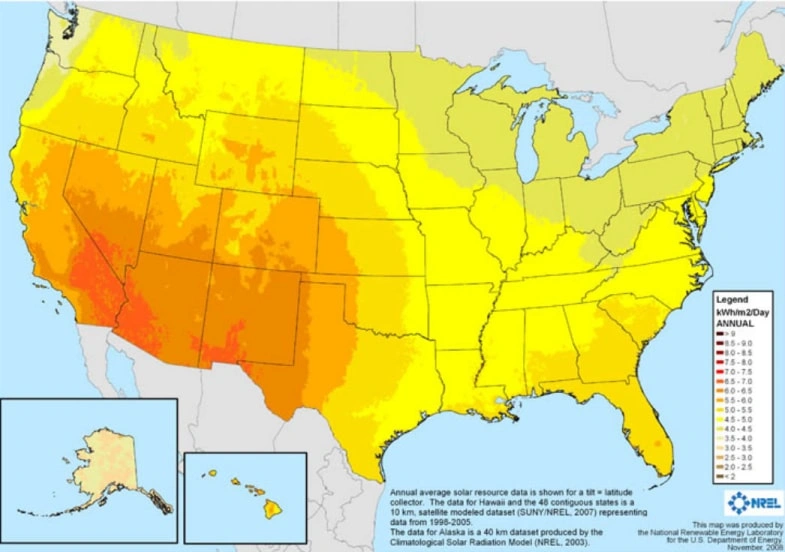
Ce tableau, issu de données sur le rayonnement solaire, met en évidence l'impact de la localisation sur l'efficacité. Les entreprises situées dans des zones à fort ensoleillement obtiennent un retour sur investissement plus élevé grâce à une plus grande autonomie.
Pour une vue graphique, voici une carte des heures d'ensoleillement du soleil illustrant les moyennes annuelles aux États-Unis :
L'optimisation de ces facteurs garantit que les systèmes de 500 watts délivrent une puissance constante, ce qui les rend idéaux pour des stratégies énergétiques d'entreprise durables.
Éléments clés pour des kits solaires hors réseau efficaces de 500W
La création d'un système d'énergie solaire compact et robuste nécessite la sélection de composants qui maximisent l'efficacité dans des espaces limités. Voici une décomposition adaptée aux applications professionnelles telles que les stations de surveillance à distance ou les unités mobiles.
1. Panneaux solaires à haut rendement (capacité totale de 400-600W)
Optez pour des modules monocristallins dotés d'un rendement de 21%+ pour des performances optimales en cas de faible luminosité. Des configurations telles que deux panneaux 250W ou trois unités 170W s'adaptent aux toits étroits ou aux supports mobiles, pour un coût estimé entre 1 400 et 600 euros en 2026.
2. Contrôleur de charge avancé
Un régulateur MPPT (20-40 A) permet d'augmenter le rendement de 20 à 30 %, ce qui est indispensable en cas de conditions météorologiques variables. Prévoyez un budget de 120 à 400 € pour des modèles fiables.
3. Stockage fiable de la batterie
Les batteries LiFePO4 (200 à 400 Ah en 12 V ou 100 à 200 Ah en 24 V) offrent une capacité utile de 2,4 à 4,8 kWh, assurant ainsi une autonomie de 1 à 3 jours. Leur prix varie entre 1 400 et 1 200 euros par unité, ce qui en fait un choix plus durable que les alternatives au plomb-acide.
4. Onduleur compact
Un modèle à onde sinusoïdale pure de 500 à 1 500 W gère efficacement les charges CA ; les installations entièrement CC ne l'utilisent pas pour optimiser les économies. Comptez sur un modèle $200-700.
5. Modules complémentaires de soutien
Comprend des convertisseurs CC, des systèmes de gestion de batterie (BMS) et des outils de surveillance via application pour un suivi en temps réel, avec l'ajout du modèle $100-300.
Cette infographie présente un flux typique pour les composants solaires hors réseau :
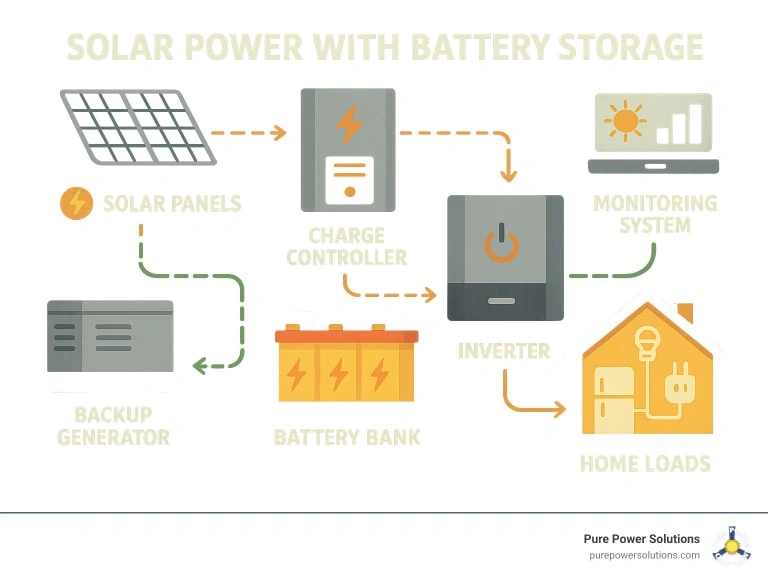
La gamme de pièces durables et à haut rendement de Sunpal garantit que ces installations résistent aux exigences commerciales dans des environnements éloignés.
Configurations pratiques de 500W pour l'énergie des entreprises durables
Pour les entreprises à la recherche de solutions solaires hors réseau, voici des configurations personnalisées avec des estimations de prix pour 2026, basées sur des installations réelles telles que des systèmes de garage ou des réseaux de chalets.
- Kit mobile de base ($800-1,500) : Deux panneaux de 250W + contrôleur MPPT 20A + batterie LiFePO4 200Ah + onduleur 1000W. Idéal pour les fourgonnettes aménagées ou les ateliers, pour alimenter des outils et des communications.
- Configuration opérationnelle améliorée ($1,500-3,000) : Panneaux de 500-600W + MPPT de 30-40A + stockage lithium de 300-400Ah + onduleur de 1 500W. Prend en charge le réfrigérateur et les appareils quotidiens pour les petits bureaux à distance.
- Système de Ferme/Cabane Robuste : Intégrer la surveillance et les sauvegardes hybrides pour une utilisation prolongée, en s'adaptant aux besoins de l'entreprise.
L'analyse des données de coûts montre des répartitions :
| Composant | Gamme budgétaire (2026) | 1 % du coût total |
| Panneaux | $300-600 | 20-30% |
| Contrôleur | $120-400 | 10-15% |
| Batterie | $500-1,200 | 30-40% |
| Onduleur | $200-700 | 15-20% |
| Compléments/Câblage | $100-500 | 10-15% |
Ces chiffres correspondent aux tendances du marché, où les kits hors réseau coûtent en moyenne entre 1 et 4,7 euros par watt installé. Sunpal adapte ces solutions à vos besoins : contactez-nous pour obtenir un devis sur mesure.
Tactiques d'optimisation pour les systèmes solaires à faible puissance
Pour que votre installation d'énergies renouvelables prospère, concentrez-vous sur l'efficacité :
- Surveillez la consommation à l'aide d'outils comme des wattmètres pour réduire le gaspillage.
- Privilégiez les équipements alimentés en courant continu pour minimiser les pertes de conversion.
- Autonomie de batterie de 2 à 4 jours pour les périodes nuageuses.
- Positionnez les panneaux face au sud avec des inclinaisons saisonnières pour une capture optimale.
- Adaptez-vous saisonnièrement : économisez davantage pendant les mois où le soleil est faible.
Les entreprises bénéficient des intégrations hybrides, comme les batteries de secours au propane pour les tâches à forte demande. Une maintenance régulière prolonge la durée de vie des systèmes, augmentant le retour sur investissement.
Perspectives finales : Réaliser des économies grâce à l'énergie solaire compacte
Les kits solaires autonomes compacts de 500 watts incarnent l'énergie durable pour les entreprises, offrant une indépendance vis-à-vis du réseau et des fluctuations de coûts. Ces systèmes favorisent la résilience, réduisent la dépendance vis-à-vis des services publics tout en s'alignant sur les objectifs écologiques. Avec un retour sur investissement en 6 à 8 ans et des économies pouvant atteindre 144 000 TPL, leur intérêt est évident. Chez Sunpal, nos panneaux solaires, régulateurs et batteries efficaces donnent un coup de pouce à vos projets. Découvrez les solutions d'énergie renouvelable de Sunpal. Obtenez une consultation gratuite.