


Sind 700W+-Solarpanels die Zukunft von Solargroßprojekten?
Jahrelang konkurrierten Hersteller von Solarmodulen durch die stetige Steigerung des Modulwirkungsgrads und der Ausgangsleistung. Heute ist dieser Wettbewerb in eine neue Phase eingetreten. Hochleistungs-Solarmodule mit Nennleistungen von 700 W und mehr sind keine Versuchsprodukte mehr – sie entwickeln sich zu einer praktischen Wahl für Solarparks im Kraftwerksmaßstab, gewerbliche Dachanlagen und andere Projekte, bei denen die Maximierung des Energieertrags bei gleichzeitiger Senkung der Installationskosten von entscheidender Bedeutung ist.
Der Übergang wird durch mehrere Markttrends vorangetrieben. Steigende Grundstückspreise, höhere Arbeitskosten und der Druck, die Stromgestehungskosten (LCOE) zu senken, haben Entwickler ermutigt, größere, effizientere Module zu suchen. Gleichzeitig haben Fortschritte bei den N-Typ-TOPCon- und HJT-Technologien (Heterojunction) es den Herstellern ermöglicht, höhere Ausgangsleistungen zu erzielen, ohne Kompromisse bei der langfristigen Zuverlässigkeit einzugehen.
Verglichen mit herkömmlichen 550-W- oder 600-W-Modulen können 700W+-Solarmodule die Gesamtzahl der für ein Projekt erforderlichen Module reduzieren, die Installation vereinfachen und die Systemkosten (BOS) senken. Diese Vorteile machen sie für EPC-Auftragnehmer, Händler und Investoren, die große Gewerbe- und Freiflächenanlagen planen, zunehmend attraktiv.
In diesem Leitfaden erklären wir, wie Solarmodule mit 700 W+ ihre höhere Leistung erzielen, vergleichen die neuesten N-Typ-TOPCon- und HJT-Technologien, untersuchen typische Spezifikationen von 700-W-Solarmodulen und besprechen, wie Sie das richtige Modul für Ihr nächstes Projekt auswählen.
Warum werden 700W+ Solarmodule zum neuen Industriestandard?
Die Photovoltaikindustrie hat im vergangenen Jahrzehnt bemerkenswerte technologische Fortschritte verzeichnet. Modulleistungsbewertungen, die einst im Durchschnitt 250 W sind stetig auf 400 W und 550 W gestiegen und übersteigen bei Premiumprodukten nun 700 W..
Diese Entwicklung dreht sich nicht nur darum, größere Module herzustellen – sie spiegelt Verbesserungen in mehreren Bereichen des Solarzellendesigns, der Herstellungsprozesse und der Systemoptimierung wider.
Heutige 700W-Solarmodule kombinieren typischerweise mehrere fortschrittliche Technologien, darunter:
- Großformatige Siliziumwafer
- Hochdichte Zellvernetzung
- Multi-Busbar-Designs
- Halbzellen-Architektur
- bifaziale Glas-Glas-Konstruktion
- N-Typ-Solarzellen
- Fortschrittliche Verkapselungsmaterialien
Gemeinsam ermöglichen diese Innovationen Herstellern, die Moduleffizienz zu steigern und gleichzeitig eine hervorragende mechanische Festigkeit und langfristige Haltbarkeit aufrechtzuerhalten.
Für Projektentwickler gehen die Vorteile über eine höhere Wattzahl hinaus.
Die Installation weniger leistungsstarker Module kann erheblich reduzieren:
- Montagestrukturen
- Kabellänge
- DC-Kombinatorboxen
- Installationsarbeit
- Transport- und Logistikkosten
- Gesamte BOS-Ausgaben
Diese Einsparungen gewinnen zunehmend an Bedeutung, wenn die Projektkapazitäten von mehreren Megawatt auf Hunderte von Megawatt steigen.
Entwicklung der Leistung kommerzieller Solarzellen (2018–2025)
Von P-Typ PERC-Modulen zu leistungsstarken N-Typ TOPCon- & HJT-Technologien
Brancheneinfluss: Höhere Modulleistungen ermöglichen eine größere Energiedichte und geringere Systemkosten (BOS) für gewerbliche und großtechnische Solaranlagen.
Jenseits höherer Wattzahlen: Warum die Leistungsdichte wichtig ist
Viele Käufer gehen davon aus, dass die Auswahl das Modul mit der höchsten Wattzahl garantiert automatisch die beste Projektleistung. In der Realität bewerten erfahrene Solarfachleute mehrere Faktoren gemeinsam.
Die Leistungsdichte – die Menge an Strom, die pro Einheit der Installationsfläche erzeugt wird – ist oft wichtiger als die Nennleistung des Moduls allein.
Eine höhere Leistungsdichte ermöglicht es Projektbesitzern,:
- Mehr Strom aus begrenzter Dachfläche erzeugen
- Jahresenergieproduktion steigern
- Kapitalrendite verbessern
- Senkung der Stromgestehungskosten über die Lebensdauer des Systems
Für gewerbliche Dächer, bei denen die verfügbare Installationsfläche begrenzt ist, kann die Maximierung der Leistungsdichte die Gesamtsystemkapazität erheblich steigern, ohne die Grundfläche zu vergrößern.
Bei Projekten im Kraftwerksmaßstab bedeuten weniger Module auch weniger Montagekomponenten und eine kürzere Installationszeit, was EPC-Unternehmen hilft, Projekte effizienter abzuschließen.
Verständnis der technischen Daten von 700W-Solarpanelen
Beim Vergleich verschiedener Hersteller sollten Käufer über die beworbene Nennleistung hinausblicken. Der zuverlässigste Weg zur Bewertung eines Moduls besteht darin, die vollständigen technischen Daten zu prüfen.
Zu den wichtigsten Parametern gehören:
| Spezifikation | Warum es wichtig ist |
| Nennleistung (Pmax) | Maximale Leistung unter Standardtestbedingungen (STC). |
| Modulwirkungsgrad | Gibt an, wie effektiv Sonnenlicht in Strom umgewandelt wird. Eine höhere Effizienz verbessert die Energiedichte. |
| Zelltechnologie | N-Typ TOPCon, HJT oder andere fortschrittliche Technologien beeinflussen Leistung und Degeneration. |
| Leerlaufspannung (Voc) | Wichtig für Systemdesign und Wechselrichterkompatibilität. |
| Kurzschlussstrom (Isc) | Dies beeinflusst die Strangdimensionierung und die elektrische Auslegung. |
| Temperatur-Koeffizient | Bestimmt, wie stark die Leistung bei steigenden Betriebstemperaturen abnimmt. Niedrigere Werte sind zu bevorzugen. |
| Bifazialer Faktor | Gibt die Fähigkeit des Moduls an, zusätzlichen Strom aus reflektiertem Licht zu erzeugen. |
| Mechanische Belastbarkeit | Misst die Widerstandsfähigkeit gegen Wind, Schnee und andere Umwelteinflüsse. |
| Produktgarantie | Spiegelt die Fertigungsqualität und Zuverlässigkeit wider. |
| Leistungsgarantie | Garantiert eine langfristige Leistungsabgabe über die gesamte Lebensdauer des Moduls. |
Anstatt sich auf eine einzige Spezifikation zu konzentrieren, vergleichen erfahrene Käufer diese Eigenschaften gemeinsam, um den Gesamtwert des Moduls zu bestimmen.
Was macht ein hochwertiges 700W Solarmodul aus?
Da immer mehr Hersteller Solarmodule mit über 700 W auf den Markt bringen, kann die Produktqualität erheblich variieren.
Ein Premium-Hochleistungsmodul sollte hohe Effizienz mit langfristiger Zuverlässigkeit verbinden. Mehrere Merkmale verdienen besondere Aufmerksamkeit:
Advanced Cell Technology
Die meisten führenden Module verwenden mittlerweile N-Typ-Solarzellen, die im Vergleich zu herkömmlichen P-Typ-Designs im Allgemeinen eine geringere Degradation, ein verbessertes Temperaturverhalten und einen höheren Energieertrag bieten.
Bifaziale Energieerzeugung
Viele 700W-Module verfügen über eine bifaziale Glas-Glas-Konstruktion, die es der Rückseite des Panels ermöglicht, reflektiertes Sonnenlicht von Oberflächen wie Beton, Sand oder Schnee einzufangen. Je nach Installationsbedingungen kann dies zu signifikanten Ertragssteigerungen bei der Gesamtenergieproduktion führen.
Niedrigtemperaturverluste
Solarmodule verlieren mit steigen Temperaturen natürlicherweise an Wirkungsgrad. Module mit einem niedrigeren Temperaturkoeffizienten behalten in heißen Klimazonen eine stärkere Leistung bei, wodurch sie sich gut für Regionen mit intensiver Sonneneinstrahlung eignen.
Langfristige Verlässlichkeit
Hochwertige Hersteller unterstützen ihre Produkte mit erweiterten Produkt- und Leistungsgarantien, was das Vertrauen in die Langlebigkeit der Module über Jahrzehnte des Betriebs demonstriert. Merkmale wie robuste Verkapselungsmaterialien, fortschrittliche Zellverbindungen und strenge Qualitätskontrollen tragen zudem zu einer langen Lebensdauer bei.
Für Käufer, die die Spezifikationen von 700-W-Solarmodulen bewerten, bietet die Berücksichtigung dieser Leistungskennzahlen neben der Wattzahl ein vollständigeres Bild des langfristigen Wertes.
Was unterscheidet N-Typ-Solarzellen von P-Typ?
Mehr als ein Jahrzehnt lang dominierte die P-Type-PERC-Technologie dank ihres ausgereiften Herstellungsprozesses und wettbewerbsfähiger Preise den globalen Photovoltaikmarkt. Da jedoch die Nachfrage nach höherer Effizienz und geringeren Stromgestehungskosten über die Lebensdauer gestiegen ist, hat sich die Branche rasant hin zu N-Type-Solarzellentechnologien verlagert, insbesondere zu TOPCon und HJT (Heterojunction).
Der Schritt ist kein einfacher Marketing-Trend. N-Typ-Zellen überwinden mehrere physikalische Einschränkungen herkömmlicher P-Typ-Siliziumzellen, sodass Hersteller Hocheffizienz-Solarmodule mit einem höheren langfristigen Energieertrag und einer verbesserten Langlebigkeit produzieren können.
Warum wechselt die Industrie zu N-Typ?
Im Gegensatz zu P-Typ-Zellen verwendet N-Typ-Silizium Phosphor als Hauptdotiermittel, wodurch es weniger anfällig für lichtinduzierte Degradation (LID) ist. Infolgedessen behalten N-Typ-Module während ihrer gesamten Lebensdauer einen höheren Prozentsatz ihrer ursprünglichen Leistung bei.
Zu den weiteren Vorteilen gehören:
- Niedrigere jährliche Degradationsraten
- Bessere Leistung bei schlechten Lichtverhältnissen am Morgen, am Abend und bei bewölktem Himmel
- Verbessertes Temperaturverhalten in heißen Klimazonen
- Höhere Umwandlungseffizienz
- Bessere Kompatibilität mit bifacialen Moduldesigns
Für gewerbliche und großtechnische Projekte, die auf einen Betrieb von 25 bis 30 Jahren ausgelegt sind, können diese Leistungsverbesserungen zu einem deutlich höheren Energieertrag über die gesamte Lebensdauer führen.
Von PERC zu TOPCon und HJT
Die Technologie-Roadmap der Branche hat sich rasant entwickelt:
| Technologie | Typische Modulleistung | Marktposition |
| P-Typ-PERC | 20–22% | Ausgereifte Technologie, allmählich schrumpfender Marktanteil |
| N-Typ TOPCon | 22–24%+ | Mainstream-Hocheffizienzlösung |
| N-Typ HJT | 23–25%+ | Erstklassige, hochleistungsfähige Lösung |
| BC- & Tandemzellen | 25%+ (im Aufbau) | Technologien der nächsten Generation in der Entwicklung |
Anstatt PERC über Nacht zu ersetzen, entwickeln sich TOPCon und HJT schrittweise zu den bevorzugten Optionen für Projekte, bei denen langfristige Leistung und Energieertrag die Investition rechtfertigen.
Entwicklung der Solarzellentechnologien (2016–2026)
Von PERC zu TOPCon, HJT, BC und Solarzellen der nächsten Generation im Tandem
P-Typ-PERC
Die Passivierungstechnologie der Rückseite verbesserte den Wirkungsgrad und ersetzte herkömmliche BSF-Zellen.
Fortschrittliche PERC
Große Wafer, halbiert geschnittene Zellen und Multi-Busbar-Technologie trieben kommerzielle Module über 500 W hinaus.
N-Typ TOPCon
Die Tunneloxid-passivierte-Kontakt-Technologie wurde zum Standardersatz für PERC.
N-Typ HJT
Hybride Siliziumtechnologie bietet eine höhere Effizienz und eine bessere Temperaturleistung.
Rückseitige Kontaktierung
Die Rückseitenkontakt-Architektur reduziert Abschattungsverluste und erhöht die Energiedichte.
Perowskit-Silizium-Tandem
Tandemstrukturen kombinieren mehrere Absorberschichten, um traditionelle Siliziumgrenzen zu überwinden.
N-Type TOPCon vs. HJT Solarpanels: Was ist der Unterschied?
Eine der heute am häufigsten gestellten Fragen unter Käufern ist ob N-Typ-TOPCon- oder HJT-Solarmodule die bessere Investition bieten.
Die Antwort hängt von den Projektprioritäten ab. Beide Technologien stellen bedeutende Verbesserungen gegenüber herkömmlichen PERC-Modulen dar, weisen jedoch jeweils einzigartige Stärken auf.
Fertigungstechnik
TOPCon Solarmodule
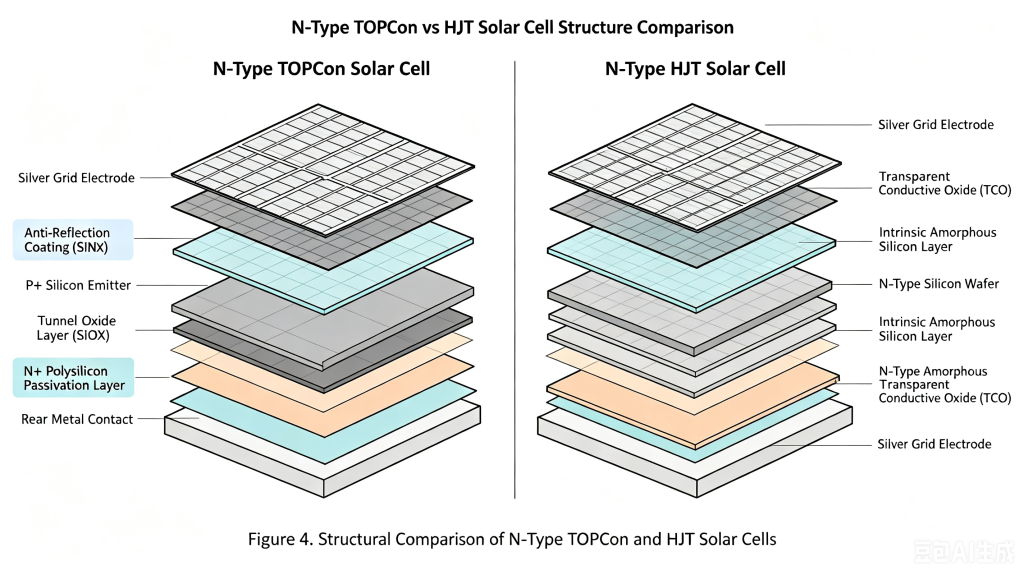
TOPCon steht für Tunnel Oxide Passivated Contact.
Es verbessert herkömmliche kristalline Siliziumzellen, indem es auf der Rückseite der Zelle eine ultradünne Tunneloxidschicht und eine dotierte Polysilizium-Passivierungsschicht hinzufügt. Diese Struktur reduziert die Ladungsträgerrekombination, sodass mehr Elektronen zur Stromerzeugung beitragen können.
Ein Grund für die weit verbreitete Einführung von TOPCon ist, dass Hersteller viele bestehende PERC-Produktionslinien aufrüsten können, anstatt völlig neue Fabriken zu bauen. Dies trägt dazu bei, die Herstellungskosten zu senken und gleichzeitig die Produktionskapazität zu erhöhen.
Heute hat sich TOPCon zu einer der am weitesten verbreiteten N-Typ-Technologien in der globalen Solarindustrie entwickelt.
HJT-Solarpanels
HJT oder die Heteroübergangstechnologie kombiniert kristalline Siliziumwafer mit ultradünnen Schichten aus amorphem Silizium.
Diese hybride Zellstruktur bietet mehrere Leistungsvorteile:
- Höhere Umwandlungseffizienz
- Niedrigerer Temperaturkoeffizient
- Bessere bifaciale Energiegewinnung
- Verringerte Degradation
- Hervorragende Leistung bei schlechten Lichtverhältnissen
Da die HJT-Herstellung andere Ausrüstungen und Produktionsprozesse erfordert, sind die Investitionskosten im Allgemeinen höher als bei TOPCon. Viele Hersteller weiten die HJT-Produktion jedoch aufgrund ihres langfristigen Effizienzpotenzials weiter aus.
Leistungsvergleich
Die folgende Tabelle fasst die Hauptunterschiede zwischen den beiden Technologien zusammen.
| Merkmal | N-Typ TOPCon | N-Typ HJT |
| Zellwirkungsgrad | Ausgezeichnet | Hervorragend |
| Modulwirkungsgrad | Hoch | Sehr hoch |
| Temperaturverhalten | Sehr gut | Ausgezeichnet |
| Schwachlichtleistung | Sehr gut | Ausgezeichnet |
| Bifazialer Gewinn | Hoch | Sehr hoch |
| Jährliche Degradation | Niedrig | Sehr niedrig |
| Herstellungskosten | Herunter | Höher |
| Produktionsreife | Sehr reif | Rasant wachsend |
| Typische Anwendungen | Gewerbe, Versorgung | Premium-Gewerbe-, Versorgungs- und Hochtemperaturprojekte |
Obwohl HJT im Allgemeinen bei der technischen Leistung führend ist, bietet TOPCon ein attraktives Gleichgewicht zwischen Effizienz, Fertigungsreife und Kosten, was es zu einer beliebten Wahl für viele Großanlagen macht.
Die Temperaturleistung ist wichtiger, als viele Käufer erkennen
Solarpanels arbeiten selten unter Laborbedingungen.
An sonnigen Sommernachmittagen können die Modulkupplungstemperaturen 60 °C (140 °F) überschreiten, was zu einer Abnahme der Ausgangsleistung führt. Aus diesem Grund ist der Temperaturkoeffizient eine wichtige Angabe.
HJT-Module weisen typischerweise einen niedrigeren Temperaturkoeffizienten als TOPCon-Module auf, was bedeutet, dass sie bei steigernden Temperaturen weniger Leistung verlieren.
Diese Eigenschaft macht HJT besonders attraktiv für Projekte in:
- Nahöstliche Wüsten
- Australien
- Südeuropa
- Lateinamerika
- Südostasien
- Afrika
Über Jahrzehnte des Betriebs hinweg kann eine verbesserte Temperaturleistung die Gesamtenergieproduktion erheblich steigern.
Bifaciale Leistung
Ein weiterer wichtiger Vorteil beider Technologien ist ihre Kompatibilität mit bifazialen Moduldesigns.
Im Gegensatz zu herkömmlichen einseitigen Modulen erzeugen bifaziale Solarmodule Strom sowohl über die Vorder- als auch über die Rückseite.
Je nach Bodenreflexionsvermögen (Albedo), Installationshöhe und Montagekonfiguration kann durch reflektiertes Sonnenlicht zusätzliche Energieerzeugung erzielt werden.
Häufige Installationsumgebungen sind:
- Weißer Kies
- Wüstensand
- Schneebedeckte Regionen
- Betonoberflächen
- Schwimmende Solaranlagen
Da HJT-Zellen typischerweise einen höheren Bifazialitätsfaktor aufweisen, erzielen sie unter günstigen Bedingungen häufig höhere Energieerträge auf der Rückseite.
Geschätzter Energieertrag unter verschiedenen Betriebsbedingungen
Vergleich des relativen jährlichen Energieertrags: PERC vs. N-Typ TOPCon vs. HJT
Standardreferenz
Geringere Degradation
& Bifaziale Leistung
Mäßige Temperatur
Konventionelle Bestrahlung
PERC-Basiswert = 100%
Wüsten- und tropische Regionen
>60°C Modulbetrieb
HJT-Vorteil nimmt zu
Reflektierende Oberflächen
Wüste / Schnee / Dach
Höherer bifacialer Gewinn
Langzeitzuverlässigkeit und Degradation
Bei der Bewertung der technischen Daten von 700-Watt-Solarmodulen ist die anfängliche Ausgangsleistung nur ein Teil der Gleichung.
Ein Modul, das heute etwas mehr Strom erzeugt, aber über die nächsten 30 Jahre schneller degradiert, liefert über seine Lebensdauer möglicherweise weniger Energie als eine stabilere Alternative.
N-Typ-Technologien sind darauf ausgelegt, häufige Degradationsmechanismen zu minimieren, wie zum Beispiel:
- lichtinduzierte Degradation
- Degradation durch Licht und erhöhte Temperaturen (LeTID)
- Potentialinduzierte Degradation
Sowohl TOPCon als auch HJT übertreffen herkömmliche PERC-Module in diesen Bereichen im Allgemeinen.
Für Investoren, die die Stromgestehungskosten (LCOE) bewerten, hat langfristige Stabilität oft einen größeren finanziellen Einfluss als geringe Unterschiede in der Nennleistung.
Welche Technologie ist die richtige für Ihr Projekt?
Anstatt zu fragen, welche Technologie universell "besser" ist, sollten Käufer ermitteln, welche Lösung am besten zu ihren Projektzielen passt.
Wählen Sie TOPCon, wenn Sie Folgendes benötigen:
- Wettbewerbsfähige Anfangsinvestition
- Bewährte Fertigungsreife
- Großflächiger kommerzieller Einsatz
- Hervorragende Effizienz bei starkem Preis-Leistungs-Verhältnis
- Zuverlässige Lieferverfügbarkeit
TOPCon hat sich bei vielen gewerblichen und großen Freiflächenprojekten zur gängigen Option entwickelt, da es Leistung und Erschwinglichkeit in Einklang bringt.
Wählen Sie HJT, wenn Sie folgendes benötigen:
- Maximale Energieausbeute
- Höchste Effizienz
- Überlegene Hochtemperaturleistung
- Höherer bifacialer Gewinn
- Geringere Langzeitdegradation
- Projekte, bei denen die Maximierung der lebenslangen Stromerzeugung die höchste Priorität hat
HJT eignet sich besonders gut für großflächige Solarparks, Regionen mit hoher Sonneneinstrahlung und Installationen, bei denen jeder Prozentpunkt zusätzlicher Energieerzeugung zu einer verbesserten Projektwirtschaftlichkeit beiträgt.
Entscheidungshilfe
| Projekttyp | Empfohlene Technologie |
| Wohnhausdächer | TOPCon oder HJT (raumabhängig) |
| Gewerbliche Dächer | TOPCon |
| Industrieanlagen | TOPCon / HJT |
| Großflächige Solarparks | HJT oder Premium TOPCon |
| Wüstenanlagen | HJT |
| Schwimmende Solaranlagen | HJT |
| Umfgebungen mit hoher Albedo | HJT |
Die Wahl hängt letztendlich von Budget, Projektumfang, lokalem Klima, verfügbarer Installationsfläche, Finanzierungsanforderungen und der erwarteten Rendite ab.
Wo werden 700W+ Solarpanels am besten eingesetzt?
Die rasante Entwicklung von 700W+-Solarpanels verändert die Art und Weise, wie Solaranlagen projektiert werden. Eine höhere Modulleistung ist nicht nur vorteilhaft für die Steigerung der Stromerzeugung – sie verbessert auch die Wirtschaftlichkeit von Projekten, indem sie die Installationskomplexität verringert und die Gesamtsystemkosten senkt.
Bei großflächigen Solaranwendungen kann jedes zusätzliche Watt, das von einem einzigen Modul erzeugt wird, die Landnutzung, den Transportbedarf, die Arbeitseffizienz und die Stromgestehungskosten (LCOE) beeinflussen.
Heute werden Hochleistungsmodule auf Basis der N-Typ-TOPCon- und HJT-Technologie in zahlreichen Anwendungsbereichen zunehmend eingesetzt, darunter Solar-Großkraftwerke, Gewerbe- und Industriedächer, landwirtschaftliche PV-Projekte und Installationen mit begrenztem Platzangebot.
Anwendungen von 700W+ Solarpanelen in verschiedenen Solarprojekten
Freiflächen-Solarkraftwerke
Großprojekte gehören zu den größten Profiteuren von Solarmodulen mit hoher Leistung.
Große Solarparks erfordern typischerweise Tausende oder sogar Millionen von Modulen. Eine Erhöhung der Modulleistung von 550 W auf über 700 W bedeutet, dass weniger Paneele benötigt werden, um dieselbe installierte Leistung zu erreichen.
Zum Beispiel:
Ein 100-MW-Solarkraftwerk:
- Bei Verwendung von 550W-Modulen werden ungefähr 181.800 Module benötigt
- Die Verwendung von 750-W-Modulen erfordert etwa 133.300 Module
Diese Reduzierung kann vereinfachen:
- Modultransport
- Montagestruktur-Installation
- Gleichstromverkabelung
- Wartungsarbeiten
Für Energieversorger und Projektentwickler können diese Verbesserungen die Bauzeit erheblich verkürzen und die Rentabilität des Projekts steigern.
Gewerbliche und industrielle Solardächer
Gewerbliche Solaranlagen stehen im Vergleich zu Freiflächenanlagen vor einer anderen Herausforderung: begrenzter Installationsfläche.
Fabriken, Lagerhallen, Logistikzentren und Gewerbegebäude verfügen oft über große, aber begrenzte Dachflächen. Eine steigende Modulleistung ermöglicht es Unternehmen, mehr Kapazität zu installieren, ohne die verfügbare Grundfläche zu vergrößern.
Beispielsweise kann das Ersetzen herkömmlicher 450-W-Module durch 700W+-Module Unternehmen dabei helfen:
- Erhöhung der installierten Leistung pro Dachfläche
- Mehr erneuerbaren Strom erzeugen
- Abhängigkeit vom Stromnetz verringern
- Energiekosteneinsparungen verbessern
Dies macht Hochleistungs-Solarmodule besonders attraktiv für:
- Produktionsanlagen
- Rechenzentren
- Einkaufszentren
- Landwirtschaftliche Gebäude
- Gewerbeparks
Landwirtschaftliche und schwimmende Solaranwendungen
Agri-PV- und schwimmende Solaranlagen profitieren ebenfalls von hocheffizienten Modulen.
Agri-Photovoltaik
Agrivoltaikanlagen erfordern eine sorgfältige Landoptimierung, da die Stromerzeugung mit landwirtschaftlichen Aktivitäten koexistieren muss.
Leistungsstärkere Module können dazu beitragen, den Energieertrag zu maximieren und gleichzeitig den Platzbedarf der Solaranlage zu verringern.
Schwimmende Photovoltaik
Schwimmende Solaranlagen stehen vor einzigartigen Herausforderungen:
- Begrenzter verfügbarer Platz
- Höhere Installationskomplexität
- Umweltbelastung
Leistungsstarke bifaziale Module können die Projektleistung verbessern, indem sie sowohl direktes Sonnenlicht als auch von der Wasseroberfläche reflektiertes Licht einfangen.
Für diese Anwendungen sind HJT-Bifazial-Solarmodule aufgrund ihres starken Schwachlichtverhaltens und ihrer hohen Bifazialität besonders attraktiv.
Wie 700W+ Solarmodule die Gesamtsystemkosten senken
Ein weit verbreitetteter Irrglaube ist, dass leistungsstärkere Module nur die Stromerzeugung erhöhen. In Wirklichkeit senken sie auch mehrere versteckte Projektkosten.
Die Gesamtkosten einer Solaranlage beinhalten viel mehr als nur Module.
Es beinhaltet:
- Montagestrukturen
- Elektrische Komponenten
- Labor
- Transport
- Installationsmaterial
- Betrieb und Wartung
Aus diesem Grund bewerten professionelle Einkäufer Solarmodule anhand der Gesamtwirtschaftlichkeit des Systems und nicht nur nach dem Modulpreis.
1. Geringere Systemkosten (BOS)
Die Kosten für die Systemtechnik (Balance-of-System) umfassen alle Komponenten außerhalb der Solarmodule.
Leistungsstärkere Module senken die BOS-Kosten, da weniger Einheiten erforderlich sind.
Zu den potenziellen Einsparungen gehören:
- Weniger Montageschienen
- Weniger Klemmen
- Weniger Verkabelung
- Weniger Steckverbinder
- Reduzierter Installationsaufwand
Bei großen Projekten können diese Einsparungen einen erheblichen Prozentsatz der Gesamtinvestition ausmachen.
2. Verringerte Installationszeit
Großformatige Solarmodule ermöglichen es Installationsteams, Projekte schneller abzuschließen.
Weniger Module bedeuten:
- Weniger Hebetechnik
- Schnellere Modulplatzierung
- Geringerer Personalbedarf
Für EPC-Auftragnehmer, die unter strengen Projektfristen arbeiten, kann die Baueffizienz die Rentabilität direkt beeinflussen.
3. Verbesserte Landnutzung
Die Verfügbarkeit von Land wird in vielen Regionen zunehmend wichtiger.
Eine höhere Leistungsdichte ermöglicht es Entwicklern, mehr Strom aus derselben Fläche zu erzeugen.
Dies ist besonders wertvoll in:
- Europa, wo die Grundstückskosten hoch sind
- Inselregionen mit begrenztem Raum
- Industriegebiete mit Sperrgebieten
- Städtische Geschäftsumgebungen
Wie 700W+ Module sich verbessern
Wirtschaftlichkeit von Solarprojekten
Typische Verbesserungen im Vergleich zu herkömmlichen 550W-Großkraftwerksmodulen
| Vergleich | 550W-Modul | 730–750W-Modul |
|---|---|---|
| Typische Modulleistung | 550W | 730–750W |
| 100-MW-Projekt | ≈181.800 Module | ≈133.300–137.000 |
| Modulwirkungsgrad | 21–22% | 23–24.5% |
| Zelltechnologie | PERC / Frühe TOPCon | N-Typ TOPCon / HJT |
| Beste Anwendung | Kommerziell | Großgewerbe und Versorgungsunternehmen |
Wie man das richtige 700W Solarpanel für Ihr Projekt auswählt
Die Auswahl eines leistungsstarken Solarmoduls erfordert mehr als nur die Wahl der höchsten verfügbaren Wattzahl.
Professionelle Einkäufer sollten mehrere Faktoren bewerten.
1. Modulwirkungsgrad berücksichtigen
Ein 700-W-Modul mit höherem Wirkungsgrad kann auf begrenztem Installationsraum mehr Strom erzeugen.
Wichtige Faktoren sind unter anderem:
- Zelltechnologie
- Modulabmessungen
- Energieumwandlungseffizienz
Für gewerbliche Dächer und flächenbegrenzte Projekte ist Effizienz oft wichtiger als die absolute Wattzahl.
2. Klimabedingungen bewerten
Umweltbedingungen wirken sich direkt auf die Leistung von Solaranlagen aus.
Für heiße Regionen sollten Käufer Modulen den Vorzug geben mit:
- Niedrigerer Temperaturkoeffizient
- Starke thermische Leistung
- Hohe Zuverlässigkeit
Für Regionen mit Schnee, Sand oder stark reflektierenden Oberflächen können bifaziale Module zusätzliche Energieerträge liefern.
3. Überprüfung der Degradationsraten und der Garantie
Ein Solarprojekt ist eine langfristige Investition.
Beim Vergleich von Herstellern beachten Sie:
- Produktgarantiezeitraum
- Lineare Leistungsgarantie
- Jährliche Degradationsrate
- Zertifizierungsstandards
Premium-N-Typ-Module bieten im Vergleich zu älteren Technologien typischerweise eine stärkere Langzeit-Energieeffizienz.
4. Wählen Sie einen zuverlässigen Solarmodulhersteller
Das schnelle Wachstum von 700W+-Modulen bedeutet, dass Käufer mehr Auswahl haben als je zuvor.
Jedoch bieten nicht alle Hochleistungspanels dieselbe Qualität.
Ein zuverlässiger Hersteller sollte Folgendes bieten:
- Moderne Produktionsanlagen
- Strengste Qualitätskontrolle
- Internationale Zertifizierungen
- Stabile globale Lieferfähigkeit
- Technische Unterstützung für den Projektentwurf
Als professioneller Solarmodullieferant konzentriert sich Sunpal Solar auf die Entwicklung hocheffizienter N-Typ-Lösungen, einschließlich fortschrittlicher HJT-Module für gewerbliche und großtechnische Anwendungen.
Für Kunden, die nach maximaler Energieausbeute und langfristiger Leistung suchen, bietet Sunpal 730W - 750W HJT-Solarmodule Bieten Sie eine Hochleistungslösung, die fortschrittliche Zelltechnologie, hervorragendes Temperaturverhalten und zuverlässige Langlebigkeit kombiniert.
Häufig gestellte Fragen zu 700W+ Solarmodulen
F1. Was ist ein 700W-Solarmodul?
A: Ein 700-W-Solarmodul ist ein Hochleistungs-Photovoltaikmodul, das unter Standardtestbedingungen (STC) etwa 700 Watt Strom erzeugen kann. Diese Module verwenden typischerweise fortgeschrittene N-Typ-Technologien, großformatige Wafer und hocheffiziente Zelldesigns.
F2. Sind 700W Solarmodule besser als 600W Module?
A: In vielen groß angelegten Anwendungen ja. Leistungsstärkere Module können die Anzahl der benötigten Module reduzieren, die BOS-Kosten senken und die Installationseffizienz verbessern. Allerdings sollten auch Projektanforderungen wie der verfügbare Platz, die Kompatibilität des Wechselrichters und das Budget berücksichtigt werden.
Q3. Was sind typische Spezifikationen von 700W-Solarpanelen?
A: Typische Spezifikationen umfassen:
- Ausgangsleistung: 700W–750W
- Zelltechnologie: N-Type TOPCon oder HJT
- Wirkungsgrad: ca. 22%–25%
- Bifazialität: bei vielen Modellen verfügbar
- Glas-Glas-Konstruktion: üblich für Premiummodule
- Langzeit-Leistungsgarantie
F4. Ist HJT besser als TOPCon?
A: Beide Technologien bieten eine hervorragende Leistung. TOPCon bietet eine starke Effizienz bei ausgereifter Fertigung und wettbewerbsfähigen Kosten. HJT liefert im Allgemeinen einen höheren Wirkungsgrad, ein besseres Temperaturverhalten, einen höheren Bifazialitätsfaktor und eine geringere Degradation. Die beste Wahl hängt von den Projektanforderungen und den Investitionsprioritäten ab.
F5. Können 700-Watt-Solarmodule für Wohnsysteme verwendet werden?
A: Technisch gesehen ja, aber sie sind aufgrund ihrer Größe und ihres Gewichts primär für größere Projekte konzipiert.
Privatkunden sollten vor der Auswahl großformatiger Module die Dachabmessungen, die statische Belastbarkeit und die Kompatibilität des Wechselrichters berücksichtigen.
F6. Lohnt sich die Investition in bifaziale 700-Watt-Solarmodule?
A: Für Projekte mit reflektierenden Oberflächen oder optimierten Montagebedingungen können bifaziale Module zusätzliche Energieerzeugung ermöglichen und die Projektrendite verbessern.
Fazit: Die Zukunft von Hochleistungs-Solarmodulen
Die Solarindustrie tritt in eine neue Era ein, in der Modulleistung, Effizienz und Langzeitleistung immer wichtiger werden.
Das Aufkommen von 700W+-Solarmodulen stellt mehr als eine einfache Erhöhung der Wattzahl dar. Es spiegelt einen umfassenderen Trend hin zu einem smarteren Solarsystemdesign, geringeren Installationskosten und einer verbesserten langfristigen Energiewirtschaftlichkeit wider.
Unter den aktuellen fortgeschrittenen Technologien:
- N-Type TOPCon bietet eine hervorragende Balance zwischen Wirkungsgrad, Kosten und Fertigungsskalierbarkeit.
- HJT-Solarmodule bieten erstklassige Leistung mit hervorragenden Temperatureigenschaften, Bifazialität und langfristiger Zuverlässigkeit.
Für Unternehmen, Entwickler und Solarprofis, die zukünftige Projekte planen, kann die Wahl der richtigen Hochleistungsmodultechnologie die Systemleistung und die Investitionsrendite direkt beeinflussen.
Da die Nachfrage nach den leistungsstärksten Solarmodulen im Jahr 2025 und darüber hinaus wächst, werden fortschrittliche 700W–750W-Lösungen weiterhin eine Schlüsselrolle beim Bau effizienterer und kostengünstigerer Solarenergiesysteme spielen. Entdecken Sie die fortschrittlichen 730W- und 750W-HJT-Solarmodullösungen von Sunpal, um herauszufinden, wie Hochleistungsmodule der nächsten Generation Ihr Solarprojekt optimieren können.