


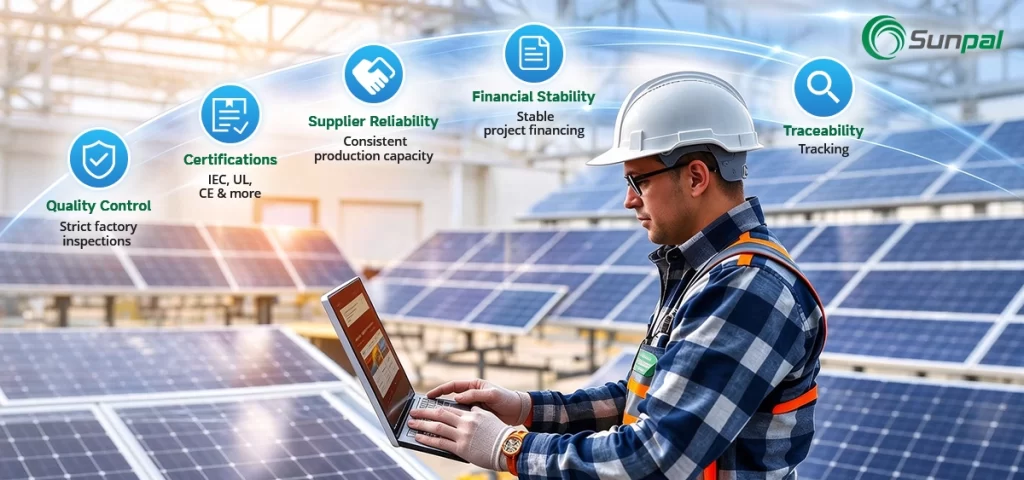
What separates a reliable solar panel manufacturer from one that simply offers an attractive price? In a competitive solar market, suppliers may present similar power ratings, product specifications, and pricing, but their manufacturing capabilities, quality control standards, and long-term support can vary considerably.
A low-priced 430W N-type TOPCon bifacial double-glass module does not always represent the best purchasing decision. Buyers should also consider the manufacturer's production capabilities, product quality, and supply reliability. These factors are equally important when comparing suppliers and planning solar wholesale procurement.
This guide explores five practical steps to help evaluate a solar panel manufacturer before placing a bulk order.
Check Manufacturer Bankability
BloombergNEF (BNEF) Tier 1 status is one reference point buyers can use when evaluating a solar module manufacturer's market acceptance and bankability.
However, it is important to understand what this classification actually measures.
What Does BNEF Tier 1 Mean?
BNEF's Tier 1 classification is based primarily on project financing records rather than a direct assessment of module quality.
Under the March 2026 BNEF methodology, a Tier 1 solar module manufacturer must have supplied its own-brand, own-manufactured products to at least six different projects financed on a non-recourse basis by six different commercial banks within the preceding two years.
This classification provides evidence of acceptance in qualifying project-finance transactions. Buyers can consult the official BNEF Tier 1 reports and methodology to understand the current classification criteria.
Why Bankability Matters
Solar projects are long-term investments. A manufacturer's financial position and business continuity can influence its ability to maintain production, provide technical assistance, and respond to warranty claims.
Before selecting a manufacturer, buyers should investigate:
- Company operating history and ownership structure
- Financial and business continuity information, where available
- Experience supplying commercial and utility-scale projects
- History of international product deliveries
- Availability of warranty support in the target market
- Ability to maintain product supply for repeat orders
An established operating history can provide additional confidence, but company age alone does not prove financial stability.
Do Not Treat Tier 1 as a Product Quality Guarantee
A manufacturer that does not appear on a current BNEF Tier 1 list should not automatically be classified as unreliable. Likewise, Tier 1 status alone is not sufficient to establish product quality or long-term reliability.
For smaller distributors and buyers sourcing specialized module configurations, the more useful approach is to assess financial bankability alongside technical documentation, independent testing, manufacturing arrangements, and warranty responsibilities.
Verify Solar Panel Certifications and Technical Documentation
Product certifications help buyers determine whether a solar module has undergone relevant qualification and safety assessments.
However, buyers should verify the actual certificate and test-report scope rather than relying on certification logos printed on a datasheet or company website.
Important International Standards
The following standards are commonly relevant when evaluating crystalline silicon photovoltaic modules.
| Padrão | Main Scope | What Buyers Should Verify |
|---|---|---|
| IEC 61215 | PV module design qualification and type approval | Applicable module models and test documentation |
| IEC 61730 | PV module safety qualification | Product construction and safety compliance |
| IEC 62941 | PV module manufacturing quality systems | Manufacturing quality management arrangements |
| ISO 9001 | Quality management systems | Certified organization, scope, and validity |
| ISO 14001 | Environmental management systems | Certified organization, scope, and validity |
| UL 61730 | PV module safety requirements for applicable North American markets | Relevant certification and product listing |
For the North American market, buyers should also confirm which applicable UL certification and listing requirements apply to the intended product and installation.
How to Verify Certification Documents
Before approving a supplier, request the following information:
- Full certificate and test-report copies.
- Certificate or report identification numbers.
- Issuing certification body or testing laboratory.
- Applicable standard and edition.
- Validity status and any relevant limitations.
- Certification scope and covered product categories.
Where possible, verify the information directly through the issuing organization or its official certification database.
Always check whether the certification applies to the relevant product series and manufacturing facility. A certificate covering one module model or factory should not automatically be treated as proof that all products from the same company have equivalent certification.
Understand the Difference Between Product and Management Certifications
Product certifications and management system certifications serve different purposes. IEC 61215 and IEC 61730 relate to module qualification and safety, while IEC 62941, ISO 9001, and ISO 14001 address manufacturing quality or broader management systems.
A manufacturer's ISO certificate does not replace product-level qualification, and product qualification does not by itself establish that every production batch will be identical.
Inspect the Factory and Check Independent Reliability Data
A manufacturer's online presence and product catalog provide useful starting information, but buyers should also investigate its actual production arrangements and independent product reliability evidence.
Verify the Manufacturer's Physical Operations
First, establish whether the company is a direct manufacturer, a module assembler, or a trading and distribution business.
These business models are not necessarily unsuitable, but buyers should understand who is responsible for production, quality control, and warranty support.
Useful verification steps include:
- Requesting the registered company name and business address
- Confirming the manufacturing facility and production location
- Reviewing production equipment and manufacturing processes
- Asking which processes are completed in-house
- Checking whether production facilities can be inspected
- Requesting information about quality inspection and production records
For larger orders, a factory audit or independent pre-shipment inspection can provide additional assurance.
Check Independent PV Module Reliability Testing
Manufacturer datasheets describe product specifications, but independent testing can provide additional information about module reliability under defined test conditions.
One useful reference is the Kiwa PVEL PV Module Reliability Scorecard.
Its Product Qualification Program (PQP) evaluates photovoltaic modules through a series of reliability and performance tests.
Relevant test categories include:
- Thermal cycling
- Damp heat
- Mechanical stress
- Potential-induced degradation (PID)
- Hail-related testing
- Light-induced and elevated-temperature-induced degradation (LID and LETID)
Understand PVEL Top Performer Results
A PVEL Top Performer designation is awarded according to the criteria for a specific test category and tested bill of materials (BOM).
It should not be interpreted as a universal ranking of an entire manufacturer or every module it sells.
For example, a manufacturer may have a module model recognized as a Top Performer in one test category but not in all categories.
Buyers should therefore check:
- The exact module model or BOM
- Which test categories achieved Top Performer status
- The relevant Scorecard edition
- Whether the tested configuration matches the product being purchased
The 2026 Kiwa PVEL Scorecard methodology provides further details about testing requirements and evaluation criteria.
Factory Verification
Production location, equipment, in‑house process & quality control
Independent Testing
PVEL reliability data, thermal cycling, PID, LID/LETID & hail tests
Warranty Review
Product warranty, degradation curve, claim process & responsibility
Serial Number Verification
Product traceability, BOM match & delivery conformity check
Final Supplier Approval
Qualified for bulk solar module procurement
Further Verification
If factory information, test records, warranty terms or traceability cannot be confirmed, pause the order and request additional documents before approval.
- Confirm real manufacturing address
- Check production equipment & capacity
- Clarify in‑house process vs outsourcing
- Review QC records & inspection capability
- Review PVEL Scorecard results
- Check thermal cycling & damp heat data
- Verify PID, LID/LETID & hail performance
- Match tested BOM to the ordered product

- Read the actual warranty document
- Check product defects & performance coverage
- Confirm degradation curve & claim process
- Clarify who handles warranty support
- Check labels, serial numbers & batch info
- Verify model & power against the order
- Confirm BOM and configuration match
- Use manufacturer verification channels
Evaluate Product Warranties and Degradation Terms
A solar module warranty is only as useful as its coverage, conditions, and claim process.
Buyers should examine the actual warranty documents instead of relying on general statements such as "25-year warranty" or "30-year performance guarantee."
Product Warranty vs. Power Performance Warranty
Solar module warranties commonly contain two different types of coverage.
Garantia do Produto
The product warranty generally covers specified manufacturing defects, materials, and workmanship issues under the stated conditions.
Buyers should check:
- Warranty duration
- Covered defects
- Exclusions and limitations
- Replacement or repair procedures
- Transportation and labor responsibilities
- Warranty claim documentation
Power Performance Warranty
The power performance warranty specifies the minimum power output a module is expected to maintain over a stated period.
It generally includes an initial degradation allowance followed by a maximum annual degradation rate, although the exact terms vary by product and manufacturer.
Review the Degradation Curve
A module's degradation curve describes how its warranted power output changes over time.
For example, buyers may encounter warranties that specify an initial degradation allowance followed by a maximum annual degradation rate.
However, there is no single degradation figure that should automatically be treated as the industry standard for every module.
When comparing products, check:
- Initial power degradation allowance
- Annual degradation rate after the first year
- Guaranteed output at key warranty milestones
- Total warranty duration
- Applicable measurement and claim conditions
The most reliable comparison is between the actual warranty documents for the specific module models being considered.
Check Warranty Backing and Labor Coverage
Another important consideration is who is responsible for honoring the warranty.
Buyers should identify:
- The legal warranty provider
- The responsible manufacturer or regional entity
- The process for submitting a claim
- The availability of local technical support
- Whether replacement transportation and labor are covered
- Whether third-party insurance or additional warranty backing exists
Some manufacturers or programs offer extended labor or service coverage, but this should be verified in writing rather than assumed to be included in a standard module warranty.
A long warranty period does not automatically guarantee that every replacement, transportation, or labor expense will be covered.
Authenticate Solar Panels and Verify Serial Numbers
Product authenticity is especially important when buying solar modules through international distributors or multiple supply channels.
Buyers should confirm that delivered modules originate from the stated manufacturer and match the products specified in the purchase agreement.
Check Physical Product Identification
Inspect the product labels and packaging to identify the manufacturer and module specifications.
Key identification details include:
- Manufacturer name
- Module model and rated power
- Serial number
- Electrical rating information
- Production or batch code
Check that the labels are legible and that the identification details are consistent across the modules and packaging.
Verify Serial Numbers With the Manufacturer
Ask the manufacturer to confirm whether the supplied serial numbers are genuine and traceable to its production records.
Depending on the product design, serial numbers may appear on the rear label, frame label, or packaging.
Where available, use the manufacturer's official verification portal or request confirmation through an authorized channel. This can help identify unauthorized products or discrepancies in production records.
Match Delivered Products With Purchase Documents
For bulk orders, compare the delivered shipment against the approved quotation and purchase order.
Focus on three key areas:
- Product specifications: Confirm the module model, wattage, construction, and cell technology.
- Order quantity: Check the number of modules, pallets, and packaging units.
- Batch consistency: Confirm that production batch information matches the agreed supply arrangements.
If discrepancies arise, request clarification before accepting the shipment. For larger orders, a third-party inspection can provide additional confirmation of product identity and order conformity.
Conclusion: Preparing for the Future of Solar Procurement
As photovoltaic technology continues to advance, the solar supply market is likely to see further developments in cell efficiency, module design, manufacturing processes, and product traceability. Buyers may also face changing certification requirements, evolving market standards, and increasing expectations for supply chain transparency.
These developments will make long-term supplier relationships and the ability to adapt to changing technical and market requirements increasingly important. Building a procurement strategy around product suitability, consistent supply, and ongoing technical cooperation can help businesses prepare for future opportunities in the solar industry.
Contacto SUNPAL to discuss your upcoming solar module requirements and explore potential supply solutions.
Perguntas Frequentes
1. How Do I Know if a Solar Panel Manufacturer Is Reliable?
Start by checking the manufacturer's production capabilities, business background, product certifications, and quality control procedures. Independent reliability test results, warranty terms, and serial number traceability can provide further insight. Buyers should also confirm that the manufacturer can maintain consistent product specifications and meet delivery requirements.
2. Does BNEF Tier 1 Mean a Solar Panel Manufacturer Has the Best Product Quality?
No. BNEF Tier 1 classification reflects a manufacturer's participation in qualifying project-financed solar projects rather than directly measuring product quality. Buyers should separately review manufacturing quality controls, independent test results, product certifications, and warranty conditions before selecting a supplier.
3. Which Certifications Should I Check When Buying Solar Panels?
A: Commonly relevant certifications and standards include IEC 61215 for module design qualification, IEC 61730 for electrical and safety requirements, and IEC 62941 for PV module manufacturing quality systems. ISO 9001 and ISO 14001 cover quality and environmental management. For specific installation environments, IEC 61701 addresses salt mist corrosion, while IEC 62716 covers ammonia corrosion testing.
4. How Can I Check the Reliability of a Solar Module?
Review the module's technical documentation, independent reliability test results, and factory quality control records. Kiwa PVEL's PV Module Reliability Scorecard and RETC's PV Module Index provide additional information about tested products. Buyers can also request electroluminescence (EL) inspection records and relevant thermal cycling, damp heat, and potential-induced degradation test results.
5. How Can I Verify That Solar Panels Are Authentic?
Check the manufacturer's name, module model, rated power, and serial numbers on the product labels and packaging. Ask the manufacturer to verify the serial numbers against its production records. For bulk orders, compare the delivered modules with the approved purchase order, product specifications, and batch information to identify any discrepancies.
6. What Should I Check Before Buying Solar Panels in Bulk?
Confirm the exact product model, technical specifications, certification documents, manufacturing origin, warranty terms, MOQ, production lead time, packaging, shipping arrangements, and serial-number traceability before approving the purchase.