


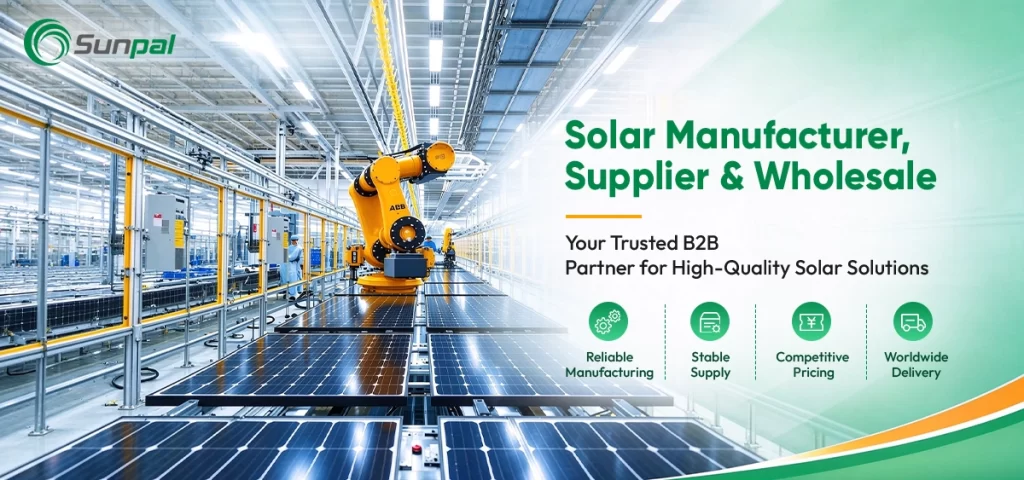
The global solar market offers a wide range of photovoltaic technologies, system configurations, and wholesale supply options. With differences in module efficiency, inverter compatibility, battery storage, and overall system costs, selecting the right solar solution requires more than comparing product prices.
Whether considering 430W modules for distributed installations, 585W panels for commercial applications, or higher-output 610W N-type TOPCon modules for larger systems, understanding how different products fit their intended applications is essential.
A well-planned purchasing strategy connects product selection with system design, project economics, and long-term supply requirements. This guide explores the main solar technologies, applications, technical criteria, cost considerations, and supplier evaluation factors to support informed procurement decisions.
What Is a Solar Manufacturer, Supplier & Wholesale?
Solar manufacturing, supply, and wholesale are interconnected parts of the photovoltaic industry, but each serves a different function in the supply chain.
Fabricante de energia solar
A solar manufacturer produces photovoltaic modules or other solar equipment. Its operations may include cell and module production, material sourcing, assembly, testing, quality inspection, and product development.
For B2B buyers, manufacturing capabilities can influence product consistency, customization opportunities, production schedules, and long-term supply arrangements.
When evaluating a manufacturer, buyers should understand which production processes are performed in-house, what products are available, and how quality control is managed.
Solar Supplier
A solar supplier provides photovoltaic products and related equipment to distributors, installers, EPC contractors, and project developers.
Some suppliers manufacture their own products, while others source equipment from different factories. Their services may include product selection, technical coordination, quotation preparation, order management, and shipping arrangements.
A supplier's suitability depends on its ability to provide products that meet the buyer's technical and commercial requirements.
Solar Wholesale
Solar wholesale refers to the bulk purchasing and distribution of photovoltaic products. Typical buyers include regional distributors, solar retailers, installation companies, and commercial project procurement teams.
Wholesale transactions may involve pallet orders, container shipments, or recurring supply agreements.
The purchasing structure can influence unit pricing, minimum order quantities, packaging, delivery schedules, and inventory planning.
Comparison of Manufacturer, Supplier, and Wholesaler
| Business Type | Main Role | Typical B2B Value | Key Buyer Considerations |
|---|---|---|---|
| Solar manufacturer | Produces photovoltaic products | Production visibility and product specifications | Manufacturing capability, quality control, consistency |
| Solar supplier | Coordinates product supply | Product sourcing and technical coordination | Product availability, documentation, service |
| Solar wholesaler | Distributes products in bulk | Volume purchasing and inventory supply | MOQ, price tiers, logistics, repeat orders |
Some companies combine manufacturing, supply, and wholesale operations. Buyers should therefore verify the actual business model instead of relying only on company descriptions.
Main Technologies and System Options
Solar product selection begins with understanding the technologies and configurations available in the market. Different module types offer different electrical characteristics, construction methods, and application possibilities.
N-Type TOPCon Solar Modules
N-type Tunnel Oxide Passivated Contact (TOPCon) technology is widely used in modern crystalline silicon photovoltaic modules.
When evaluating N-type TOPCon products, buyers should review module efficiency, rated output, temperature coefficients, electrical parameters, mechanical construction, and applicable product documentation.
For wholesale purchasing, several module power categories may be relevant:
430W N-Type TOPCon Modules
A 430W N-type TOPCon bifacial double-glass module may be suitable for applications where its dimensions, output, and installation characteristics match the project requirements.
Buyers sourcing a low-price 430W N-type TOPCon bifacial double-glass mono module should compare the exact product specifications, including rated power, efficiency, glass construction, bifaciality information, and warranty conditions.
585W N-Type TOPCon Modules
A 585W N-type TOPCon bifacial double-glass module may be considered for commercial and larger-scale installations.
For buyers comparing 585W N-type TOPCon bifacial double-glass module manufacturers, important evaluation points include electrical performance, module dimensions, mechanical load ratings, cell configuration, and logistics requirements.
610W N-Type TOPCon Modules
A wholesale 610W N-type TOPCon high-density half-cell mono module may be relevant to projects requiring higher-output modules.
Buyers should check the actual cell layout, module dimensions, current and voltage parameters, and compatibility with the selected inverter and mounting structure.
Higher rated power alone does not guarantee better project economics. The module must fit the system design and installation conditions.
Bifacial and Double-Glass Module Construction
Bifacial modules can generate electricity from both the front and rear sides when the rear side receives sufficient reflected or direct light.
Double-glass construction uses glass on both sides of the module rather than a conventional glass-and-backsheet structure.
When considering a 430W or 585W bifacial double-glass module for bulk purchasing, buyers should review:
- Front-side rated power
- Bifaciality information
- Glass thickness and module construction
- Module dimensions and weight
- Mechanical load ratings
- Installation height and rear-side exposure requirements
Actual rear-side energy contribution depends on factors such as ground reflectivity, mounting height, shading, and system layout. It should not be treated as a fixed additional output.
Solar Panel Technology Comparison:
| Tecnologia | Key Characteristics | Aplicações Típicas |
|---|---|---|
| TOPCon tipo N | High-efficiency N-type cell technology | Residential, C&I and utility-scale |
| Bifacial | Generates power from front and rear sides | Ground-mounted and suitable for reflective-surface projects |
| Double-glass | Glass on both sides of the module | Projects requiring double-glass module construction |
Common Solar System Configurations
Solar modules are only one part of a complete photovoltaic system. Depending on project requirements, buyers may need to consider different system configurations.
| Tipo de sistema | Main Components | Aplicação Típica |
|---|---|---|
| On-grid solar system | PV modules, grid-connected inverter, mounting structure | Grid-connected residential and commercial projects |
| Hybrid solar system | PV modules, hybrid inverter, battery storage | Sites requiring solar generation and energy storage |
| Off-grid solar system | PV modules, off-grid inverter, battery storage | Remote locations without reliable grid access |
| Commercial and industrial system | PV modules, commercial inverter, optional BESS and EMS | Factories, warehouses, commercial buildings |
The appropriate configuration depends on grid availability, electricity consumption, backup requirements, export restrictions, and project economics.
B2B Applications and Project Fit
Solar module selection should reflect the project's physical conditions, energy requirements, and financial objectives. A product that works well in one installation may not be the best option for another.
Residential and Small Distributed Projects
Residential and small distributed installations generally require modules that fit available roof space and comply with structural and electrical requirements.
Buyers should consider module dimensions, weight, rated output, roof layout, shading, and inverter compatibility.
For distributors, maintaining a range of module power categories can help serve different installation sizes and customer preferences.
Commercial and Industrial Rooftop Projects
Commercial and industrial projects often involve larger roof areas and higher electricity consumption.
Important project considerations include:
- Available roof area and structural loading
- Daytime electricity demand
- Roof orientation and shading
- Inverter capacity and string configuration
- Grid connection and export restrictions
- Operation and maintenance access
Higher-output modules may help optimize module count in certain layouts, but their dimensions and electrical characteristics must remain compatible with the roof and system design.
Utility-Scale and Ground-Mounted Projects
Ground-mounted projects typically provide greater flexibility in module arrangement and mounting structure design.
Project developers should assess land availability, ground conditions, row spacing, shading, electrical configuration, and maintenance access.
Bifacial modules may be considered where the ground surface and mounting design provide suitable rear-side light exposure.
Example Project Scenarios
The following examples illustrate how buyers can match module categories with different purchasing and project requirements. They are indicative selection scenarios, not verified SUNPAL project performance results.
| Project Scenario | Potential Module Category | Main Selection Considerations |
|---|---|---|
| Small commercial rooftop | 430W TOPCon | Roof dimensions, module layout, inverter compatibility |
| Large commercial rooftop | 585W TOPCon bifacial double-glass | Roof loading, electrical design, installation logistics |
| Large ground-mounted project | 610W high-density TOPCon | String design, mounting structure, module dimensions |
The final module choice should be based on verified product datasheets and project-specific engineering calculations.
Technical Specifications and Design Criteria
Technical specifications determine whether a solar module can operate safely and effectively within a proposed photovoltaic system.
Buyers should compare the exact model specifications instead of relying only on product names or rated wattage.
Key Solar Module Specifications
| Especificação | What It Means | Porque é que é importante |
|---|---|---|
| Rated power (Pmax) | Maximum rated output under specified test conditions | Helps compare module output |
| Eficiência do módulo | Percentage of incident solar energy converted into electricity | Influences power density and space utilization |
| Open-circuit voltage (Voc) | Voltage when the module circuit is open | Important for string voltage calculations |
| Short-circuit current (Isc) | Current under short-circuit conditions | Relevant to electrical protection and system design |
| Voltage at maximum power (Vmp) | Operating voltage at maximum power | Used in inverter and string matching |
| Current at maximum power (Imp) | Operating current at maximum power | Important for inverter input compatibility |
| Temperature coefficient | Indicates how electrical output changes with temperature | Helps assess performance under different temperatures |
| Module dimensions and weight | Physical size and mass | Affects transportation, mounting, and structural requirements |
| Mechanical load ratings | Published resistance to specified mechanical loads | Relevant to installation conditions and structural design |
Technical Specification Checklist
Before approving a product quotation, buyers should confirm the following information:
- Exact manufacturer and module model
- Rated power and module efficiency
- Cell technology and configuration
- Monofacial or bifacial design
- Glass and backsheet or double-glass construction
- Voc, Isc, Vmp, and Imp
- Temperature coefficients
- Module dimensions and weight
- Mechanical load ratings
- Applicable certificates and test reports
- Product and power performance warranty
- Packaging and pallet configuration
System Design and Compatibility
Module specifications must be evaluated together with the other system components.
For example, the module's operating voltage and current should be checked against the inverter's MPPT operating range and maximum input current. Maximum string voltage must also remain within the inverter's permitted DC input voltage under the project's expected minimum temperature conditions.
Other design factors include:
- Number of modules per string
- Number of strings per MPPT
- DC-to-AC capacity ratio
- Cable sizing and protection devices
- Mounting structure compatibility
- Grounding and electrical safety requirements
For commercial and utility-scale projects, these calculations should be completed by qualified system designers using the actual module and inverter datasheets.
Performance, Reliability and Lifetime
Solar module performance depends on product design, operating conditions, installation quality, and maintenance. Buyers should assess both initial electrical performance and long-term reliability.
Factors Affecting Solar Module Performance
Several factors influence the electricity generated by a photovoltaic module:
Irradiação solar: The amount of sunlight reaching the module affects its available energy input.
Temperatura: Module output generally changes with operating temperature. Buyers should review the temperature coefficient when evaluating products for hot climates.
Shading: Partial shading can reduce system output and affect string performance.
Orientation and Tilt: Module direction and installation angle influence the amount of solar radiation received.
Soiling: Dust, dirt, and other deposits can reduce light reaching the solar cells.
System Losses: Inverter conversion, wiring, mismatch, and other system losses affect the energy delivered to the load or grid.
Reliability and Quality Considerations
Reliability assessment should consider product construction, manufacturing quality, test documentation, and installation conditions.
Relevant checks may include:
- Visual inspection and workmanship assessment
- Electrical performance testing
- Electroluminescence (EL) inspection, where applicable
- Verification of applicable module design qualification and safety documentation
- Review of mechanical load specifications
- Confirmation of packaging and transportation protection
For bulk orders, buyers should also clarify how production batches are inspected and how deviations from approved specifications are handled.
Understanding Solar Module Warranties
Solar module warranties commonly include two distinct elements:
Product Warranty: Covers specified product defects and workmanship issues under the applicable warranty terms.
Power Performance Warranty: Defines the warranted power output over a stated period according to the manufacturer's warranty conditions.
Buyers should review the actual warranty document for coverage periods, exclusions, degradation terms, claim procedures, and responsible parties. Warranty duration alone is not sufficient to determine product reliability.
Cost, Procurement and ROI Considerations
Solar purchasing decisions should consider the complete cost of procurement and the expected economics of the installed system.
What Affects Solar Wholesale Prices?
Wholesale solar module prices can vary according to several factors:
| Cost Factor | Potential Influence on Purchasing Cost |
|---|---|
| Module technology | Cell technology, module construction, and product specifications |
| Rated power and efficiency | Product design and manufacturing characteristics |
| Order quantity | Available volume pricing and MOQ |
| Market supply and demand | Changes in product availability and market pricing |
| Embalagem | Pallet design and export packaging requirements |
| Freight and insurance | Shipping method, route, and destination |
| Import duties and taxes | Country-specific trade and tax requirements |
| Payment terms | Deposit arrangements and settlement conditions |
Buyers should compare quotations based on equivalent products and commercial terms.
How to Compare Wholesale Quotations
A structured comparison can help identify differences between suppliers.
| Item de Comparação | Supplier A | Supplier B |
|---|---|---|
| Module manufacturer and model | Confirm exact model | Confirm exact model |
| Rated power | Verify datasheet | Verify datasheet |
| Module technology | Confirm configuration | Confirm configuration |
| Certificações | Review applicable documents | Review applicable documents |
| Garantia | Check coverage and exclusions | Check coverage and exclusions |
| MOQ | Confirm order quantity | Confirm order quantity |
| Lead time | Confirm production and delivery | Confirm production and delivery |
| Embalagem | Confirm pallet and container details | Confirm pallet and container details |
| Unit price | Compare equivalent terms | Compare equivalent terms |
| Total landed cost | Calculate destination cost | Calculate destination cost |
Supplier A and Supplier B are comparison placeholders. Buyers should populate this table with actual quotations rather than relying on illustrative scores or assumed supplier performance.
Evaluating Project ROI
For project developers and commercial buyers, module purchase price is only one part of the financial assessment.
Project returns may be affected by:
- Total system installation cost
- Annual electricity generation
- Self-consumption rate
- Electricity tariff and export compensation
- Operation and maintenance costs
- Degradação do sistema
- Inverter replacement and other lifecycle expenses
- Financing costs and project lifetime
A basic payback estimate can be expressed as:
Simple Payback Period = Initial Project Investment ÷ Annual Net Financial Savings
This is a simplified indicator, not a complete investment model. A more detailed financial assessment may include discounted cash flow, net present value (NPV), internal rate of return (IRR), financing costs, and sensitivity analysis.
For commercial projects, actual returns depend on local electricity prices, load profiles, system design, and regulatory conditions.
How to Choose a Supplier or Solution
Selecting a suitable supplier requires evaluating product quality, supply arrangements, technical support, and commercial reliability together.
1. Check Company Background and Supply Capabilities
Understand whether the company is a direct manufacturer, a distributor, or a sourcing partner. Ask for information about its production arrangements, product portfolio, and experience serving similar markets.
2. Verify Product Specifications and Documentation
Request official datasheets, applicable certificates, test reports, and warranty documents for the exact products being quoted.
Check whether the documents correspond to the product model and destination-market requirements.
3. Evaluate Quality Management
Ask how incoming materials, production processes, finished products, and pre-shipment inspections are managed.
For repeat orders, confirm how the supplier maintains consistency between approved samples and delivered batches.
4. Compare Commercial and Delivery Terms
Review MOQ, unit price, payment terms, production lead time, packaging, shipping arrangements, and responsibility for transportation-related costs.
When comparing quotations, make sure they cover equivalent products and delivery conditions rather than focusing on unit price alone.
5. Review Warranty and Technical Support
Clarify warranty coverage, claim procedures, technical assistance, and responsibility for handling product issues.
For distributors, dependable communication and support can be particularly important when serving customers across different regions.
Supplier Evaluation Checklist
| Evaluation Area | Questions to Ask |
|---|---|
| Company background | Is the company a manufacturer, supplier, or wholesaler? |
| Product range | Can it provide the required module technologies and power ratings? |
| Documentation | Are datasheets, certificates, and warranties available? |
| Quality management | How are product quality and batch consistency controlled? |
| Order flexibility | What MOQ and volume pricing options are available? |
| Delivery | What are the production lead time and shipping arrangements? |
| After-sales support | Who handles warranty claims and technical questions? |
A supplier should be evaluated against the buyer's actual purchasing and project requirements. No single qualification or price point can establish overall suitability.
Looking Ahead: Long-Term Solar Supply
As the solar industry continues to evolve, advances in photovoltaic technology and changing market demands will create new opportunities for solar applications. Choosing products with suitable technical characteristics and establishing stable supply relationships can help businesses adapt to these changes and prepare for future projects.
SUNPAL offers a range of solar module options, including N-type TOPCon products for different applications. Whether planning an upcoming purchase or considering future projects, buyers are welcome to contact SUNPAL to discuss their requirements, explore suitable products, and request a quotation.
Perguntas Frequentes
What Is the Difference Between a Solar Manufacturer, Supplier, and Wholesaler?
A solar manufacturer produces PV hardware (ingots, cells, panels), a supplier coordinates availability, and a wholesaler distributes bulk stock. Vertically integrated manufacturers like Sunpal combine all three roles—delivering direct factory pricing, 5GW+ production capacity, custom OEM branding, and direct 40HQ container ocean dispatch without middleman markups.
How Do B2B Buyers Compare Wholesale Solar Options?
B2B buyers should normalize wholesale options across 6 verified parameters: Cell technology, STC rated power & efficiency (22.5%+), Electrical boundary parameters, International certifications, Container packaging density, Total Delivered Duty Paid landed cost per watt.
Which Technical Specifications Matter Most for Solar System Compatibility?
Crucial panel specifications include rated power, module efficiency (≥ 22.5%), Vₒc, Iₘₚ, temperature coefficient (-0.29%/°C), and mechanical load ratings (5,400 Pa snow / 2,400 Pa wind). Installers must verify array Vₒc against inverter MPPT voltage windows (150V–850V DC) under local minimum temperatures to prevent clipping or overvoltage shutdown.
What Key Factors Drive Wholesale Procurement Costs and Solar Project Returns?
Procurement costs depend on cell technology, order volume (pallet vs. 40HQ container tiers with 5%–8% volume discounts), ocean freight density, import tariffs, and payment terms. Project Levelized Cost of Energy (LCOE) is driven by 30-year linear performance retention (≥ 87.4%), low annual degradation (≤ 0.4%), system self-consumption, and non-cancellable third-party reinsurance.
How Should B2B Buyers Evaluate a Wholesale Solar Supplier?
Audit suppliers against 5 measurable factory quality benchmarks: Vertical manufacturing capacity (5GW+) and Tier-1 bankability, Triple-Stage EL testing with 0 to +5W positive power sorting, 100% serial-matched Flash-Test data, Support for third-party FAT audits, and Defined 7–14 day RMA replacement SLAs.