


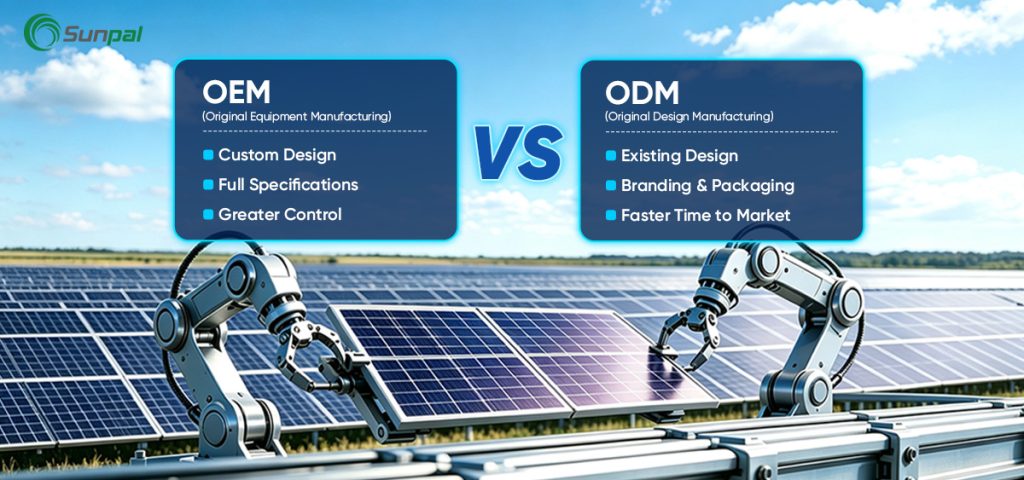
Not every solar module available on the market fits a distributor's exact product requirements. Some buyers need greater control over module specifications, while others simply want to sell proven products under their own brand without taking on the cost and complexity of product development. This is where OEM and ODM manufacturing models come into play.
Although both approaches allow distributors to work with manufacturers on branded solar modules, they differ significantly in design responsibility, customization flexibility, investment requirements, and production arrangements. Understanding these differences is essential before selecting a manufacturing model. For a broader overview of supplier selection, product evaluation, and wholesale procurement, explore our solar manufacturer, supplier, and wholesale guide.
Understanding OEM and ODM Manufacturing Models
OEM and ODM represent two different approaches to working with solar module manufacturers.
OEM (Original Equipment Manufacturing) generally involves manufacturing products according to specifications and requirements provided by the buyer. The distributor has greater influence over product configuration, electrical characteristics, mechanical dimensions, and selected components.
ODM (Original Design Manufacturing) relies on an existing product platform developed by the manufacturer. Distributors select a suitable model and customize elements such as branding, labels, packaging, and certain configurable specifications.
However, terminology can vary between manufacturers. Some suppliers use OEM and ODM interchangeably in their marketing materials. Before placing an order, distributors should clarify who controls the product design, who approves the bill of materials (BOM), and which party owns or controls the relevant intellectual property and certification documentation.
Key Differences Between OEM and ODM Solar Modules
For distributors evaluating potential manufacturing partners, the main differences involve product control, investment requirements, production arrangements, and certification considerations.
| Comparison Factor | OEM Solar Modules | ODM Solar Modules |
|---|---|---|
| Design Responsibility | Manufactured according to buyer-defined specifications | Based on the manufacturer's existing design |
| Product Customization | Greater flexibility in electrical and mechanical specifications | Mainly branding and selected product adjustments |
| Brand Development | Supports proprietary product specifications and positioning | Suitable for private-label product lines |
| Initial Investment | Potentially higher due to engineering, validation, and tooling requirements | Generally lower when using an established platform |
| MOQ | Depends on customization, production setup, and order volume | Often more flexible for existing product platforms |
| Production Lead Time | May be longer due to development and validation | Generally faster for established models |
| Certification | Design changes may require additional testing or certification | Existing certifications may cover the unchanged base design |
These differences are not fixed industry-wide rules. Actual MOQ, lead times, and certification costs depend on the manufacturer's capabilities, the degree of customization, and the destination market.
When Should Solar Distributors Choose ODM?
ODM is a practical option when a distributor wants to introduce a branded solar module without developing a completely new product. It is particularly relevant for businesses that are expanding their product range or entering a market where demand has not yet been fully established.
Entering a New Market
When entering a new region, distributors may not yet know which module configurations will generate consistent demand. Starting with an existing product platform allows them to test customer preferences without committing to a customized design too early.
For example, a distributor exploring the residential and small commercial markets may begin with established module configurations and adjust its product selection as sales data becomes available.
Building a Private-Label Product Range
ODM can also help distributors establish their own brand identity. Custom logos, product labels, and packaging can create a consistent market presence while the underlying module design remains based on the manufacturer's existing platform.
This can be useful for wholesalers that want to build brand recognition across multiple sales channels without taking responsibility for full product development.
Managing Initial Procurement Commitments
Using existing products may reduce the need for additional engineering and product validation. However, buyers should still confirm the manufacturer's MOQ, available inventory, production schedule, and private-label requirements.
A lower development burden does not automatically mean that every ODM order will have a low MOQ or short lead time. These commercial conditions should be confirmed for the specific product and order quantity.
When Should Solar Distributors Choose OEM?
OEM is more suitable when distributors have specific product requirements that cannot be fully met by an existing module platform. It is often considered by established businesses with clearer customer demand, technical requirements, and procurement plans.
Meeting Specific Technical Requirements
Some projects require module characteristics that differ from standard market offerings. These may include particular module dimensions, electrical parameters, mechanical structures, or configurations designed for specific installation conditions.
In such cases, an OEM arrangement allows the distributor to discuss these requirements directly with the manufacturer and evaluate whether they can be incorporated into a production design.
Developing a Differentiated Product Portfolio
Distributors operating in competitive markets may want to offer products with specific configurations or features that distinguish their portfolio from standard products.
An OEM project can support this strategy when the requested changes are technically feasible and commercially justified. However, product differentiation should be evaluated against development costs, production capacity, certification requirements, and expected sales volume.
Establishing Contractual Product Exclusivity
Some distributors may also consider OEM arrangements when they want to negotiate exclusive products for a particular market or customer group.
Exclusivity is not automatically included in an OEM agreement. Its scope, duration, territory, product models, and any minimum purchasing commitments should be clearly defined in the contract. Buyers should also clarify whether the manufacturer can supply similar configurations to other customers.
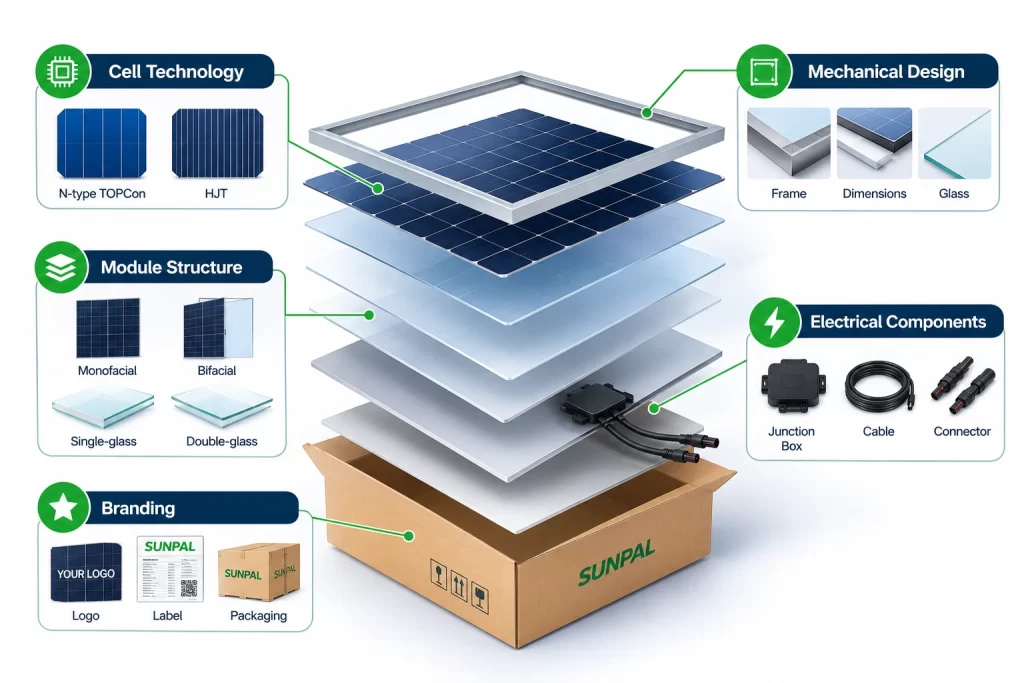
Solar Module Customization Options for Distributors
Solar module customization can cover several aspects of product design and configuration. The available options depend on the manufacturer's production capabilities, engineering resources, component supply chain, and applicable certification requirements.
| Customization Area | Items to Confirm |
|---|---|
| Cell technology | N-type TOPCon, HJT, or other available cell technologies |
| Module structure | Monofacial or bifacial design; single-glass or double-glass construction |
| Electrical specifications | Rated power, Voc, Isc, Vmp, Imp, and temperature coefficients |
| Mechanical design | Module dimensions, weight, frame, glass thickness, and mounting compatibility |
| Electrical components | Junction box, cable length, and connector type |
| Branding and packaging | Logo, product label, carton design, and shipping protection |
Matching Module Specifications to Target Applications
Distributors should begin with the intended application rather than selecting a module based on rated power alone. Module dimensions, weight, electrical characteristics, and installation conditions all influence product suitability.
For example, buyers sourcing a 430W N-type TOPCon bifacial double-glass mono module in bulk may prioritize compact module dimensions and compatibility with residential or smaller commercial installations. Buyers sourcing a 585W N-type TOPCon bifacial double-glass mono module in bulk may place greater emphasis on module dimensions, string design, handling requirements, and installation compatibility for larger projects.
These power ratings are examples of procurement requirements, not complete product specifications. Even modules with similar wattage can have different voltage, current, dimensions, and mechanical characteristics. Distributors should compare official datasheets and confirm compatibility with inverters, mounting structures, and local installation requirements.
For reference, buyers can review available N-type TOPCon bifacial double-glass solar modules and confirm the specifications and configurations currently offered.
Checking Whether Customization Is Production-Ready
Not every requested modification can be implemented simply by changing a specification sheet. Changes to cell configuration, module dimensions, glass, encapsulants, or electrical components may affect production processes and product performance.
Before approving a custom design, distributors should ask the manufacturer to assess technical feasibility, sample requirements, production implications, and any additional testing. The final specification should be documented and approved by both parties before mass production.
Certification and Regulatory Compliance
Certification is an important part of OEM and ODM solar module sourcing. Distributors need to ensure that the products they purchase meet the applicable requirements of their target markets and that the supporting certification documents correspond to the actual modules supplied. This requires checking not only whether a manufacturer holds relevant certificates but also whether those documents cover the specific product models and configurations involved in the agreement.
Verify Certificate Ownership and Model Coverage
Buyers should request relevant certificates, test reports, and product documentation from the manufacturer. Key details to verify include the certificate holder, covered model numbers, applicable standards, and the product configurations identified in the documents.
For private-label modules, distributors should also confirm how the original certified product is linked to the branded version being supplied. The manufacturer's certification documents should provide a clear basis for identifying the underlying product and its approved configuration. A change in branding or labeling alone does not necessarily require new testing, provided the product remains within the scope of the existing certification.
Understand the Impact of Design Changes
Changes to a module's materials, components, or physical structure may affect its existing test results and certification coverage. For example, modifications to solar cells, glass, encapsulants, frames, or junction boxes may require further technical assessment before the revised product can be supplied under the original certification.
The IEC TS 62915:2023 standard provides guidance on retesting photovoltaic modules following design changes. Distributors should ask manufacturers to assess proposed modifications against the applicable testing requirements and consult the relevant certification body when necessary. Any additional testing or documentation requirements should be clarified before approving the customized design for mass production.
Check Target-Market Requirements
Certification and regulatory requirements vary across markets. Depending on the destination country, distributors may need to consider applicable product standards, conformity assessment procedures, labeling rules, and import documentation.
These requirements should be identified before finalizing product specifications and placing large orders. For distributors sourcing customized or private-label modules for multiple regions, it is particularly important to confirm that the selected product configuration and supporting documents are suitable for each intended market rather than assuming that approval in one country automatically applies elsewhere.
BOM Ownership and Manufacturing Change Control
The bill of materials (BOM) identifies the components and materials used in a solar module. For OEM and ODM projects, it is an important reference for ensuring that production remains consistent with the approved product design.
Distributors should clarify whether they have access to the approved BOM and which party is responsible for authorizing changes. The agreement should also explain how the manufacturer handles component substitutions when original materials become unavailable or supply conditions change.
A practical change-control process should cover:
- BOM approval: Identify the approved component list and the version used for production.
- Component substitution: Define which substitutions require prior written approval from the distributor.
- Change notification: Require the manufacturer to communicate relevant material, supplier, or design changes.
- Batch traceability: Maintain production records that help identify which components and specifications were used in each batch.
These arrangements are particularly important for repeat orders. Unauthorized or poorly documented component changes may cause differences between the modules originally tested or approved and those delivered in later batches. Maintaining clear approval records, change notifications, and batch-level traceability helps distributors monitor product consistency and identify the specifications used if quality issues arise.
Quality Assurance and Solar Module Reliability
A manufacturer's general quality certifications do not replace the need to understand how individual products are inspected and tested. Distributors should review the quality-control procedures relevant to the specific module model and production arrangement.
Review Factory Inspection and Testing Procedures
Depending on the production process, relevant quality checks may include incoming material inspection, electroluminescence (EL) testing, power measurement through flash testing, visual inspection, and final packaging checks.
These inspections help identify potential cell defects, verify electrical output, and detect visible manufacturing or packaging issues before shipment. Buyers should confirm which tests are performed, how results are recorded, and whether inspection records are available for their orders.
Establish Pre-Shipment Quality Requirements
For larger wholesale orders, distributors may agree on pre-shipment inspection procedures before production or shipment begins. These can specify inspection scope, sampling arrangements, packaging requirements, and the documentation to be provided.
The agreement should also explain how nonconforming products are handled, including the process for reporting defects, investigating quality issues, and agreeing on corrective actions.
The aim is not simply to receive a certificate or inspection report, but to ensure that delivered products match the approved specifications and that potential issues can be traced and addressed.
Intellectual Property and Private-Label Protection
Private labeling and product customization can create commercial value, but distributors should not assume that branding a module gives them ownership of its underlying design.
Before signing an OEM or ODM agreement, both parties should clarify the ownership and permitted use of product designs, engineering drawings, custom specifications, technical documentation, logos, labels, and packaging artwork.
For custom OEM projects, it is particularly important to establish whether the distributor owns the commissioned design or only has permission to use it. If the distributor requests regional or customer exclusivity, the agreement should define the covered products, territory, duration, and restrictions on supplying similar products to other buyers.
Confidentiality provisions should also address how technical and commercial information is protected during development and production. Clear contractual terms can reduce disputes when either party wants to modify the product, change suppliers, or end the manufacturing relationship.
How to Evaluate OEM and ODM Solar Module Suppliers
Choosing the right manufacturing model is only one part of supplier selection. Distributors also need to determine whether a manufacturer can deliver the agreed product specifications, maintain production consistency, and support the product after delivery.
| Evaluation Area | What Distributors Should Verify |
|---|---|
| Manufacturing capability | Relevant production lines, capacity, and experience with the required module type |
| Technical support | Ability to review specifications, assess customization requests, and validate samples |
| Certification | Certificate holder, model coverage, test reports, and target-market requirements |
| Quality management | Inspection procedures, testing records, and batch traceability |
| Supply consistency | Production planning, component sourcing, and repeat-order controls |
| Commercial terms | MOQ, pricing structure, lead time, payment terms, and packaging arrangements |
| After-sales support | Warranty responsibilities, claim procedures, and technical assistance |
Request Evidence Rather Than Relying on General Claims
Distributors should request relevant datasheets, company profiles, sample records, and references to previous OEM or ODM projects to verify the manufacturer's capabilities.
Evaluate Production and Communication Capabilities
Buyers should confirm whether the supplier can support repeat orders, meet delivery schedules, and communicate promptly about production delays or supply disruptions.
Total Cost, Warranty, and Long-Term Supply Considerations
The quoted module price is only one part of the overall sourcing cost. Distributors should consider the expenses and responsibilities involved in bringing a product to market and supporting it after delivery.
Calculate the Total Cost of Ownership
For OEM projects, the total cost may include engineering work, sample production, additional testing, certification-related expenses, custom packaging, and inventory commitments. ODM projects may reduce some development costs, but buyers should still account for branding, logistics, market compliance, and after-sales support.
The commercial comparison should therefore consider more than the unit price. MOQ, freight, payment terms, production lead time, and inventory turnover can all affect the actual cost of a sourcing decision.
For distributors serving price-sensitive markets, a customized product may offer differentiation but also create additional inventory and development risks. The expected sales volume should justify these commitments before a project moves into mass production.
Clarify Warranty and After-Sales Responsibilities
Warranty arrangements should be agreed upon before an order is placed. Distributors need to understand who provides the product and performance warranties, which documents are required for claims, and how technical investigations or replacements are handled.
For private-label modules, the agreement should identify the responsible party and explain how warranty claims are managed between the manufacturer, distributor, and end customer.
It is also useful to clarify the availability of technical support and replacement products over the expected service period. Unclear responsibilities can create delays and disputes when customers report product issues.
Consider Repeat-Order Reliability
Long-term supply depends on more than the manufacturer's ability to complete one shipment. Distributors should assess whether the supplier has sufficient production capacity, reliable component sourcing, and realistic lead times to support future orders.
As demand grows, the manufacturer should also be able to coordinate production schedules, accommodate reasonable changes in order volume, and maintain a stable supply flow. These factors help distributors plan inventory, meet customer commitments, and avoid unnecessary supply disruptions.
Conclusion
As distributors expand into new customer segments and markets, their product requirements may evolve beyond standard module offerings. Developing private-label products and exploring customized solutions can create additional opportunities to strengthen brand positioning and broaden commercial reach.
Choosing the right manufacturing partner is an important part of this process. A cooperation model that accommodates changing product requirements and supports future development can help distributors build a more adaptable product portfolio over time.
SUNPAL works with solar distributors on wholesale module supply and product customization. Whether you are preparing to launch a private-label range or planning your next stage of product development, contact our team to explore potential cooperation opportunities.
Frequently Asked Questions
Can ODM Solar Modules Be Sold Under a Distributor's Own Brand?
Yes. Many ODM arrangements support private labeling, including custom logos, labels, and packaging. Distributors should confirm the available branding options and ensure that product documentation and certification details accurately represent the supplied module.
Who Owns the BOM in an OEM Solar Module Agreement?
BOM ownership and access depend on the contract. The agreement should specify whether the distributor can review and approve the BOM, request changes, and receive updated documentation when components are modified.
Can a Solar Manufacturer Change the BOM Without Approval?
That depends on the agreed change-control terms. Distributors should define which substitutions require prior written approval and how changes affecting product specifications, certification, or quality will be communicated and managed.
Do Private-Label Solar Modules Need Separate IEC Certification?
Not necessarily. The relevant question is whether the existing certification covers the actual product design and model being supplied. A change in branding alone may not require separate testing, while certain design or material changes may require further assessment.
Can OEM Solar Modules Be Exclusive to One Distributor?
Exclusivity can be negotiated, but it should not be assumed. The agreement should define the covered models, territory, duration, customer scope, and any purchasing conditions attached to the arrangement.
Who Handles Warranty Claims for Private-Label Solar Panels?
The responsible party should be identified in the supply agreement. Distributors should confirm the warranty provider, claim process, required evidence, technical support arrangements, and responsibility for replacement or other remedies.