


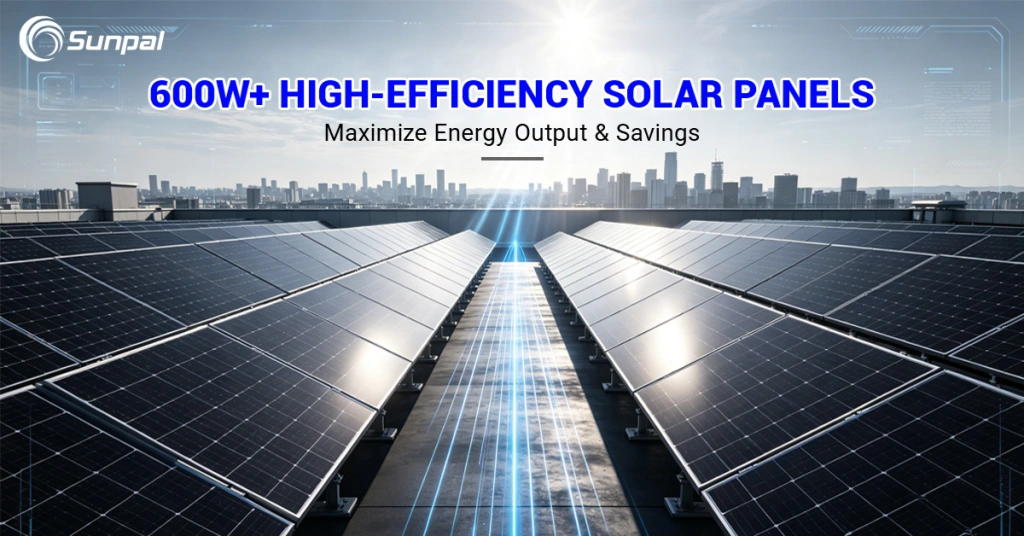
Imagine developing a commercial rooftop or utility-scale solar project, only to find that years later, your system is generating less power than expected while occupying more space and requiring higher installation and maintenance costs. For many projects still relying on traditional 350W–550W modules, lower power density can mean more panels, more racking, more cabling, and reduced long-term energy yield. As land, labor, and BOS costs continue to rise, these hidden inefficiencies can significantly impact project profitability over its lifetime.
This is why 600W+ solar panels, also commonly referred to as 600+ solar panels in the market, are rapidly becoming the preferred choice for modern solar developments. According to CRU industry forecasts, N-Type TOPCon technology now accounts for more than 80% of global solar cell production capacity, while 600W+ modules have become the mainstream option for new commercial and utility-scale PV projects. As module manufacturing scales up and BOS costs continue to rise worldwide, developers are increasingly adopting high-power modules to maximize energy output and reduce total system costs.
By delivering more power from each module, 600W+ solar panels help solar panel savings, optimize rooftop and land utilization, simplify installation, and lower expenditures on racking, cabling, and labor. Combined with the lower degradation and higher solar panel efficiency of N-Type TOPCon technology, these advantages contribute to lower LCOE, stronger lifetime energy production, and improved project profitability. For developers, EPCs, and investors seeking higher returns and greater competitiveness, 600W+ solar panels are becoming a key component of next-generation solar projects in 2026 and beyond.
What Is a 600+ Solar Panel?
A 600 Watt solar panel represents the latest generation of high efficiency solar panels built on advanced N-Type TOPCon technology, designed to exceed the output limits of conventional P-Type mid-power panels. Tested under standard STC conditions (1000 W/m² irradiance, 25°C cell temperature, AM1.5 spectrum), these modules deliver a rated power output of 600W and above, making them the mainstream choice for modern commercial and utility-scale solar projects.
Most premium 600W+ modules adopt a 0/+5% positive power tolerance design, ensuring stable real-world output above the rated capacity and reducing underperformance risks commonly seen in traditional ±5% tolerance modules. In today’s solar economics, project profitability is no longer determined by module price alone, but by total system cost and full lifecycle energy yield, where high-power 600W+ systems offer clear structural advantages.
From a broader industry perspective, N-Type TOPCon remains the dominant technology platform for high-power modules in 2026, while alternative routes such as HJT, BC, and perovskite tandem cells continue to evolve for niche or next-generation applications. However, TOPCon-based 600W+ modules are expected to remain the mainstream solution for large-scale solar deployment over the next 3–5 years due to their balance of efficiency, cost, and manufacturing maturity.
Core Technical Advantages & Working Principle of 600W+ Modules
The performance advantage of 600W+ solar panels is not driven by a single breakthrough, but by the systematic integration of multiple cell and module-level engineering improvements that collectively increase power density and energy yield per square meter.
At its core, N-Type TOPCon cell architecture reduces recombination losses and improves electron-flow efficiency, enabling higher conversion efficiency and lower annual degradation compared to traditional P-Type technologies. This foundational improvement is further enhanced through half-cut cell design, which reduces internal resistance and minimizes power loss under partial shading conditions, improving overall string-level performance.
Additional innovations such as multi-busbar (MBB) interconnection technology and high-density large-format silicon wafers further optimize current collection and maximize active cell area utilization, directly increasing module output without proportionally increasing system complexity. In bifacial configurations, reflected irradiance from ground surfaces can be partially captured, providing an additional 10–25% energy gain depending on installation conditions.
Together, these engineering advancements enable mainstream 600W+ modules to achieve conversion efficiencies of 20–23%, shifting solar design logic from simple module scaling to high-density energy optimization per unit area.
Rational Cost & Benefit Analysis (Industry Standard Perspective)
Unlike one-sided marketing ROI promotion, third-party industry evaluations show the value of 600W+ modules lies in system-level long-term cost optimization, rather than short-term single-module price advantages.
Cost Optimization
Although individual 600W+ modules have a slightly higher upfront unit price, the overall CAPEX per watt drops significantly for large-scale projects. Fewer modules reduce expenditure on racking structures, cables, connectors, and on-site construction labor. Meanwhile, fewer equipment points effectively lower long-term O&M failure rates and routine maintenance costs over the 25-year lifecycle.
Benefit Improvement
Based on solar irradiation data from the Global Solar Atlas and performance modeling using NREL PVWatts, a single 600W+ module delivers 2.4–3.6 kWh of daily power generation, with annual output varying by region: 650–980 kWh in cloudy coastal areas, 870–1200 kWh in the US Southeast, and 980–1420 kWh in high-irradiance US Southwest regions. Based on multiple studies published by NREL, the 15–20% increase in cumulative power output and slower degradation rate effectively reduces solar LCOE and improves long-term asset stability.
600W+ TOPCon vs Traditional 350W–550W Panels
Compared with traditional 350W–550W P-Type solar modules, 600W+ N-Type TOPCon panels deliver significantly higher system-level efficiency and cost optimization across commercial and utility-scale projects.
Due to higher power density per module, 600W+ systems require fewer panels to achieve the same installed capacity, which reduces Balance of System (BOS) costs, including racking, cabling, and installation labor. Overall system costs can be reduced by approximately 20–30%, while improving land and rooftop utilization efficiency by up to 30–40%.
Over the full lifecycle, 600W+ modules also deliver maximum energy output, typically increasing cumulative generation by 15–20%, supported by lower annual degradation rates compared with traditional P-Type modules. This results in more stable long-term performance and improved project economics.
From a financial perspective, these advantages help shorten project payback periods and improve long-term return on investment, making 600W+ TOPCon modules a preferred choice for modern solar developments.
A typical benchmark shows that a 100kW system using 450W modules requires about 223 panels, while a 620W system requires only 162 panels, significantly simplifying system design and installation.
2026 Real-World Market Deployments & Industry Performance
The rapid penetration of 600W+ modules is fully verified by global large-scale project deployments in 2026, reflecting universal industry recognition of high-power technology:
European Industrial Rooftop PV Deployments
Many European industrial park renovation and new construction projects have completed the switch from 450W–500W modules to 600W+ high-power systems in 2026. Limited rooftop bearing capacity and high local labor costs make low-module-quantity high-density designs the optimal choice. Post-operation data shows such projects achieve an average 16–18% increase in annual power generation and a 25% reduction in BOS comprehensive costs.
US Utility-Scale Ground Solar Farms
Southwest US high-irradiance regions take the lead in promoting large-scale 600W+ bifacial module deployments. By reducing land occupation per MW and simplifying trenching and wiring construction, these projects effectively lower overall LCOE and improve PPA bidding competitiveness. Industry statistics show 600W+ module adoption rates in US utility-scale projects have exceeded 70% in Q1 2026.
Global Agrivoltaic Project Upgrades
Agrivoltaic projects pursuing dual land utilization widely adopt 600W+ modules. Fewer modules enable wider elevated support spacing, ensuring agricultural planting space while improving per-hectare power generation efficiency. Field data confirms this model achieves a 15% average increase in land energy output without compromising crop productivity.
Is 600W+ Right for Your Project?
You SHOULD consider upgrading to 600W+ panels if:
- Project capacity is over 100kW
- Land or rooftop installation space is limited
- Your EPC and on-site labor costs keep rising yearly
- You are bidding for utility-scale solar projects
- You need a lower LCOE to enhance project competitiveness
You MAY NOT need 600W+ panels if:
- Building small residential systems (<10kW)
- Deploying mobile, RV or temporary off-grid solar setups
- Extremely limited upfront project budget with no long-term ROI priority
In practice, the suitability of 600W+ technology is determined by whether the project prioritizes lifecycle energy yield and system cost efficiency over initial capital minimization.
Industry Future Outlook
continue its transition toward higher power density, improved conversion efficiency, and lower levelized cost of electricity (LCOE), driven primarily by continued advancements in advanced solar technology and the scaling of global manufacturing capacity.
As TOPCon technology matures and production volumes expand, system-level costs are expected to decline further while energy yield per installed watt continues to improve. This structural shift is accelerating the adoption of high-power solar systems in commercial and utility-scale applications, where long-term cost efficiency and land utilization have become key investment drivers.
Solar energy is therefore expected to strengthen its position as one of the most competitive energy sources for large-scale power generation and industrial electricity demand, supporting the ongoing global energy transition.
Start Your High-Return Solar Project Now
Stop investing in outdated, low-efficiency solar systems with high costs and slow returns.
Sunpal's professional 600W+ high-power solar solutions help you cut project costs, boost power generation revenue, and achieve long-term stable investment returns.
Contact Sunpal's technical team to learn more about project evaluation options, customized system solutions, and ROI modeling support for your solar project.